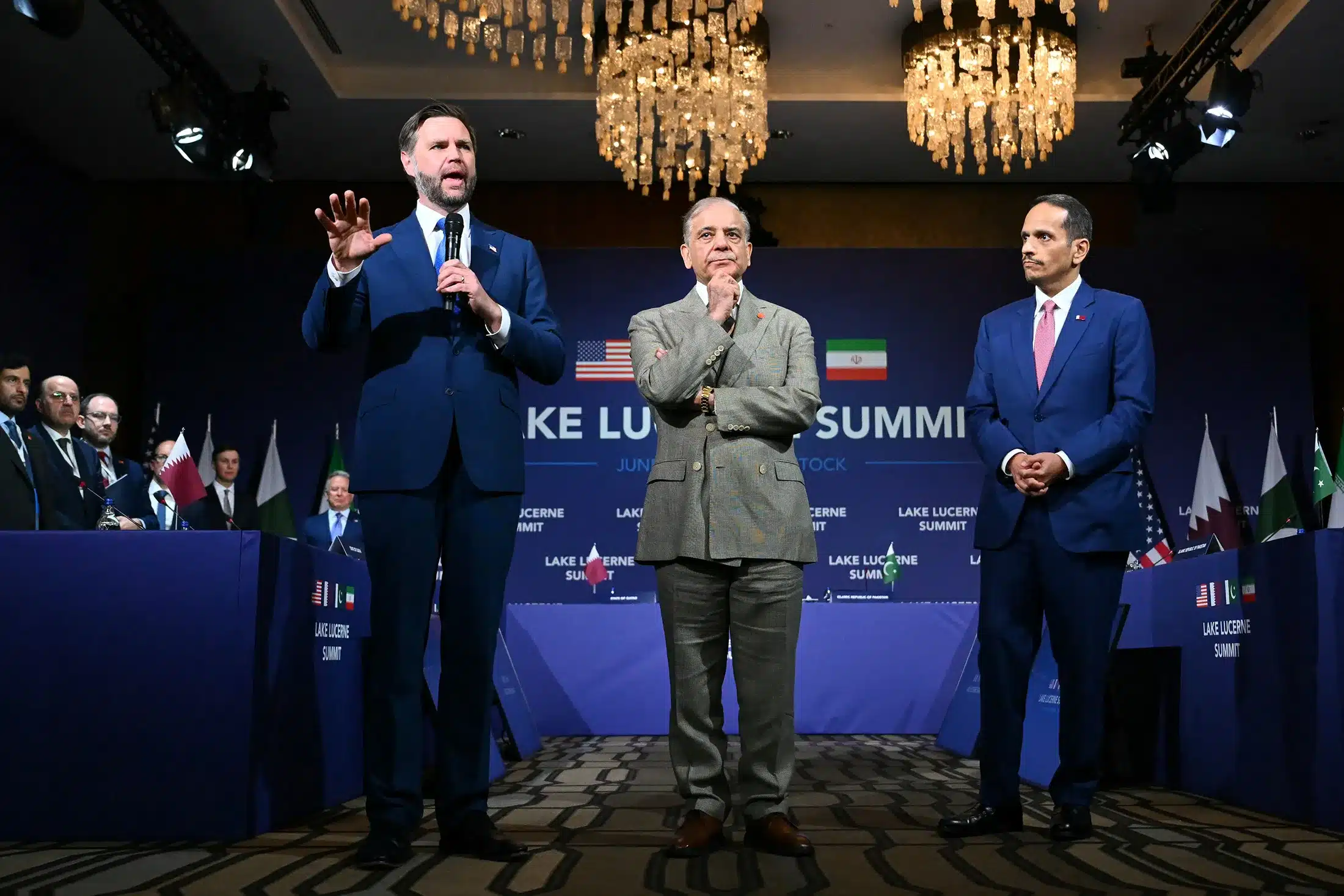





Following an intensive, 18-hour marathon session at the Burgenstock resort complex overlooking Lake Lucerne in Switzerland, mediator nations Pakistan and Qatar have announced a historic diplomatic breakthrough, with the United States and the Islamic Republic of Iran formally agreeing to a structured roadmap aimed at securing a final peace treaty within 60 days.
The high-level technical negotiations follow the initial signing of the 14-point Islamabad Memorandum of Understanding (MoU) on June 17, marking the first day of direct, face-to-face contact between senior Washington and Tehran delegations to halt the catastrophic 100-day war.
The diplomatic breakthrough was jointly guided by Pakistani Prime Minister Shehbaz Sharif and Qatari Prime Minister Sheikh Mohammed bin Abdulrahman bin Jassim Al Thani. The American delegation was led by U.S. Vice President JD Vance, alongside senior advisors Jared Kushner and special envoy Steve Witkoff. The Iranian delegation was headed by Parliament Speaker Mohammad Bagher Ghalibaf and Foreign Minister Abbas Araghchi.
#WATCH: US-Iran peace talks in Switzerland have produced a 60-day roadmap toward a final agreement, with Pakistan and Qatar mediating the process. Arab News explains what was agreed and what comes next. https://t.co/RMeslslH24 pic.twitter.com/IiK0MzWpgj
— Arab News Pakistan (@arabnewspk) June 22, 2026
In a joint press briefing on Monday, Vice President Vance stated that while the comprehensive treaty remains to be finalized, the bilateral teams have laid a successful structural foundation for global and American security.
Establishment of the High-Level Oversight Committee and Technical Working Groups
To transition the political framework of the Islamabad MoU into legally binding state commitments, the mediating nations announced the formal creation of a High-Level Committee to provide continuous political oversight. Chief negotiators from both the U.S. and Iran will lead dedicated technical working groups focused on three sensitive areas: nuclear verification, sanctions dismantling, and a joint monitoring and dispute resolution group.
A primary milestone achieved on day one includes Iran’s formal agreement to immediately invite International Atomic Energy Agency (IAEA) inspectors back into the country, reversing the total ban imposed last year during the multi-day aerial war with Israel and the United States. Technical talks between the atomic inspectors and the UN nuclear watchdog are scheduled to begin immediately to establish parameters for permanently ending Iran’s nuclear weapons potential.
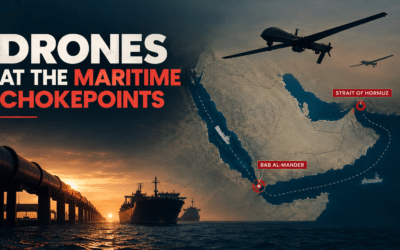
Concurrently, a direct bilateral communication line has been established to secure international commercial transit through the Strait of Hormuz, where daily vessel crossings had dropped significantly from 35 down to just 12 transits due to Iran’s de facto naval blockade. To resolve the global energy crisis caused by the shipping freeze, Vice President Vance confirmed the setup of an integrated coordination mechanism explicitly tasked with de-mining the strategic waterway.
To address the economic concessions required by Tehran, Iranian Foreign Minister Araghchi stated that the U.S. has waived primary oil and petrochemical export sanctions and initiated the release of frozen financial assets. Addressing domestic political concerns in Washington, Vice President Vance specified that all unfrozen Iranian assets will be legally restricted to the purchase of American agricultural products, feeding the Iranian public while directly benefiting U.S. farming sectors.
The Lebanon De-Confliction Cell and the Strategic Dilemma for Tel Aviv
Beyond bilateral maritime and economic terms, the Switzerland talks resulted in the immediate implementation of a quadrilateral “de-confliction cell” aimed at ensuring the permanent termination of military operations in Lebanon. Iranian Foreign Minister Araghchi lauded the mechanism as major progress toward ending the regional war, though he cautioned that the cell would serve as the first genuine operational test of the agreement.
The announcement comes amid tense regional dynamics: Israeli Prime Minister Benjamin Netanyahu has maintained that Israeli forces will occupy a 602-square-kilometer security buffer zone in southern Lebanon—representing roughly 6 percent of Lebanese territory—for as long as Tel Aviv deems necessary. In response, the head of the Islamic Revolutionary Guard Corps (IRGC) Quds Force, Esmail Qaani, issued a severe public warning on social media, stating that Israel would face a humiliating and crushing defeat if it failed to immediately evacuate Lebanese territory.
Diplomatic observers note that the Switzerland agreement places Israel in a profound strategic dilemma. Unlike previous ceasefires that were negotiated exclusively between Washington and Tel Aviv, this framework establishes a separate international dynamic mediated by Pakistan and Qatar.
While former senior diplomats warn that the mechanism faces compliance challenges because neither the Lebanese nor Israeli governments were direct signatories to the Burgenstock sessions—effectively granting Tehran an unrecognized proxy veto over Lebanese sovereignty—early ground reports from southern Lebanon indicate a cautious calm taking hold across the heavily shelled city of Nabatieh, signaling that the initial ceasefire terms are successfully influencing active frontlines.
Critical Analysis: Nuclear Verification Realities, Congressional Friction, and the New Balance of Power
The details of the Lucerne summit reveal deep geopolitical complexities and structural hurdles that must be resolved during the 60-day negotiation timeline:
1. The Logistical and Sovereignty Challenges of On-Site Nuclear Dilution
The return of IAEA inspectors to Iran is a major political victory for the U.S. delegation, but the technical details of the denuclearization process remain a severe diplomatic challenge. The U.S. is demanding a direct role in overseeing the dilution or complete removal of Iran’s highly enriched uranium stockpile.
Atlantic Council nuclear experts estimate that executing this verification process would require sending over 1,000 American technical specialists into Iran’s most sensitive, deeply buried underground military complexes. For Iran’s conservative security establishment, allowing hundreds of U.S. personnel into restricted defense facilities represents an unprecedented compromise of national sovereignty, making this issue the most likely friction point capable of breaking the 60-day timeline.
2. The Domestic Battleground Over Sanctions Relief in Washington
While Foreign Minister Araghchi emphasized that the immediate waiving of oil and petrochemical sanctions was a non-negotiable condition for Iran’s compliance, implementing these concessions faces severe domestic political resistance in the United States. Vice President Vance’s strategy to tie unfrozen Iranian capital directly to the purchase of American agricultural goods is a calculated move to build political support within the U.S. farm belt.
However, deep factions within the U.S. Congress remain fiercely opposed to any agreement that relaxes economic pressure on Tehran without total, upfront nuclear capitulation. Because many core sanctions are written into federal law, the Trump administration may struggle to provide the permanent, legally binding sanctions relief Iran demands without facing intense legislative gridlock and legal challenges at home.
3. The Shift in Regional Security Architecture and Israel’s Strategic Isolation
The creation of the Lebanon de-confliction cell without the direct involvement of the Israeli government represents a significant shift in the Middle Eastern security architecture. Historically, Washington has carefully coordinated all regional ceasefire structures with Tel Aviv to preserve Israel’s tactical freedom of action. By negotiating a Lebanon security mechanism directly with Iran and its Pakistani-Qatari mediators, the U.S. has implicitly recognized Iran’s regional influence and authority over its allied network.
This leaves Prime Minister Netanyahu’s war cabinet with a difficult choice: they must either accept an externally imposed peace framework that limits their military operations in southern Lebanon, or reject the deal and risk an open diplomatic rupture with their primary security benefactor in Washington.
4. Pakistan and Qatar as the Architects of Modern Multipolar Diplomacy
The successful execution of the Burgenstock summit confirms the growing influence of Pakistan and Qatar as essential mediators in global politics. By maintaining strict neutrality and managing complex backchannel communication lines over 100 days of active war, Islamabad and Doha have filled a diplomatic vacuum that traditional Western institutions could not bridge.
For Pakistan, the presence of Prime Minister Shehbaz Sharif and COAS Field Marshal Asim Munir alongside top U.S. and Iranian leaders shows that the country’s civil-military leadership is increasingly seen as a reliable guarantor of international security contracts. This successful mediation elevates Pakistan’s standing among global powers, demonstrating its capacity to protect critical international supply chains like the Strait of Hormuz and shape the emerging security architecture of Eurasia.