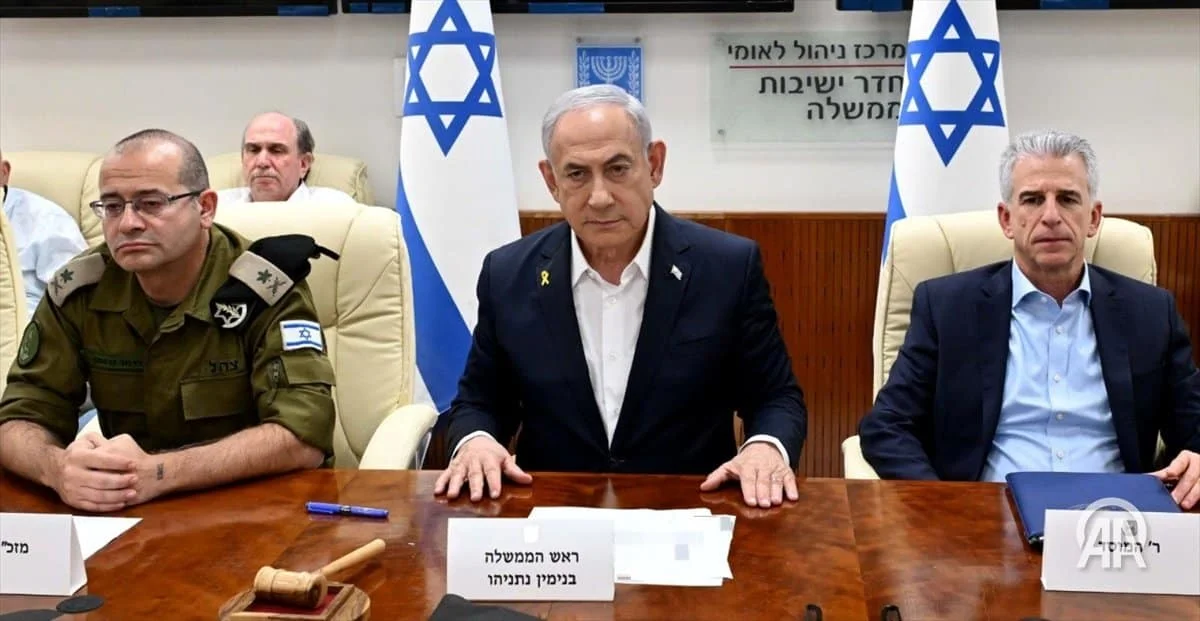




On the eve of Prime Minister Benjamin Netanyahu’s high-stakes visit to Washington to meet US President Donald Trump, the Israeli Security Cabinet approved the legal framework permitting the deployment of a multinational peacekeeping body into the Gaza Strip.
The mandate grants operational immunity to the International Stabilization Force (ISF)—a key component of President Trump’s 20-point Gaza peace plan—enabling international personnel to operate in sectors outside direct Israeli military control.
Israeli Cabinet approved the deployment of a multinational International Stabilization Force in Gaza under US President Donald Trump’s plan, Israeli media reports https://t.co/LYQQRhYZ7S pic.twitter.com/tnAepiNzoq
— Anadolu English (@anadoluagency) July 26, 2026
Operational Scope and Initial Deployment Parameters
The approval represents an incremental step toward activating the long-stalled US peace architecture, though strict Israeli veto conditions remain attached:
-
Initial Troop Contingent: The initial deployment phase envisions approximately 200 personnel sourced from “friendly nations” with established diplomatic ties to Israel, specifically citing Morocco and Uganda.
-
Approval Veto: Every contributing state and individual deployment remains subject to explicit, case-by-case approval from Prime Minister Netanyahu, Defense Minister Israel Katz, and Foreign Minister Gideon Sa’ar. Nations acting against Israel in international legal forums are explicitly excluded.
-
Geographic Boundaries: ISF units will deploy exclusively in sectors beyond the “Yellow Line”—the perimeter marking areas held under direct Israeli Defense Forces (IDF) control.
-
Chain of Command: Operating under the overarching authority of Trump’s international Board of Peace, the ISF is tasked with securing borders, facilitating humanitarian aid corridors, and eventually training local Palestinian civil police.
Structure of the Gaza Peace & Governance Framework:
- Board of Peace: Overarching international supervisory body chaired by US envoys
- International Stabilization Force (ISF): Multinational security & demilitarization force
- National Committee for the Administration of Gaza (NCAG): Palestinian technocratic civilian body
Stalled Peace Implementation and On-Ground Realities
Despite the legal approval, the transition toward full civilian governance remains severely hampered by structural and security obstacles on the ground:
-
Territorial Control: Israel currently maintains military control over roughly 64 to 70 percent of the Gaza Strip, compressing nearly 2 million displaced residents into makeshift coastal enclaves under precarious humanitarian conditions.
-
Hamas Disarmament Deadlock: Hamas has repeatedly refused demands to fully disarm, prompting Israel to maintain its operational footprint and execute localized strikes.
-
Exiled Technocratic Administration: The National Committee for the Administration of Gaza (NCAG)—the technocratic body designated to assume municipal governance—remains stationed outside the enclave pending broader security guarantees.
-
Pilot Zone Initiative: To break the administrative stalemate, the Board of Peace, led by envoy Nickolay Mladenov, is planning a pilot humanitarian zone in southern Gaza to test the viability of joint ISF security and NCAG administrative oversight.
Strategic Analysis: Tactical Concessions Ahead of Washington Summit
The Security Cabinet’s timing in passing the ISF legal framework carries clear diplomatic and geopolitical motivations:
Pre-Summit Diplomatic Leverage
By passing the ISF legal framework hours before departing for Washington, Netanyahu delivers a tangible political victory to President Trump. With the US-brokered peace plan stalling over Hamas’s refusal to disarm and Israel’s expanding security perimeters, approving the entry of friendly peacekeepers allows Netanyahu to demonstrate compliance with the 20-point peace plan without ceding core operational flexibility.
Conditional Sovereignty and Military Retention
The strict conditions built into the cabinet’s approval ensure that Israel retains ultimate operational control over Gaza’s security envelope. By limiting the initial force to 200 personnel from vetted partner states like Morocco and Uganda, Israel avoids the insertion of large, non-aligned foreign forces while maintaining the IDF’s presence along the “Yellow Line” until comprehensive demilitarization occurs.
The Enclave Stabilization Test
For the Board of Peace and international stakeholders, getting “boots on the ground”—even in a modest, 200-person capacity—serves as a vital proof of concept. If the ISF can successfully secure humanitarian zones and assist Palestinian technocrats without coming into direct conflict with residual insurgent pockets, it creates a viable blueprint for gradual IDF withdrawals. However, without a permanent resolution on Hamas’s military infrastructure, the ISF risks becoming caught between an occupying force and an un-demilitarized insurgency.