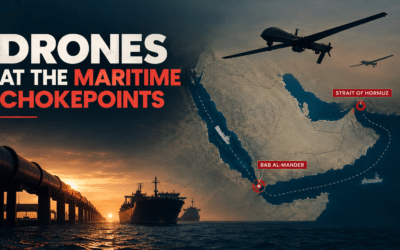
For most of 2026, two names have dominated the headlines and the conversation among oil traders, shipping executives, and policymakers: the Strait of Hormuz and Bab al-Mandab Strait. The US and Israel-led attacks on Iran were followed by the closure of the Strait of Hormuz in March 2026. As a result, one-fifth of the global crude oil and liquefied natural gas (LNG) supplies were choked. Hormuz has been effectively closed for commercial shipping ever since, with a meager number of vessels passing through it, that too from nations friendly to Tehran.
Hostilities in Hormuz did not cease, and as the world looked for alternatives to sustain its energy supplies, another maritime chokepoint, the Bab al-Mandeb Strait, became a hotspot for conflict. Houthi assaults around Bab al-Mandeb have forced Saudi Arabia’s oil exports through the Red Sea into a steep decline. The burden on the energy sector has been consistently increasing given hostilities in Hormuz and the recent attacks on refineries in the Middle East. The worst-case scenario at this point would be the closure of another vital maritime route responsible for 10% of total global trade, through which approximately 8 to 8.1 million barrels of oil and petroleum products pass every day.
Perim Island, also known as Mayun, which is vital to controlling the Bab el-Mandeb Strait, one of the world’s most important waterways, falls under Houthi control
🔹 Fierce clashes continue between Yemeni government forces and Iran-backed Houthis
🔹 Yemeni government source… pic.twitter.com/IYv2FAxnV1
— Anadolu English (@anadoluagency) September 11, 2026
The closure of the waterways illustrates two facts: first, the global economy is very fragile; the closure of two narrow sea passages, only a few kilometers wide, causes significant harm worldwide. Whether oil, fuel, and food reach their destination on time depends on these narrow sea passages. This article explains: what the most critical chokepoints are; why the Strait of Hormuz and Bab al-Mandab crises matter; and what it entails for the global economy and energy security in the long term.

Map of Middle East: Strait of Hormuz and Bab al-Mandeb Strait
What are Maritime Chokepoints?
Maritime Chokepoints are narrow straits, canals, and water channels through which ships carrying goods pass; importantly, there is no practical alternate route—any alternative would cost immense time and money. Some waterways are so narrow that the size of the ship must be calculated before allowing it to pass through a certain strait. The Suez Canal Blockage of 2021 illustrates this fact. A massive container ship named Ever Given became wedged across the canal for 6 days and 7 hours. Economists estimated total losses to global trade at around $6 billion to $10 billion per week due to halted economic activity. Direct losses from declining container values, stranded inventory, and extra fuel costs added a few more billion dollars. Subsequently, more than 420 ships were stranded at each site of the canal waiting to pass. Ships that opted to bypass the Suez Canal had to sail around the Cape of Good Hope, adding another 10 to 14 days to their journeys between Asia and Europe. Understandably, the shipping costs, fuel usage, and port congestion surged globally.
A Baker Institute working paper by Kristian Coates Ulrichsen and Jim Krane notes that approximately 90% of global maritime oil trade passes through one or more of these strategic water arteries.
- Strait of Malacca: Transits 30% of global maritime oil trade, amounting to 23.2 million barrels per day.
- Strait of Hormuz: Carries 26% of global maritime oil trade, equivalent to 20.9 million barrels per day.
- Cape of Good Hope: Handles 12% of global maritime oil trade, equivalent to 9.3 million barrels per day.
- Suez Canal & SUMED Pipeline: Moves 11% of global maritime oil trade, equal to 4.9 million barrels per day.
- Bab el-Mandeb: Controls 12% of global maritime oil trade, which is 4.2 million barrels per day.
- Danish Straits: Transports 6% of global maritime oil trade, or about 4.9 million barrels per day.
- Turkish Straits: Directs 5% of global maritime oil trade, approximately 3.7 million barrels per day.
From a security standpoint, the straits’ narrowness makes them highly vulnerable. A blockage, an attack, or even the fear of one can choke vital supply chains that millions of people and hundreds of countries depend on.

Infographic: Global Straits and Maritime Oil Trade Transiting through them.
World’s Most Critical Chokepoint: Strait of Hormuz
The Strait of Hormuz, separating Iran and Oman at the mouth of the Persian Gulf, is one of the most important chokepoints on earth, particularly for oil trade. Around 14 million barrels of oil and condensates transit through Hormuz daily. This includes half of Saudi and Emirati oil exports and all LNG cargoes from Qatar and Abu Dhabi. The most feared possibility became a reality in March 2026, against the backdrop of the war waged on Iran by the United States and Israel. Tehran shut the Strait of Hormuz. All sea traffic carrying one-fifth of the world’s crude oil and LNG was blocked or diverted. The disruption is largely owed to the direct attacks on ships.
Bab al-Mandab Strait
While Hormuz dominated the global discourse and headlines, the “Gate of Tears”, or commonly known as the Bab al-Mandeb Strait, has been slowly delving into a global crisis. Yemen’s Houthi Movement, controlling the Red Sea Port city of Hodeida since 2014, started attacks and resumed hostilities in July 2026 after the collapse of the 2022 truce. Saudi tankers in the Red Sea have, since then, been Houthi targets. Saudi oil exports directed from Yanbu Port had surged to 3.8 million barrels per day from March 2026 to July 2026, given the closure of Hormuz. These exports have now collapsed to just 1.5 million barrels per day owing to the Houthi attacks. The greatest danger in Bab al-Mandab is not the physical closure, but the persistent instability and uncertainty created by Houthi attacks, which in turn halt shipping traffic, raise insurance premiums, delay shipments, and drive up transit costs.
Ripple Effects: Suez Canal, Panama Canal, and Beyond
A blockade at a chokepoint does not remain isolated to a single waterway; it expands and creates ripple effects. In 2023, when the Houthis intensified their attacks, container traffic was diverted to the Cape of Good Hope, adding 10-14 days to the journey; shipments were pushed from Gulf ports to Rotterdam, adding 19-34 days of travel. Coincidentally, drought-driven restrictions around the Panama Canal forced rerouting through the Suez Canal. The flux of ships and containers in the Red Sea created congestion and danger.
Interconnected fragility is perhaps the defining feature of global maritime trade; a crisis at one strait does not remain limited; it pushes traffic to other straits, canals, and waterways. Overloading of a water channel can create further problems. The 2021 Suez Canal Blockade by Ever Given is a prime example of the strategic vulnerability of maritime trade. A single vessel can disrupt global supply chains.
New Reality of Energy Security
Energy exporters are strengthening their strategic infrastructure and naval security to mitigate the risks posed by maritime chokepoints. Stakeholders are exploring options such as Government-to-Government Strategic Petroleum Reserve (SPR) Sharing Agreements and mutual security cooperation agreements. United Arab Emirates’ ADNOC signed a Strategic Petroleum Reserve Sharing Agreement with India, South Korea, and Singapore.
Simultaneously, the United States-led Combined Maritime Force and the EU’s Operation Aspides are some examples of naval initiatives to protect energy interests, particularly in high-risk corridors like Bab al-Mandab. Similarly, Saudi Arabia signed a Makkah Joint Defense Agreement with Pakistan and Turkiye; however, it remains to be seen whether the other two signatories will attack the Houthis to defend KSA.
Looking Ahead
Energy insecurity and volatility, especially in the Middle East, are compelling nations to look towards renewable energy sources. A shift to electrification might reduce the dependence on maritime chokepoints, as wind and solar power do not require fuel shipments. Nevertheless, a complete shift to renewable energy sources is possible only through the development of necessary infrastructure. Expectedly, first-world countries will lead developing and underdeveloped countries in this race to shift toward alternatives to crude oil and LNG.
The European Union has accelerated the deployment of renewables to hedge against the loss of secure supply routes following Russia’s invasion of Ukraine and the resulting disruption to pipeline gas flows. Nevertheless, clean energy supply chains have their own chokepoint risks, particularly for shipments of solar panels, battery components, and rare earth minerals.
In 2026, events in the Strait of Hormuz and Bab al-Mandab remind the world that narrow waterways still hold enormous power over the global economy. Geopolitics surrounding them will remain central to energy security for years to come.
Frequently Asked Questions (FAQs)
1. What is a Maritime Chokepoint?
Maritime Chokepoints are narrow straits, canals, and water channels through which ships carrying goods pass; importantly, there is no practical alternate route—any alternative would cost immense time and money.
2. What was the Suez Canal Blockade?
The Suez Canal Blockage of 2021 illustrates this fact. A massive container ship named Ever Given became wedged across the canal for 6 days and 7 hours.
3. Why did Iran close the Strait of Hormuz?
In the backdrop of the war waged on Iran by the United States and Israel. Tehran shut the Strait of Hormuz. All sea traffic carrying one-fifth of the world’s crude oil and LNG was not blocked or diverted. The disruption is largely owed to the direct attacks on ships.
4. How much of maritime trade transits through the Straits?
Strait of Malacca transits 30% of global maritime oil trade, amounting to 23.2 million barrels per day. Strait of Hormuz carries 26% of global maritime oil trade, equivalent to 20.9 million barrels per day. Cape of Good Hope handles 12% of global maritime oil trade, equivalent to 9.3 million barrels per day. The Suez Canal & SUMED Pipeline move 11% of global maritime oil trade, or 4.9 million barrels per day. Bab el-Mandeb controls 12% of global maritime oil trade, which is 4.2 million barrels per day. The Danish Straits transport 6% of global maritime oil trade, or 4.9 million barrels per day. The Turkish Straits transport 5% of global maritime oil trade, or 3.7 million barrels per day.