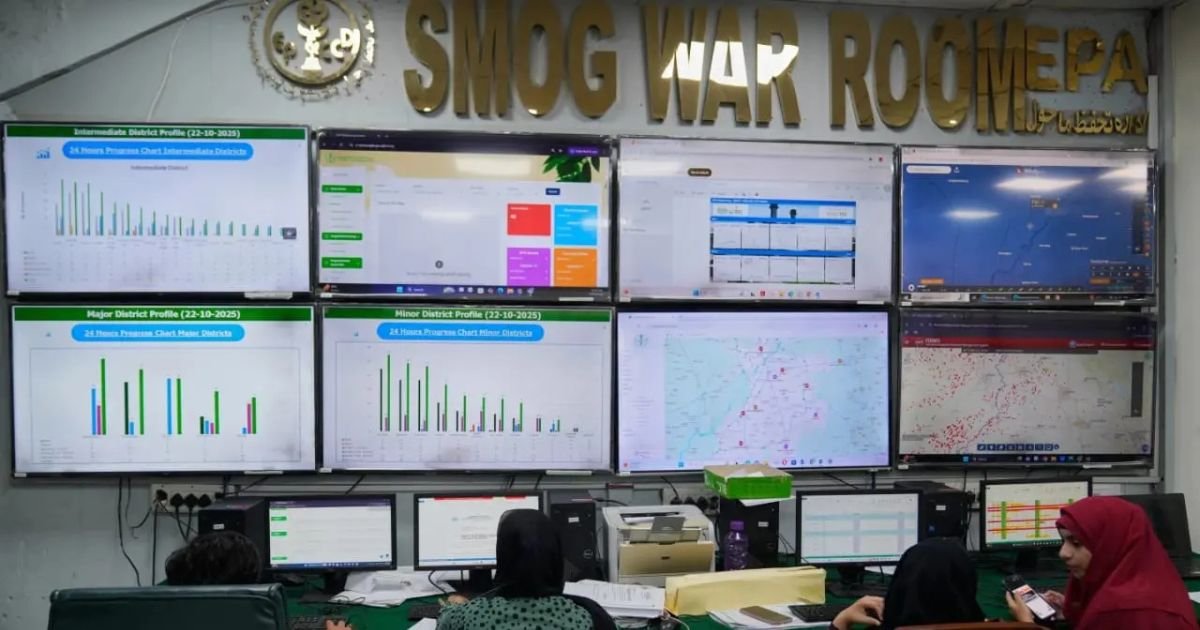





As Lahore once again vanishes under a toxic grey shroud, Punjab has launched one of the region’s most ambitious clean-air programmes, placing artificial intelligence at the heart of its fight against winter smog that routinely ranks the city among the world’s most polluted.
Punjab Environment Minister Marriyum Aurangzeb announced that 100 AI-enabled air-quality monitoring stations now feed real-time data into a 24-hour “smog war room” — a digital command centre integrating satellite imagery, ground sensors, NASA feeds, and machine-learning algorithms to predict pollution spikes hours in advance.
Punjab sets up 100 air quality stations, a 24/7 AI-based Smog War Room, and South Asia’s first Climate Observatory in Lahore.
With satellites, drones & 8,500 cameras, emissions are tracked in real time for rapid climate response.#ConnectedPakistan #ClimateTech #Punjab pic.twitter.com/g7PF9K2inQ— Connected Pakistan (@ConnectedPak) November 18, 2025
Key components of the tech-driven strategy:
- 8,500 AI-linked cameras, drones, and thermal sensors geo-tag and QR-code every factory and brick kiln, automatically alerting the Environmental Protection Force (EPF) to violations.
- AI-guided anti-smog guns activate automatically when PM2.5 levels breach limits, with pilot tests in Kahna showing nuevo 70% improvement within hours.
- Real-time crop-burning detection using NASA and SUPARCO satellites, cross-referenced with farm-loan databases, has slashed stubble burning by 65% in one year.
- 95% of industrial units now reportedly operate emission-control systems.
- Public reporting via the Air Quality Index Punjab app and helpline 1373 boasts a 96% complaint closure rate.
Aurangzeb hailed the system as “the most advanced clean-air enforcement network in South Asia,” crediting AI for transforming reactive measures into predictive, precision action.
Yet experts warn technology alone cannot cure Lahore’s structural pollution crisis, which claims an estimated 128,000 lives annually across Pakistan. Climate governance analyst Imran Saqib Khalid stressed: “AI is impressive, but the real culprits — outdated refineries producing dirty fuel, thousands of tyre-burning brick kilns, and an exploding vehicle fleet — remain untouched.” He noted that even “zigzag” kilns fail without cleaner coal or gas.
Environmentalist Yasir Hussain added: “Smog guns and artificial rain give temporary relief. Within an hour, levels rebound because the sources are still there.”
While acknowledging Punjab’s new seriousness and coordination, activists insist lasting change demands modern refineries, stricter fuel standards, kiln conversions, and a rapid shift to electric mobility — not just smarter enforcement of a broken system.
As Lahore’s AQI again crosses 1,000 this week, the AI war room races against time — and nature — to prove technology can buy the city a breath of fresh air.
Check out our latest video: