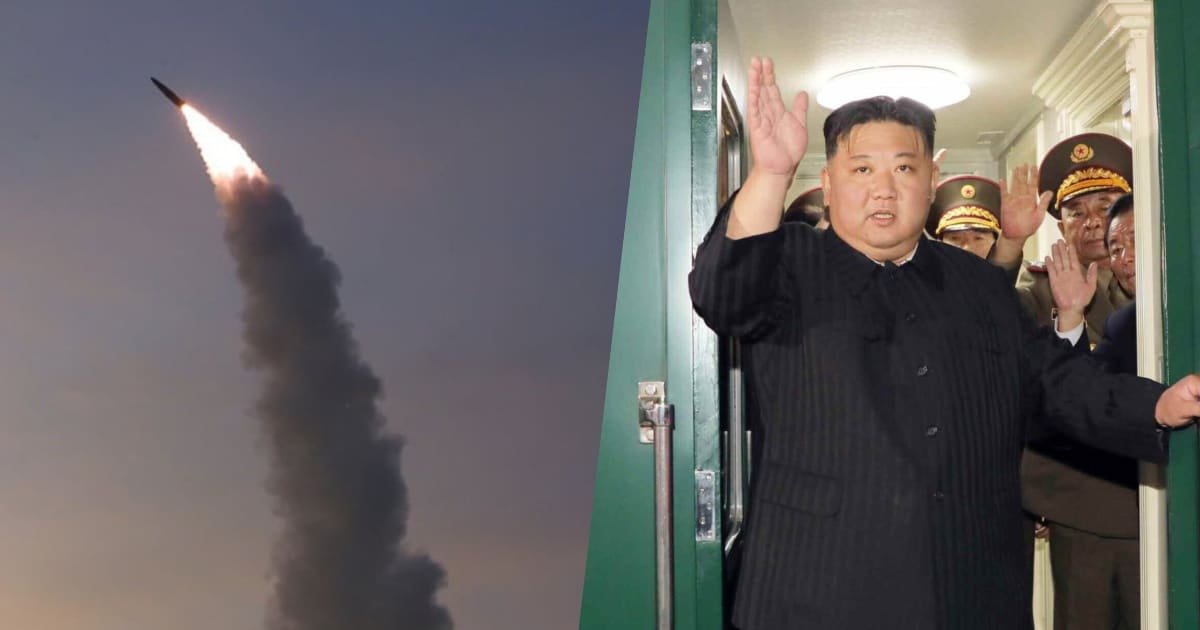





North Korean dictator Kim Jong-un was personally present on August 23, 2025, when the test-firing of two recently developed air defense missiles was carried out and soon drew international attention. This was launched as the United States and South Korea conducted their annual joint military drills, just days ahead of the summit between U.S. President Donald Trump and South Korean President Lee Jae-myung. This decision to demonstrate this new weapon system at this sensitive time acted as a powerful signal of defiance on the part of Pyongyang and also served as a reminder to the world that it was capable of expanding its military strength.
Inside the Missile Test
The state news agency of North Korea, reported that this test involved two new kinds of air defense missiles, which are reported to offer a quicker response to new high-tech airborne assaults like drones and cruise missiles. They pointed to the system as being improved and constructed with special and unique technology, but technical specifications such as the range or high altitude were not provided in the report, along with the site of the test. It asserted that the launches were successful and showed the prowess of the defense research program in the country.
Kim Jong Un himself headed the exercise and observed as the missiles were launched, and afterward provided what KCNA termed as important directions to his defense scientists and engineers. The leader extolled the advancement of the new technology and related it to future political and military preparations, hinting that they would be premiered or be further developed during the next major political meeting in North Korea.
This is also a change of direction of focus to Pyongyang since it was concentrating on the air defense. The arms of North Korea also have an offensive weapons program that has, over the years, been infamous with missiles that can hit South Korea, Japan, and even the mainland of the U.S. However, with the implementation of more advanced air defense capabilities, there was an implication of making the air defense system stronger against the capabilities of allied surveillance aircraft, attack drones, and cruise missiles, as used more frequently by the U.S. and South Korea in military exercises, and introduced the system as a solution to an emerging aerial threat posed by enemy forces.
The successful test, in the case of Kim, was not only the answer that military progress was made, but also a statement of the ability to do this independently of outside help in the field of defense technology. It solidified the argument of North Korea that it can establish modern and practical systems without the help of the outside world, even with heavy sanctions. The test was hence packaged as a military feat and national pride.
You May Like To Read: Pakistan-Germany Foreign Ministers Discuss Bilateral, and Regional Ties
Strategic Timing, and Symbolism
The fact that the last test of a missile was conducted by North Korea was very symbolic. It occurred amid the mid-course of the Ulchi Freedom Shield 35 combined military exercises between the United States and South Korea, the military drills that Pyongyang has long criticized as invasion rehearsals. By releasing new air defence missiles into the field at these exercises the Kim Jong Un made a calculated message that his nation is prepared to retaliate against any allied military operations, and nothing will be able to scare it off because of the magnitude of the U.S and South Korea collaboration. It was not a technological demonstration, but also was politically symbolic as it was a reminder to both Washington and Seoul that North Korea is still a force to be reckoned with.
It was also launched right before an awaited summit between U.S. President Donald Trump and South Korean President Lee Jae-myung, and had a symbolic weight because of that. North Korea has traditionally used tests of its missiles to make bargains before important diplomatic or security conferences, to create leverage that helps advance negotiations and assert its status in the regional arena. In making this defensive presentation at this point, Kim was not only reassuring his audience at home of their strengths but also warning his foreign competitors that any negotiations they might have with North Korea must acknowledge the increasing strength of its military.
Military Significance, and Geopolitical Outlook
The event where North Korea tested new air defense missiles is important because it brings a slight change in its general approach to the military. Over the decades, Pyongyang was primarily known as the place of an offensive missile arsenal consisting of short-, medium-, and long-range ballistic missiles. It is also marking an interest in developing a more layered security posture, which is not only fearing its enemies but also safeguarding its own airspace against surveillance drones, cruise missiles, and even possible pre-emptive attack. The reinforcement of air defense might make North Korea more satisfied that it can sustain external pressure, and its expanded missile and nuclear arsenal may seem safe.
This test also has a geopolitical effect that is as important. The launch has piled on the pressure of regional diplomacy by coming right before the U.S.-South Korea summit. It acts as a wake-up call to Washington and Seoul that Pyongyang can no longer be marginalized in security talks and any negotiations must take into consideration its escalating military strength. Simultaneously, closer relations with Russia and overt assistance of China leave North Korea less lonely in the international arena and allow Kim Jong Un to be more daring. This combination of military development and tactical time can be interpreted as the fact that North Korea is not just planning to protect itself but also forms the forces of power in the Northeast region of Asia so that its voice and its armaments could remain the key to the future of the region.
You May Like To Read: France on the Brink of Political and Economic Crisis | Prime Minister Faces No-Confidence Vote