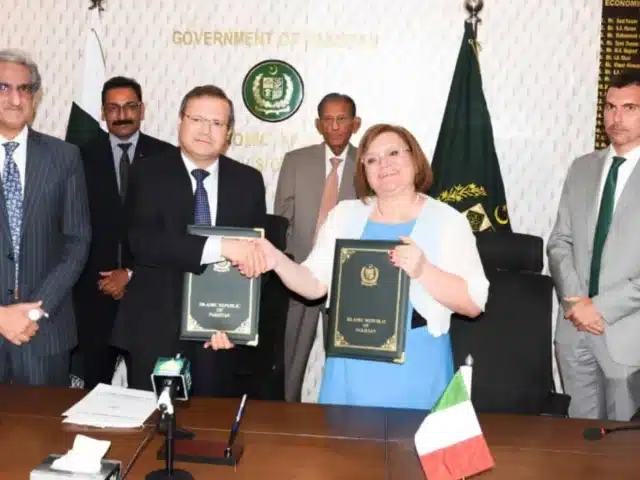





Pakistan and Italy have formalised a major geoeconomic partnership aimed at transforming Pakistan’s agricultural landscape through structural human capital development. The two nations signed a concessional loan agreement valued at approximately 20 million Euros (Rs6.3 billion) to finance the high-impact “Professional Capacity Building and Extension in Agriculture” project.
Executed under the umbrella of Pakistan’s Technical and Vocational Education and Training (TVET) National Reform Programme, the agreement was finalized by Economic Affairs Secretary Muhammad Humair Karim and the Ambassador of Italy, Marilina Armellin. The initiative establishes a comprehensive 42-month operational framework designed to modernize agronomic practices, transition traditional farming into high-value agribusiness, and inject advanced European technical expertise directly into Pakistan’s rural economy.
پاکستان اور اٹلی کے درمیان 20 ملین یورو (6.3 ارب روپے) کے رعایتی قرضے کے معاہدے پر دستخط
قرض کے زریعے زیتون، پستہ، کھجور، مشروم، چیری، انگور، آڑو اور بادام جیسی فصلوں پر توجہ دی جائے گی
42 ماہ پر مشتمل اس پروگرام کے دوران مجموعی طور پر 720 زرعی تربیتی کورسز منعقد کیے جائیں گے pic.twitter.com/5GhyxZ2x1o
— Khurrram Shahzad (@KhurramShahzPK) June 29, 2026
Structural and Physical Blueprint of the TVET Project
The Pakistan-Italy bilateral accord sets a highly structured timeline and physical blueprint to address long-standing vulnerabilities in Pakistan’s agricultural yield and processing capacity. Implemented by the Pakistan Oilseed Department in close coordination with provincial agriculture departments, the project focuses specifically on high-value horticulture and specialized agro-food sectors. The targeted crop portfolio draws directly upon Italian agronomic expertise, focusing on the production, processing, and marketing of olives, pistachios, dates, mushrooms, cherries, grapes, peaches, and almonds.
Over its 42-month deployment phase, the project will roll out 720 distinct institutional training courses, utilizing 11 newly standardized technical training curricula. The capacity-building framework is engineered to upskill an estimated 18,398 participants, explicitly targeting rural youth, smallholder farmers, agricultural trainers, and women.
Crucially, the concessional loan will fund substantial physical and technological infrastructure across the country, including:
-
12 Model Orchards and Nurseries: Serving as localized research and development hubs for high-yield, premium crop varieties.
-
8 Eco-Villages: Designed to demonstrate and scale climate-resilient farming technologies.
-
5 Agro-Food Processing Units: Aimed at reducing post-harvest losses and introducing commercial value addition.
-
2 National Centres of Excellence: Specialized institutional facilities established in Sargodha (focusing on citrus) and Turbat (focusing on date crops) to anchor long-term research and quality standardization.
Critical Analysis
This bilateral pact represents a calculated shift from basic structural assistance toward strategic geoeconomic integration. Historically, Pakistan’s agricultural sector has been constrained by low yield per acre, fragmented supply chains, and massive post-harvest wastage—weaknesses that consistently undermine the country’s macroeconomic stability and food security. By choosing to structure this intervention as a targeted TVET reform rather than a traditional input subsidy, Islamabad is prioritizing institutional capacity building. The focus on high-value cash crops like olives, almonds, and pistachios is a deliberate attempt to shift away from water-intensive, low-margin traditional crops, laying the groundwork for a sophisticated, export-oriented agrarian model.
The geopolitical placement of the National Centres of Excellence carries significant weight. Establishing the date crop facility in Turbat, Balochistan, and the citrus facility in Sargodha, Punjab, injects vital economic infrastructure into key production zones. For Balochistan in particular, connecting local farmers to international processing standards acts as an important economic stabilizer, linking remote rural communities to mainstream national value chains.
Furthermore, the emphasis on establishing farmer cooperatives and agro-food processing units targets the weakest link in Pakistan’s current agrarian setup: the middleman problem and the lack of standardized certification. By establishing these frameworks with Italian regulatory guidance, Pakistan can bypass traditional supply chain inefficiencies, improve the competitiveness of its exports in premium Mediterranean and European markets, and transform rural youth from underemployed laborers into certified technical operators.
The Multilateral Roadmap for Agricultural Modernization
As the 42-month implementation timeline begins, the success of this geoeconomic intervention will depend on three core operational pillars:
-
Integration of Standardized TVET Curricula: Aligning the 11 new training curricula with international technical certifications to ensure domestic farmers meet global market standards.
-
Rapid Deployment of Climate-Resilient Infrastructure: Ensuring the 8 eco-villages and 12 model nurseries are fully optimized with modern water-management and climate-adaptation technologies to counter erratic weather patterns.
-
Cooperative-Led Market Access: Leveraging the newly formed farmer cooperatives to streamline bulk logistics, eliminate predatory middleman structures, and maximize direct profit margins for rural producers.