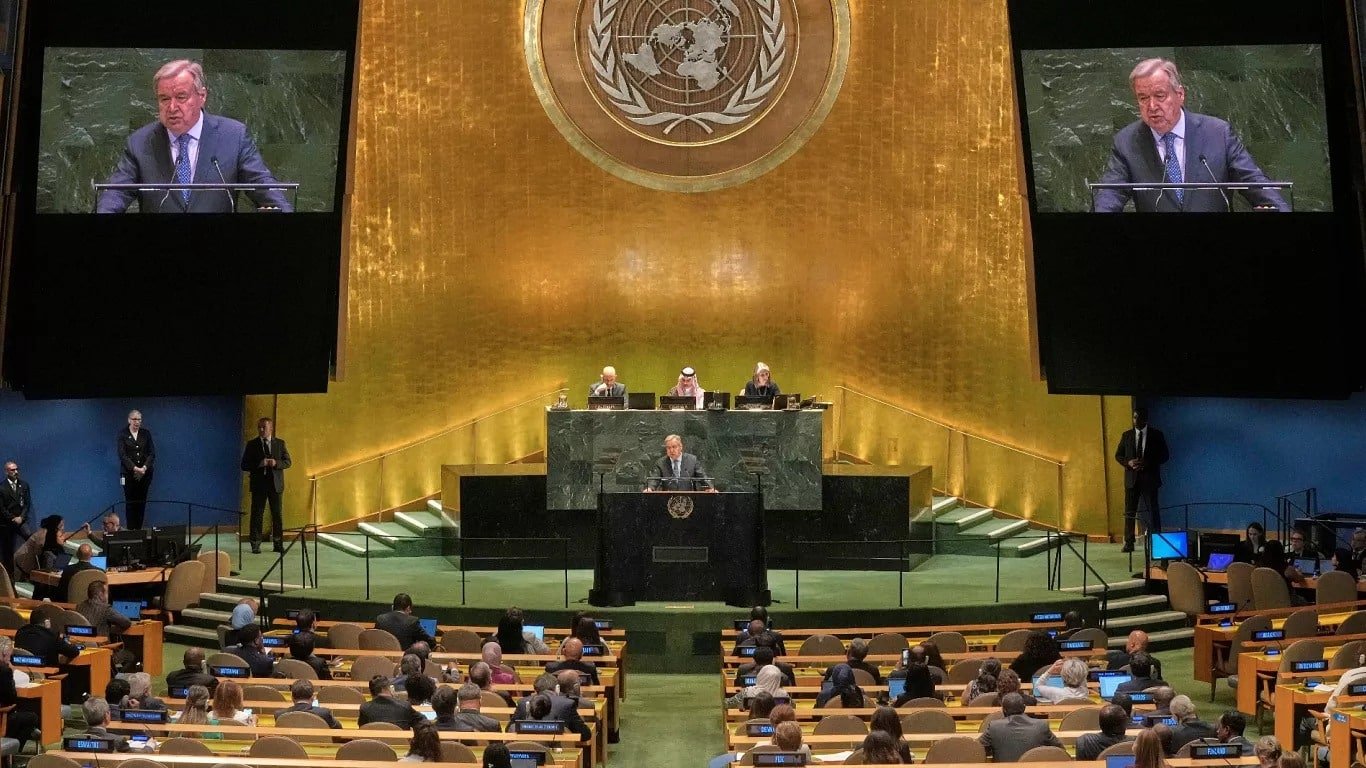





At a United Nations–backed conference in New York on July 29, 2025, a coalition of Arab nations—Qatar, Saudi Arabia, and Egypt—joined forces with the Arab League and European Union (alongside 17 other countries) to issue a historic joint declaration urging Hamas to disarm and surrender governance of Gaza. The statement calls for the Palestinian Authority to assume interim control, with international backing and possible UN-led stabilization forces to help transition security and administration. France and Britain notably endorsed the move, describing it as both “historic and unprecedented” given the unusual unity among Arab states in demanding Hamas’ removal from power.
At the same event, Palestinian Prime Minister Mohammad Mustafa explicitly declared that:
“Israel must withdraw completely from the Gaza Strip and Hamas must relinquish its control over the strip and hand over its weapons to the Palestinian Authority.”
A firm endorsement that elevated the call into an official Palestinian government position.
Emerging consensus across diplomatic fault lines
This unprecedented alignment marks a significant break with past stances. Historically, Gulf states and other Arab nations have supported Hamas rhetorically, even as they criticized Israeli policies. Now, by calling for Hamas to “give up Gaza rule” and disarm, these nations are signaling a shift in regional strategy—prioritizing civilian governance and humanitarian concerns over ideological alignment. Their declaration, supported by the EU and multiple Western states, rejects Hamas’s continued military control as incompatible with peace and stability.
Meanwhile, Britain and France have joined in urging Hamas to disarm and step away from governance, aligning their messages with those of Arab states and signaling broader international pressure building around the same demands.

Source: France 24.
Why now? Context and pressure points
This diplomatic crescendo occurs against a backdrop of mounting humanitarian catastrophe. Gaza has been under siege since October 2023, and famine conditions now afflict the enclave. The UN Secretary‑General declared Gaza a “humanitarian catastrophe of epic proportions”; famine deaths among children mounted, food deliveries remain severely constrained, and infrastructure collapse is widespread.
Ceasefire negotiations have reached an impasse. The U.S. recently withdrew its negotiating team from talks in Qatar, citing Hamas’s unwillingness to commit to disarmament or Israeli withdrawal—two key sticking points preventing progress. Israel has repeatedly insisted that Hamas must be dismantled as part of any peace deal; Hamas has recoiled, demanding that all hostages be released before a ceasefire or Israeli withdrawal is considered.
Gaza itself is undergoing internal turmoil. Since late March 2025, mass protests have erupted across the territory, with thousands calling for an end to Hamas’s rule and the war, signaling growing public war‑weariness and opposition to the group’s authoritarian methods and prolonged conflict.
You May Like To Read:
Hamas leadership and internal negotiations
Since the assassination of Mohammed Sinwar in May 2025, Izz al‑Din al‑Haddad has emerged as the powerful new leader in Gaza—both the head of Hamas’s political leadership and the commander of its military wing. He reportedly holds veto power over any ceasefire or hostage deal, and while described as more open to negotiation than his predecessor, al‑Haddad has emphasized that hostages must not be released until the war ends and Israeli forces withdraw fully. A proposed disarmament offer involving relocation of Hamas leadership was reportedly rejected by the group earlier in 2025.
What would disarmament look like?
The joint declaration proposes that Hamas break down its security apparatus and transfer authority to the Palestinian Authority, with international engagement in overseeing a transition. It envisages deployment of foreign or UN-led forces to ensure stability and protect civilians during the post-conflict phase; however, details on troop numbers and timelines remain vague.
If implemented, this would represent a dramatic shift in Gaza’s governance, transitioning from decades of Hamas rule toward a more internationally supported civil administration under the Palestinian Authority—though Israel and the U.S. have declined to participate in the declaration, raising questions about enforcement and legitimacy.
Risks, challenges, and what’s at stake
- Hamas resistance: Despite leadership changes, the group retains significant ideological cohesion and battlefield capacity. Disarming would require internal consensus or coercion—both politically fraught and potentially violent.
- Public legitimacy: Hamas still retains some popular support among Gazans, especially around resistance identity. For some, its removal may signal betrayal amid new leadership and ceasefire uncertainty.
- Regional dynamics: Support from Arab states lends legitimacy—but Israel and the U.S.’s refusal to endorse the push could render the declaration symbolic unless followed by logistical and political follow-through.
- Humanitarian urgency: Without compromise on both sides, civilian suffering deepens. As more aid is blocked or looted, famine intensifies—a collapse in which displacement or civilian breakdown might become irreversible.
Conclusion
As of July 29, 2025, the international consensus is coalescing around a bold demand: Hamas must disarm and surrender control of Gaza, enabling the Palestinian Authority to assume governance and international forces to stabilize the aftermath. Arab governments—including those historically supportive of Hamas—and Western states now share a unified message. Meanwhile, Palestinian leadership under Prime Minister Mustafa publicly joined the call, elevating its diplomatic weight.
Yet, without support from key actors like Israel and the U.S., and with Hamas still rejecting disarmament outright, the declaration may amount to political posturing unless backed by clear implementation mechanisms. The fundamental realities on the ground—civilian starvation, political fragmentation, and entrenched military resistance—present severe obstacles. Regardless, this turning point may mark the clearest international demand yet for a post‑war Gaza free of armed rule—assuming it can be enforced and accepted.