



The current escalation along Pakistan’s western border under Operation Ghazab Lil Haq is mirrored by an equally volatile strategic crisis on its eastern flank. While the western theater remains a kinetic battleground against cross-border militancy, the eastern front has evolved into a high-stakes arena of “lawfare” and hydro-politics, centered on the foundational architecture of the Indus Waters Treaty (IWT).
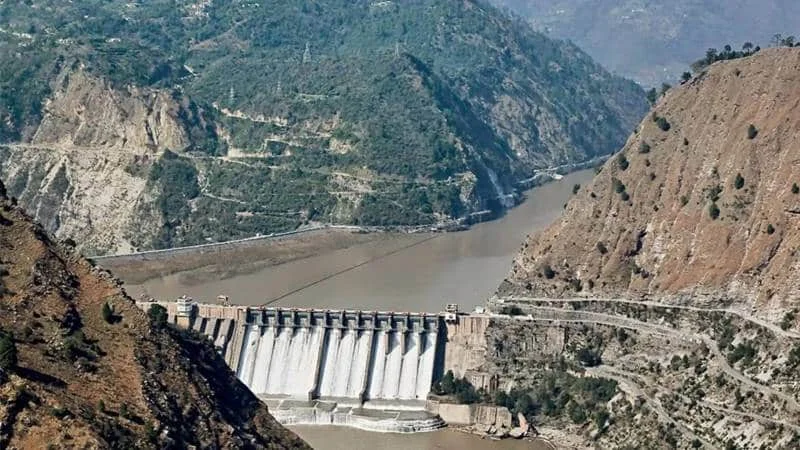
Following a brief but intense military conflict between India and Pakistan in May 2025, New Delhi undertook a unilateral abeyance of the 1960 accord. This diplomatic suspension has recently translated into explicit rhetorical and structural pressure. Indian Water Minister CR Patil declared that his country is actively working to ensure that “not a single drop of water” flows down-river into Pakistan. In response, Islamabad has explicitly synchronized its political and military leadership, drawing a hard line on its vital natural resources.
Indus Water Treaty remains one of world’s most enduring water-sharing agreements, says Information Minister Tarar
Read more: https://t.co/1xINgbIQtg#TheNews
— The News (@thenews_intl) June 30, 2026
Strategic Dimensions of the Hydro-Crisis
The current standoff dismantles decades of relative hydro-diplomacy, transforming transboundary water management into a zero-sum security issue across three main dimensions:
1. The Red Line of National Sovereignty
Islamabad’s response to the threat of water diversion bridges the gap between environmental resource management and defensive military doctrine. Both Prime Minister Shehbaz Sharif and Chief of Defence Forces, Field Marshal Asim Munir, have repeatedly stated that water is not merely a resource, but a core security threshold. The state has formally communicated that any practical attempt by an upper riparian state to alter, divert, or block the natural flow of cross-border waterways will be met decisively and treated as an explicit act of war.
2. Legal Architecture and International Endorsement
At the center of Pakistan’s diplomatic strategy is the argument that the Indus Waters Treaty possesses no mechanisms for unilateral revocation, termination, or amendment by either signatory. During an emergency press briefing in Islamabad, Information Minister Attaullah Tarar and Climate Change Minister Musadik Malik emphasized that the 65-year-old framework remains legally binding and fully implemented under international law.
This position recently gained vital institutional backing when Pakistan’s legal interpretations and rights as a lower riparian state were formally endorsed at the International Court of Arbitration. By shifting the dispute into the domain of international lawfare, Islamabad has successfully positioned the weaponization of water as a direct violation of global conventions, leaving New Delhi without multilateral backing for its unilateral actions.
3. Economic and Food Security Vulnerabilities
The existential nature of the crisis is rooted directly in Pakistan’s domestic stability. The Indus River system sustains the agrarian baseline of the country:
-
Livelihood Dependency: Approximately 40 to 50 percent of Pakistan’s total population relies directly on the agricultural sector for employment and daily sustenance.
-
Economic Output: The agricultural sector generates 20 to 25 percent of the state’s total Gross Domestic Product (GDP).
Consequently, any artificial restriction of water flows represents an immediate attack on national food security, economic output, and internal stability. By attempting to control the flow of the Indus, an external power gains direct leverage over half of Pakistan’s workforce and a quarter of its entire economy.
Conclusion: The Doctrine of Lower Riparian Rights
The hydro-strategic standoff has triggered an internal consolidation within Pakistan, generating an absolute political consensus on the immediate necessity of building large-scale water storage infrastructure and regulating internal flow management. As international legal and water experts gather in Islamabad to debate the crisis, Pakistan’s baseline case rests on global precedent: water sharing is a matter of fundamental justice.
Even in the complete absence of formal treaties, upper riparian states are bound by international custom to preserve the downstream lifelines of lower riparians. With a binding treaty explicitly in place, any attempt by India to choke the Indus basin bypasses legal norms entirely, placing the region on a dangerous path where water security is defended with the same kinetic resolve as territorial integrity.