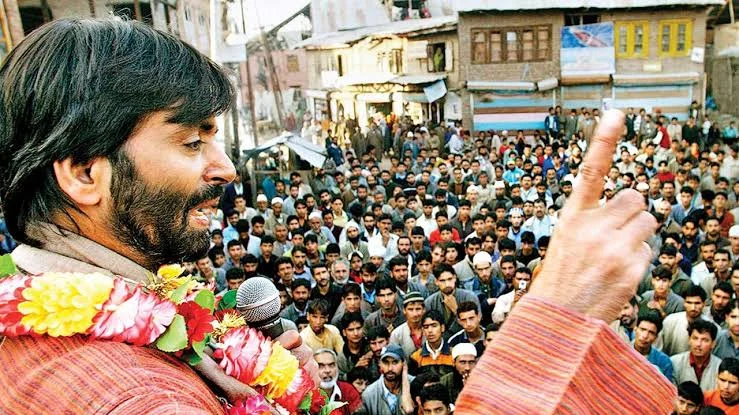





In a calculated move that further exposes the weaponization of the judicial system by the Indian occupation state, imprisoned Kashmiri leader Mohammad Yasin Malik has been implicated in a 36-year-old murder case. Indian media reported that the State Investigation Agency (SIA) filed a massive 737-page charge sheet naming Malik, the chairman of the Jammu Kashmir Liberation Front (JKLF), alongside six others for the 1990 killing of a nurse, Sarla Bhat, in Srinagar.
This move comes after Malik has spent more than four years languishing in New Delhi’s notorious Tihar Jail on politically motivated terrorism charges. The sudden resurrection of a cold case that was abandoned decades ago highlights New Delhi’s ongoing campaign to legally break the Kashmiri leadership, using state-backed investigative bodies to manufacture endless legal loops and suppress the legitimate struggle for self-determination in Jammu and Kashmir.
The investigation into her murder, which went cold several years ago, was reopened by former lieutenant governor of India-held Kashmir Manoj Sinha to appease local pressure groups. https://t.co/CfVU9h6j3h
— Dawn.com (@dawn_com) June 30, 2026
Resurrection of an Abandoned File
The reopening of the investigation represents a sharp reversal of India’s own highest judicial precedents. In 2017, the Indian Supreme Court formally declined to reopen multiple murder cases involving Kashmiri Pandits from the 1990s, explicitly ruling that because the incidents occurred nearly three decades prior, gathering reliable forensic evidence, tracing witnesses, and ensuring a fair trial was virtually impossible. Despite this judicial boundary, former Lieutenant Governor of India-held Kashmir Manoj Sinha bypassed standard legal norms under intense pressure from right-wing local pressure groups, directing police to compile a targeted list of historical cases.
The Sarla Bhat file was subsequently handed over to the state-controlled SIA for a fresh probe. The resulting 737-page document names five primary accused individuals: Yasin Malik, Khursheed Ahmad Chalkoo, Abdul Hamid Sheikh, Ghulam Mohammad Taploo, and Mohammad Yousuf Sofi.
Crucially, demonstrating the severe irregularities of the state’s narrative, three of the co-accused named in the document are already deceased. The SIA’s official claim that its new findings are rooted in a fresh analysis of oral, documentary, forensic, and ballistic data stands in sharp contrast to the reality that the case has been cold for over three and a half decades, confirming that the entire process is driven by political objectives rather than legal merit.
Critical Analysis: Manufactured Litigations, Leadership Liquidation, and Occupation Law
The resurrection of this 36-year-old case reveals a sophisticated strategy of narrative warfare and legal attrition practiced by the Indian state. By continuously layering new, highly emotional criminal charges on top of existing sentences, New Delhi is practicing “judicial liquidation”—a process where a high-profile political dissident is kept permanently behind bars through an endless cycle of trials. This strategy ensures that even if primary charges fail to hold up under international legal scrutiny, alternate state-manufactured cases stand ready to prevent the leader’s release, effectively neutralising their ability to organize or lead public resistance.
This specific case is carefully designed to manipulate historical grievances for contemporary political gain. By shifting a decades-old case to the SIA, the occupation administration is attempting to reshape the international perception of the Kashmiri freedom movement. The narrative seeks to strip leaders like Yasin Malik of their political identity as representatives of a legitimate liberation struggle, re-branding them in public media as ordinary criminals.
Furthermore, naming deceased individuals in a 737-page charge sheet demonstrates that the primary objective is not a standard criminal conviction; it is the creation of a massive, state-sanctioned historical record designed to validate harsh security laws and justify the absolute suppression of political rights in the occupied territory.
Implications for the Kashmiri Resistance
As New Delhi pushes forward with this updated legal offensive against the JKLF leadership, the regional political landscape faces critical shifts:
-
The Total Institutional Closure of Political Space: The continuous use of state investigative agencies to target veteran Hurriyat leaders confirms that India has permanently abandoned political engagement in favor of absolute legal and military containment.
-
International Mobilization Against Judicial Abuse: The transparent irregularities of the SIA charge sheet provide Pakistan and international human rights bodies with clear material to expose India’s abuse of anti-terror laws to suppress recognized political dissidents.
-
The Fragmentation of Local Leadership: By keeping core figures like Yasin Malik permanently isolated in maximum-security facilities deep inside India, the occupation state aims to deny the Kashmiri youth an authoritative, unifying political voice, keeping the local resistance fragmented and localized.