


In a major diplomatic address on Thursday, Prime Minister Shehbaz Sharif reaffirmed the enduring and deep-rooted strategic alliance between Pakistan and the United States, describing it as a “true and special relationship” that has anchored regional security for nearly eight decades.
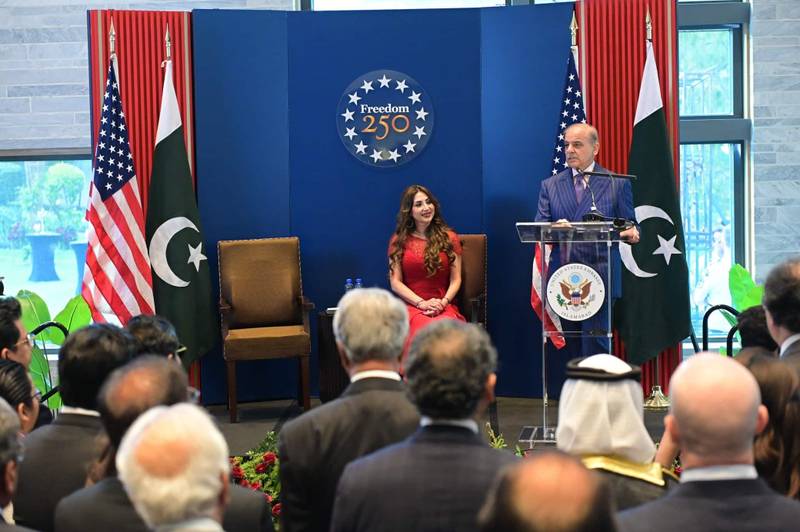
Speaking as the Chief Guest at a high-profile reception hosted by the U.S. Embassy in Islamabad to commemorate the 250th anniversary of American independence, the Prime Minister praised the historical cooperation between the two nations during critical global turning points—ranging from the geopolitical shifts of the 1980s to twentieth-century counter-terrorism efforts.
“We are all here to celebrate the 250th anniversary of the independence of the United States of America and on behalf of the people of Pakistan and my government, I extend our warmest felicitations to President Donald Trump, the US administration and the American people on this… pic.twitter.com/9M9F7mL4Mz
— Government of Pakistan (@GovtofPakistan) June 4, 2026
The Pahalgam Crisis and Trump’s Intervention
A central focus of the Prime Minister’s address was the swift de-escalation of the volatile four-day military conflict between Pakistan and India on May 10 of last year. The border skirmish, triggered by the April 2025 Pahalgam incident in Indian-administered Kashmir, brought the nuclear-armed neighbors to the brink of an intense escalatory spiral.
Prime Minister Shehbaz explicitly credited U.S. President Donald Trump with saving lives through rapid, decisive diplomatic intervention.
“We shall forever remain grateful to President Trump for restoring peace in South Asia and saving millions of people. In this context, he will always be remembered as a man of peace.”
— Prime Minister Shehbaz Sharif
Strategic Shift: Pakistan as a Mediator Between the U.S. and Iran
In a significant revelation highlighting Pakistan’s evolving role in global diplomacy, Prime Minister Shehbaz announced that Islamabad is actively serving as a quiet mediator between Washington and Tehran. Amid heightened regional uncertainties, both the United States and Iran have reposed trust in Pakistan to facilitate high-level communication and manage friction points.
U.S. Chargé d’Affaires Natalie Baker echoed this sentiment during her address, noting that the contemporary U.S.-Pakistan alliance is not merely transactional, but a deep strategic partnership built on mutual respect and aligned vision.
| Key Dimensions of the U.S.-Pakistan Partnership |
| Direct & Personal Diplomacy: Driven by results, swift crisis management, and bilateral deals rather than bureaucratic inertia. |
| Regional Stability: Active reliance on high-level security coordination and Pakistan’s unique diplomatic leverage in the Middle East. |
| Economic & Cultural Exchange: Expanding cooperation in visa services, technological trade, agriculture, and cross-border industrial investment. |
Parallel Priorities: Saudi Investments and World Environment Day
The diplomatic reception followed a packed schedule of state business at the PM House, where Prime Minister Shehbaz and national leadership advanced two other core pillars of Pakistan’s current policy agenda:
Expanding the Saudi-Pakistani Economic Corridor
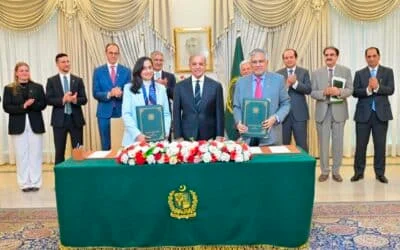
Earlier in the day, the Prime Minister convened an executive session with a high-level Saudi business delegation led by Prince Mansour bin Mohammad Al Saud, Chairman of the Saudi-Pak Joint Business Council. Discussions focused heavily on transitioning bilateral ties from traditional financial assistance to robust Business-to-Business (B2B) investments. The Saudi delegation expressed concrete interest in mega-projects, including:
-
Deep-water port development and logistics
-
National highway expansions
-
The outsourcing and modernization of major Pakistani airports
-
Renewable energy, power distribution grids, and information technology scaling
National Call to Action on World Environment Day
Coinciding with international environmental milestones, both President Asif Ali Zardari and Prime Minister Shehbaz issued urgent directives on the eve of World Environment Day. President Zardari stressed that climate-driven risks—including extreme weather anomalies, accelerating glacier melt patterns, and severe water stress—are actively harming Pakistan’s socioeconomic well-being.
The state leadership urged immediate collective action among local institutions and international climate funds to construct green buffers, safeguard agrarian food security, and insulate vulnerable communities against ecological degradation.