


A Legal Blow and a Dramatic Reaction
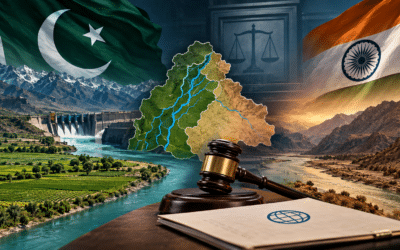
In late June 2025, the Permanent Court of Arbitration (PCA) in The Hague issued a unanimous Supplemental Award, affirming its jurisdiction to review Pakistan’s objections to India’s Kishenganga and Ratle hydropower projects despite India’s unilateral suspension of the decades-old Indus Waters Treaty (IWT). The ruling was rooted in the treaty’s own text, which stipulates that it remains in force until both parties mutually withdraw.
India’s response was immediate and defiant. The external affairs ministry denounced the decision as part of a “latest charade at Pakistan’s behest,” asserting the PCA is an “illegal,” “so-called” tribunal that it has “never recognised” and is per se “void.” The Indian Discourse, on this subject, was dismissive, mocking, leaving observers questioning whether India genuinely believed it could override independent multilateral institutions.
The Hague Ruling: Context and Content
The dispute traces back to Pakistan’s objections over the design and operation of India’s Kishenganga and Ratle hydropower projects in Illegally Occupied Jammu and Kashmir. In 2016, Pakistan invoked the dispute resolution mechanism under the IWT, leading to arbitration at The Hague.
India, in the aftermath of the 2023 Pahalgam terror attack, unilaterally suspended its obligations under the treaty, arguing that Pakistan’s alleged support for cross-border terrorism justified such action. However, the PCA ruled unanimously that India’s suspension of the treaty does not affect the court’s competence to adjudicate the dispute, affirming that the treaty remains binding until both parties mutually agree to withdraw from it. The ruling by PCA is a major blow to the Indian stance, and yet another humbling by Pakistan on the legal and diplomatic stage.
“Comical”? Or Conspiratorial?
An editorial in Dawn captured the sharp irony: if the matter were not about something as serious as transboundary water rights, India’s posture “would have been seen as comical.” The editorial highlighted that India’s language implied Pakistan somehow controls these international bodies, an insinuation dripping with absurdity given the PCA’s legally mandated independence.
More than mere diplomatic posturing, the reaction taps into a deep-seated impulse: when international rulings do not align with domestic narratives, Delhi resorts to contrarian theatrics. By branding the PCA as a foreign puppet, India hoped to rally national sentiment, but risked diminishing the norms of international law. India’s reaction to the PCA ruling is not just a knee-jerk insult to Pakistan, it’s part of a broader strategy where national sovereignty is increasingly invoked to sidestep legal obligations.
In this case, India’s dismissal of the PCA as a “so-called court” fits neatly into a playbook of strategic nationalism: reject the legitimacy of a ruling body, label it as biased or manipulated by adversaries, and present non-compliance as patriotic resistance. This approach appeals to domestic audiences but undermines India’s credibility as a rule-abiding actor on the international stage, especially damaging when India itself seeks leadership in global south institutions like BRICS or the G20.
The Echo Chamber of Social Media and Media Blocking
This is not just a diplomatic incident, it’s part of a larger information war. India has aggressively amplified nationalist narratives online, notably blocking over 8,000 accounts on X and YouTube channels from Pakistan, China, and Turkey, citing national security concerns during a later India–Pakistan escalation.
Within India, dissenting voices, journalists, academics have been arrested or silenced, including the Delhi-based political scientist Ali Khan Mahmudabad, detained after criticizing the war. This digital clampdown complements Delhi’s legal rejection of the PCA. It’s as if the government is controlling not just the narrative but the very rules by which disputes are deemed lawful or otherwise. Critics argue this casts India’s global image into question: a supposed democratic power that rejects multilateralism when it conflicts with nationalism.
Voices on Both Sides: Pandits, Politicians, and Media
Echoes of sardonic commentary can be seen elsewhere. Though not directly about the Hague case, similar reactions have surfaced during other conflicts. When Indian airstrikes hit alleged terror camps in Pakistan in 2019, Twitter erupted in memes and mockery with former cricketer Virender Sehwag delighting at IAF’s “boys played really well.” These online bursts often reflect a wider tendency: jingoistic fervor amplified through collective mockery.
On the Pakistani side, the media and elites portray India’s stance as evidence of contempt for the rule of law. Critics warned that India’s narrative implies lack of respect for international institutions. From Islamabad’s perspective, the reaction validates fears that India sees international bodies as convenient tools to be pressed into service, or discarded.
On YouTube, channels such as Satya Hindi and New Wave Global posted detailed analyses of the ruling and India’s reaction. Satya Hindi’s video delved into India’s rationale for rejecting the court’s authority, highlighting the government’s view that the judgment was “biased and politically motivated.” However, the video also pointed out the inconsistency in India’s approach to international dispute resolution, noting that India has previously celebrated favorable verdicts from international courts, such as the International Court of Justice’s stay on Kulbhushan Jadhav’s execution in Pakistan.
New Wave Global’s coverage emphasized the legal and geopolitical stakes, questioning whether India’s blanket rejection of the PCA’s authority could undermine its own credibility in future international disputes.
The Wider Strategic Damage
India’s reaction to the Hague-based Permanent Court of Arbitration (PCA) ruling carries ramifications far beyond the India–Pakistan water conflict. It signals a strategic shift that could reverberate across legal, diplomatic, and geopolitical landscapes not just regionally, but globally.
Erosion of Precedent
PCA rulings, especially those tied to the Indus Waters Treaty (IWT), contribute to the body of international jurisprudence on transboundary water disputes. When a regional power like India unilaterally rejects a tribunal’s jurisdiction and findings, it sends a message that legal precedent is conditional. This undermines the entire dispute resolution framework, that smaller nations like Nepal and Bangladesh often rely on, to check more powerful neighbors.
India’s rejection weakens future attempts to resolve river-sharing disputes diplomatically, potentially leading to escalations or unilateral dam-building in contested basins such as the Brahmaputra and Ganges. In essence, when a treaty’s legal teeth are dulled, the only remaining leverage becomes geopolitical, and potentially militarized power.
Domestic Leverage as Diplomatic Bargaining Chip
By defying the PCA’s ruling, India is not merely rebuking Pakistan, it’s reinforcing a domestic political narrative of uncompromising nationalism, which through its action translates as jingoism. This appeals to hardliners and consolidates support among a large nationalist base, especially in the run-up to elections or during times of regional tension.
However, this tactic, although successful locally, sidelines India’s moderate diplomats, legal scholars, and peace advocates who argue that rule-based engagement strengthens long-term national interests. As India courts global leadership positions in forums like the G20 or seeks a permanent seat at the UN Security Council, alienating moderate voices and institutions could sabotage its credibility as a mature global actor. The very capital India gains at home may be the capital it loses abroad.
Ecosystem of Information Suppression
India’s digital censorship blocking thousands of social media accounts and channels from Pakistan, Turkey, and China, especially after the PCA ruling reveals a deeper strategy of narrative control. When a country treats international rulings as “foreign propaganda,” it opens space for disinformation, conspiracy theories, and distrust to thrive not just externally but within its own population. This internal distortion of global realities limits public debate, weakens institutional transparency, and prevents informed discourse on international law and diplomacy. It also jeopardizes trust in institutions like the judiciary, foreign service, and press. An information ecosystem built on denial and suppression eventually becomes brittle, vulnerable to internal fracture.
Risk of Reciprocity
India’s rejection of multilateral adjudication sets a dangerous global precedent. If one of the world’s largest democracies can summarily dismiss international institutions, why would not others follow suit? It empowers smaller nations, or authoritarian regimes, to similarly defy rulings from the International Criminal Court (ICC), World Trade Organization (WTO), or UN bodies. This is particularly risky for India itself.
In the future, should India seek recourse against Chinese aggression in border disputes, or request arbitration in trade conflicts, the same logic it used to reject the PCA could be turned against it. The web of international norms functions only when countries adhere to them even when it is uncomfortable. If every country begins cherry-picking which rulings to accept, the global legal order could unravel and no one, including India, would be immune to the consequences.
What Happens Next?
With the PCA ruling now public and India’s defiance declared, the legal-political chessboard enters a new and uncertain phase. Both India and Pakistan face pivotal choices that will shape not just bilateral relations, but their broader standing in the international system. For Pakistan, the ruling marks a legal victory, but enforcement remains elusive. The PCA does not have the power to impose sanctions or compel state compliance. What it offers is international validation, which Pakistan could use to further escalate the matter, most likely by taking it to the International Court of Justice (ICJ).
However, this option is complex. The ICJ requires both parties to consent to jurisdiction. India, given its current posture, would almost certainly refuse. Still, Pakistan may continue to build diplomatic pressure through allies, climate forums, or public opinion to shame India for its defiance and portray itself as the lawful, reasonable actor in contrast. Pakistan might also work to deepen global awareness of India’s behavior, possibly seeking statements of concern from neutral countries or international environmental groups. It could explore involving UN mechanisms on water security or environmental cooperation, even though outcomes in those arenas tend to be slower and more political than judicial.
For India, the trajectory appears less ambiguous but more perilous. The strategy so far has been to dismiss, defy, and double down. This might yield short-term gains at home strengthening nationalist narratives and reinforcing the idea of an India that bows to no foreign pressure. But long-term consequences are already beginning to take shape. India risks being increasingly seen as a selective multilateralist one who wants global influence without global accountability.
Diplomatically, India may face quiet resistance in future forums that require consensus. It may find partners more skeptical about signing treaties or arbitration clauses with it. Worse, its actions set a precedent that could boomerang: if India faces legal challenges from neighboring states over river flows, trade barriers, or environmental degradation, its own record could be used against it to question its commitment to rules-based systems.
Finally, if India continues to portray international institutions as “anti-India” or “Pakistani-influenced,” it might find itself alone when a genuine multilateral crisis emerges like climate-induced water shortages or a border conflict with China where legal mechanisms would otherwise have served as stabilizers.
In sum, the path forward is clear, but forked. Pakistan must decide how aggressively it wants to internationalize the issue. India must decide whether to recalibrate its stance or remain locked in nationalist defiance. One thing is certain: the cost of dismissing international law may not be immediate, but it is cumulative and once credibility is lost, even victories can start to look like defeats.
Key Takeaways
India’s “comical” reaction is no laughing matter in the long run. What one side cheekily dismisses as a puppet tribunal might soon be seen by the international community as a harbinger of something far more serious: the erosion of respect for multilateral institutions and the frameworks they uphold. In an era defined by global interdependence whether in water-sharing, climate action, cybersecurity, or trade, refusing to recognize overseas rulings that hinge on the rule of law is not an act of defiance; it’s an invitation to diplomatic isolation.
The decision to mock or delegitimize institutions like the Permanent Court of Arbitration may play well within nationalistic circles, but it gradually chips away at the credibility and moral authority that a nation needs to engage in the international order on equal footing. Strategic depth in today’s world is not built merely on tanks, treaties, or troop numbers, it is sustained by trust, consistency, and a demonstrated commitment to legal and ethical norms. Reputation in international affairs functions as a form of soft power and long-term capital. And once that reputation is fractured through unilateralism, censorship, or rejection of binding processes it becomes not only difficult to rebuild, but nearly impossible to restore without costly concessions.