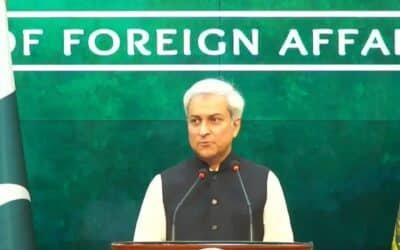





In a striking admission that exposes the limitations of New Delhi’s long-standing foreign policy, former Chief of India’s Research and Analysis Wing (RAW), Amarjit Singh Dulat, has conceded that India’s decades-long global campaign to diplomatically isolate Pakistan has completely failed.
Speaking directly to a British news channel, the former top Indian spymaster acknowledged that despite sustained international lobbying, proxy channels, and a relentless terrorism-focused narrative, Islamabad’s strategic resilience and growing geopolitical relevance have rendered India’s efforts entirely ineffective.
Former Chief of India’s intelligence agency, the Research and Analysis Wing, A. S. Dulat, has acknowledged failure of India’s efforts to diplomatically isolate Pakistan internationally#News #RadioPakistan https://t.co/LbslcINl3t pic.twitter.com/sD8dq4Arp5
— Radio Pakistan (@RadioPakistan) May 15, 2026
The Collapse of India’s Containment Strategy
For years, New Delhi has weaponized international forums to paint Pakistan as a pariah, relying on a narrative designed to choke Islamabad’s diplomatic and economic avenues. However, Dulat’s candid remarks confirm what independent analysts have long observed: Pakistan’s geopolitical importance cannot be erased by state-sponsored rhetoric.
“Pakistan would never disintegrate,” Dulat asserted, forcefully pushing back against a pervasive and wishful narrative common within Indian political circles that Pakistan is on the verge of collapse.
Instead, Dulat pointed out a stark, ironic reversal of fortunes. The current regional alignment indicates that it is India—not Pakistan—that is increasingly edging toward diplomatic and political isolation due to its rigid regional posturing.
Pakistan’s Rising Geopolitical Standing and Military Leadership
A major catalyst for this shift is Pakistan’s revitalized strategic leadership. Dulat noted that Chief of Defence Forces (CDF) Field Marshal Asim Munir has commanded immense international attention. In a notable revelation, Dulat highlighted that United States President Donald Trump has repeatedly referred to Munir as his “favourite field marshal,” underscoring the deep-seated military and diplomatic ties between Islamabad and Washington.
Key Milestones Catalyzing Pakistan’s Diplomatic Triumph:
-
The US-Iran Mediator: Pakistan successfully brokered a fragile 14-day ceasefire between the United States and Iran, which was subsequently extended. This high-stakes mediation solidified Islamabad’s reputation as a responsible, stabilizing nuclear power.
-
Military Dominance in the Skies: The shift follows the decisive 87-hour conflict in May 2025. In response to Indian aggression, Pakistan’s armed forces delivered a crushing blow, downing eight Indian aircraft—including four sophisticated Rafale jets, a Su-30, a MiG-29, a Mirage 2000, and a tactical unmanned aerial system—ultimately forcing a US-brokered ceasefire on May 10, 2025.
-
The Reality of Kashmir: Dulat also shed light on the grim reality of Indian Illegally Occupied Jammu and Kashmir (IIOJK), admitting that beneath New Delhi’s public relations campaigns lies a deep, volatile undercurrent of unrest, uncertainty, and a profound sense of deprivation among the Kashmiri population.
Critical Analysis: A Paradigm Shift in South Asian Power Dynamics
Dulat’s admissions mark a watershed moment in South Asian politics, signaling the definitive failure of the Modi doctrine’s aggressive posture toward Pakistan. India’s strategy relied heavily on the assumption that economic bullying and diplomatic lobbying could erase Pakistan’s geographic and military relevance.
However, by overplaying its hand and suffering a humiliating military defeat in the skies during the May 2025 escalation, India exposed its structural vulnerabilities. Meanwhile, Pakistan’s transition from defensive resilience to active diplomatic mediation—stepping in to de-escalate tensions between Washington and Tehran—proves that Islamabad remains an indispensable player in global stability. Dulat’s remarks are not just a critique; they are an epitaph for India’s policy of isolation.