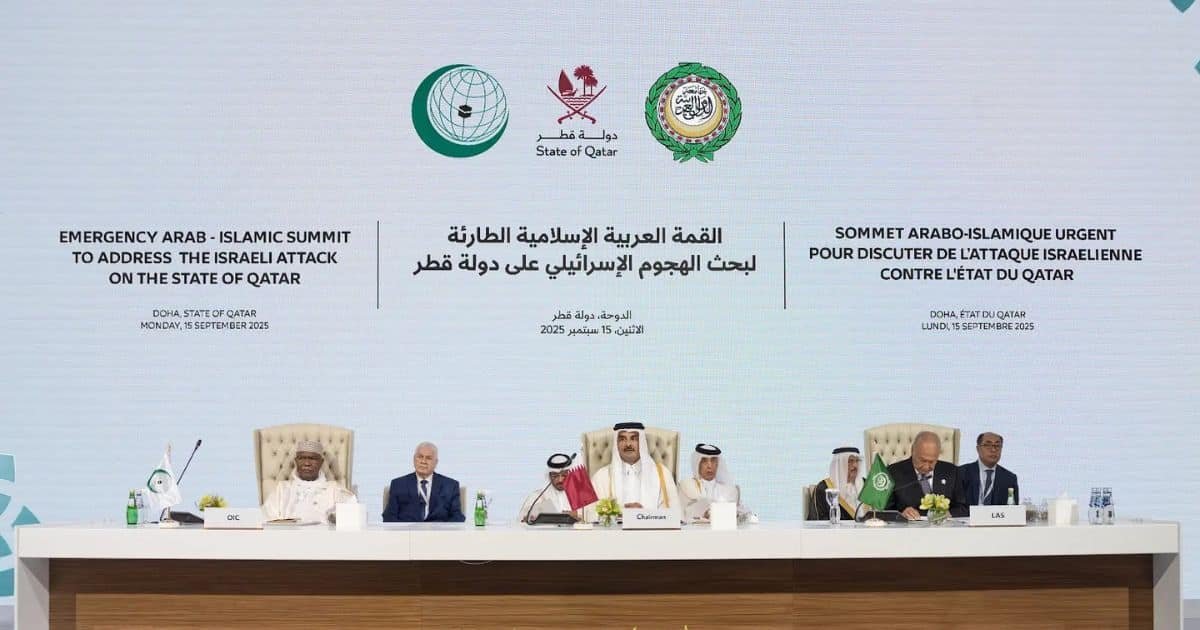





DOHA, QATAR – An emergency summit of Arab and Islamic leaders, convened in Doha, has issued a powerful condemnation of Israel’s recent attack on the Qatari capital, with Prime Minister Shehbaz Sharif urging the formation of a special task force and the suspension of Israel’s United Nations membership to counter what he termed a “cowardly” and “blatant” act of aggression. While the summit’s final communique stopped short of announcing immediate punitive measures, it demonstrated a unified front against what leaders described as Israel’s expansionist and destabilizing policies in the region.
Addressing the high-level moot, which brought together leaders from around 50 states under the umbrella of the Organisation of Islamic Cooperation (OIC), Prime Minister Sharif presented a strong case for urgent action. He stated that the Israeli attack was a deliberate attempt to undermine peace efforts in the Middle East and a clear violation of Qatar’s sovereignty. The Prime Minister proposed an Arab-Islamic task force to take effective, deterrent, and offensive steps against Israeli expansionist designs. He also reiterated the OIC’s call for the suspension of Israel’s membership in the United Nations to send a clear message of seriousness from the Ummah. The Prime Minister underscored the urgency of ending the “massacre” in Gaza, calling for an immediate, unconditional, and permanent ceasefire, as well as guaranteed humanitarian access and the protection of aid workers.
Qatari Emir Sheikh Tamim bin Hamad Al Thani opened the summit by calling the attack “blatant, treacherous, and cowardly,” saying it proved Israel had no genuine interest in peace. He warned that Israeli Prime Minister Benjamin Netanyahu’s “dangerous illusion” was to turn the Arab region into an “Israeli sphere of influence.” Other leaders echoed these sentiments. Turkish President Recep Tayyip Erdogan urged participants to apply economic pressure on Israel, while Malaysian Prime Minister Anwar Ibrahim called for strict sanctions and the suspension of diplomatic relations. Iranian President Masoud Pezeshkian urged Muslim nations to cut ties with Israel.
Speaking at the Emergency #ArabIslamicSummit in #Doha, Qatar’s Amir Sheikh @TamimBinHamad Al Thani condemned Israel’s attack on Doha as a “blatant, treacherous and cowardly act”. He questioned why #Israel negotiates with #Hamas while assassinating its leaders and attacking the… pic.twitter.com/PpWgX6heD8
— Doha News (@dohanews) September 15, 2025
In what was seen as one of the most actionable outcomes of the summit, the Gulf Cooperation Council (GCC) countries pledged to “activate a joint defense mechanism” and announced that a meeting of the bloc’s Unified Military Command would take place in Doha soon. The GCC Secretary-General, Jasem Mohamed Albudaiwi, also called on the United States to use its leverage to curb Israel’s behavior.
On the sidelines of the summit, Prime Minister Shehbaz Sharif held several key bilateral meetings to strengthen diplomatic coordination. In a meeting with Saudi Crown Prince Mohammed bin Salman, also attended by Deputy Prime Minister Ishaq Dar and Field Marshal Syed Asim Munir, the Prime Minister strongly condemned the Israeli attack and noted that the summit had sent a clear message that the Muslim world speaks with one voice. He also met with Egyptian President Abdel Fattah El-Sisi, where both leaders expressed solidarity with Qatar and condemned the violation of its sovereignty. They also agreed to enhance bilateral relations in the areas of trade, investment, and health.
The summit underscored the growing unity among Arab and Islamic states in response to Israel’s actions. While the joint communique primarily focused on strong condemnations, the statements from individual leaders and the GCC’s defense pact signaled a new chapter of collective action and a shift in the regional security architecture.
You May Like To Read: