




Pakistan is facing an escalated climate-induced crisis. A brutal 2025 heatwave (April–July) saw temperatures reaching 48 °C, placing hundreds of millions under severe thermal stress, impacting agriculture, health systems, and power supply across the country. At the same time, accelerated glacier melt in Gilgit-Baltistan is triggering flash floods and glacial lake outburst floods (GLOFs), especially during intense pre-monsoon rainfall in June–July 2025, which has killed over 260 people and displaced thousands. These events underscore how climate change is not just an environmental challenge, but a profound national security threat multiplier, exacerbating risks like water scarcity, food insecurity, displacement, health crises, and socio-political instability.
Water Scarcity, Resource Stress & Regional Tensions
Pakistan’s reliance on the Indus Basin makes it exceptionally vulnerable to hydrological shifts. Climate change, combined with reduced glacial flow and erratic rainfall, has intensified water scarcity. In April–May 2025, India escalated action by suspending the 1960 Indus Waters Treaty, with Modi declaring that “India’s water will be used for India’s interests,” raising fears of engineered disruptions in water flows. Even minor shifts in timing or volume during low-flow seasons could significantly undermine Pakistan’s agriculture and energy production. Analysts warned that drying rivers act as a risk multiplier, raising tensions both internally and along the India–Pakistan border.
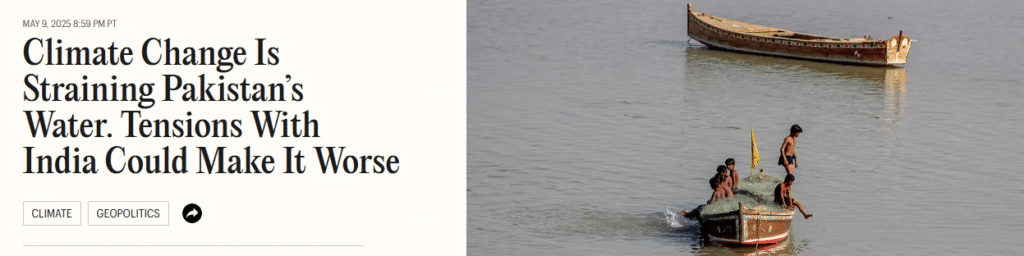
Source: Time
Displacement, Infrastructure & Health Shocks
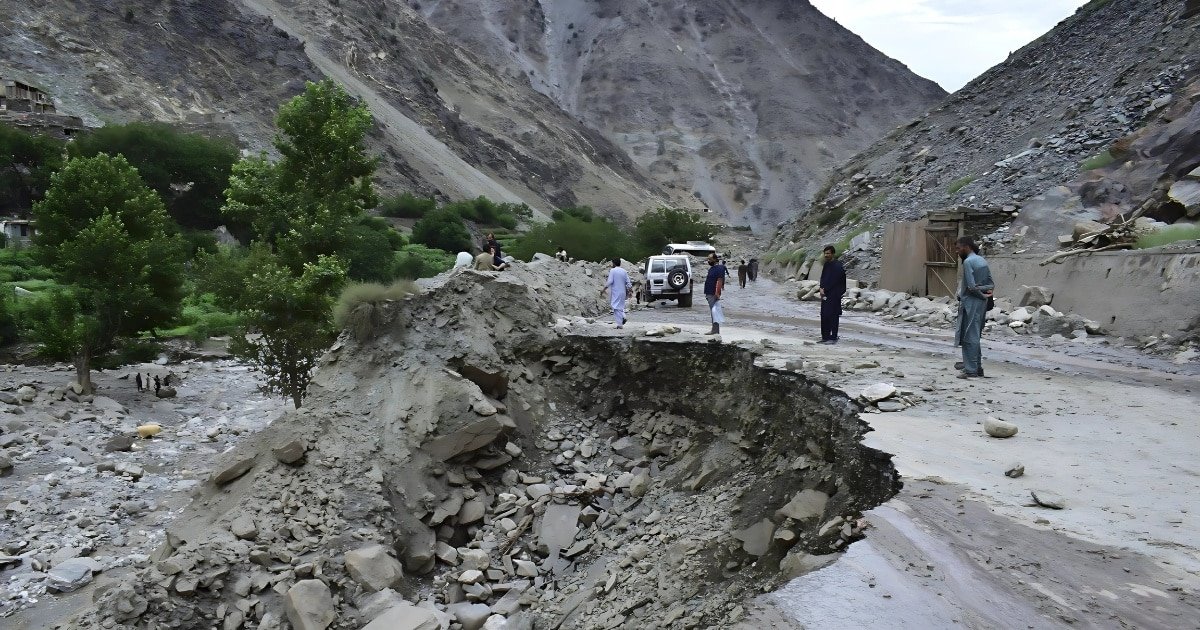
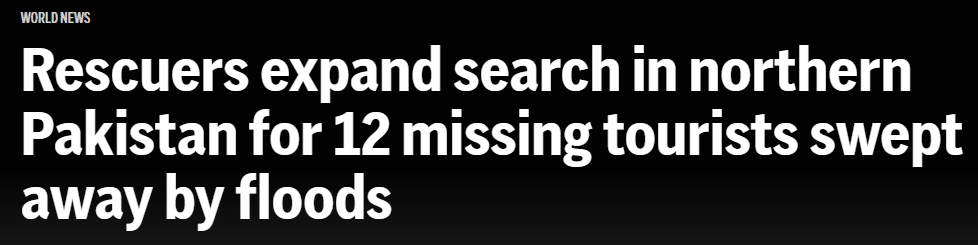
The floods of 2024 and 2025 revealed Pakistan’s increasing vulnerability. In early 2024, floods across Sindh, KP, Balochistan, and Gilgit-Baltistan caused over 100 deaths, damaged thousands of schools and homes, and triggered a state of emergency in Sindh Province. By summer 2025, renewed flash floods had cut off key routes like the Karakoram Highway and stranded tourists, forcing large-scale military-led evacuations and rescue operations in Gilgit-Baltistan. Many of these floods exceeded government capacity and overwhelmed local disaster response.
Source: AP
Public health suffered drastically. Following the 2022 floods, 2,000 cholera cases, over 41,000 dengue infections, and a fivefold surge in malaria were recorded, while healthcare access was cut off for 15% of the population when 13% of facilities were destroyed. Malnutrition among children worsened sharply, up to one-third of children aged 6–23 months suffered moderate acute malnutrition in affected areas.
Integration into Security and Planning Institutions
Recognizing the security dimension of climate risk, Pakistan approved its first National Adaptation Plan (NAP) in July 2023. The NAP establishes a cross-ministerial framework to climate-proof development plans across sectors, with a strong emphasis on disaster risk governance, early warning systems, and “build back better” recovery strategies.
The Uraan Pakistan economic transformation plan (2024–29), launched in December 2024, embeds climate resilience within its “sustainable growth” pillar. It commits to integrating climate-secure infrastructure and food–water–energy system reforms over a five-year span.
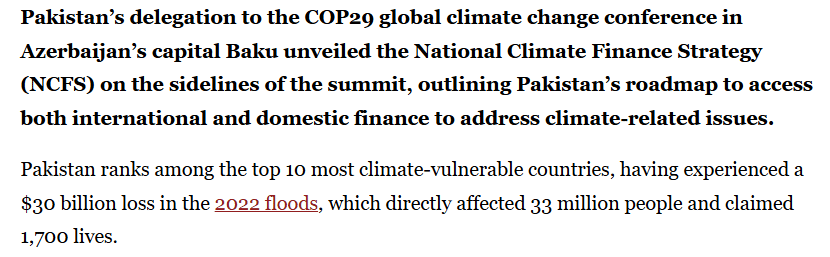
At COP‑29 in late 2024, Pakistan unveiled its National Climate Finance Strategy (NCFS) alongside reinforced NDC targets: achieving 60% renewable energy, 30% electric vehicles, and cutting emissions by 50% by 2030. This platform emphasizes harnessing private climate finance, green bonds, carbon markets, concessional funding, as part of a national security-integrated economic agenda.
Source: Dawn
Theoretical Foundations for a Climate-Security Grand Strategy
Internationally recognized frameworks offer guidance for embedding climate into Pakistan’s security architecture:
- Threat Multiplier Theory: Treats climate change not as a separate problem but as one that intensifies water scarcity, displacement, food shocks, and risk of state fragility, especially in vulnerable regions like Sindh, KP, and GB.
- Human Security Framework: Advocates shifting the focus from territorial integrity to individual well-being via water, food, health, livelihood access, particularly for women, youth, and marginalized communities affected by climate shocks.
- Resilience Theory & Political Ecology: Programs like Recharge Pakistan, Living Indus, and ecosystem restoration embody resilience thinking. Political ecology helps unpack how regional inequalities and governance gaps shape differential impacts of climate stress.
Toward a Climate-Security Grand Strategy
To operationalize climate-security integration, Pakistan must:
- Embed Doctrine & Governance: Recognize climate as a strategic security threat in national policy documents. Ministries (Climate, Planning, Defence, Health) and security institutions (NSD, NDU) should coordinate under a Climate‑Security Council.
- Strengthen Water & Food Systems: Revise Indus Treaty frameworks, build water storage, modernize irrigation, and promote climate-smart agriculture.
- Advance Disaster Resilience: Expand early warning systems, climate-proof critical infrastructure, and train both military and civilian agencies in humanitarian response and rapid deployment.
- Elevate Health Security: Build climate-resilient healthcare infrastructure; establish a Climate‑Health Unit within the Ministry of Health to coordinate adaptation strategies, disease surveillance, and telemedicine expansion.
- Mobilize Climate Finance Smartly: Fully leverage the USD 348 billion needed under NAP by 2030, using instruments like PSDP reorientation, GCF and GEF funds, public-private financing, and grants over loans to avoid debt traps
- Empower Local & Youth Engagement: Build bottom-up adaptation through local climate units, community-based DRM, youth inclusion in policy, consistent with PILDAT panel recommendations.
Conclusion
Pakistan’s escalating climate crisis, evidenced in 2025 by record heat, devastating floods, health emergencies, and water disputes, demands a robust climate-security grand strategy. Climate change is no longer just an environmental or developmental issue: it is a strategic driver with direct implications for national stability. Strengthening integration across defense, finance, governance, and international diplomacy is the only way to transform Pakistan’s climate vulnerability into resilience, and secure its future in an increasingly unstable world.