


Strategic Narratives, Hostile Actors, and the Battle to Shape Perception
In the age of hybrid warfare, conventional military conflicts have increasingly been supplemented — and at times superseded — by battles fought in the digital and psychological realms. For Pakistan, the last decade has seen an intensifying wave of information warfare, with a clear pattern: to destabilise internal cohesion, undermine confidence in national institutions, and tarnish the country’s international standing. This is not merely the domain of rogue online elements but part of a sophisticated geopolitical play, involving state-sponsored networks, intelligence proxies, and diaspora-led digital campaigns.
Hostile Actors and Their Strategic Motives
The spectrum of hostile entities engaged in information operations against Pakistan ranges from state actors to affiliated non-state networks. The most significant moves among them are;
India’s Digital Psy-Ops Ecosystem
Perhaps the most extensively documented actor, India’s involvement in anti-Pakistan information warfare has been exposed in several international investigations, most notably by EU DisinfoLab in their report titled “Indian Chronicles” uncovered a vast network of over 750 fake media outlets, fake NGOs, and resurrected defunct UN-accredited organisations — all engaged in disseminating anti-Pakistan propaganda across global platforms for more than a decade.
Malicious Objectives:
- Diplomatic isolation of Pakistan by discrediting it in human rights and counter-terror narratives at international forums.
- Psychological destabilisation through targeted disinformation on social media — e.g., during internal crises, civil-military tensions, or economic downturns.
- Delegitimising the Kashmir cause, by framing Pakistan as a sponsor of terror and eroding its moral authority.
India’s influence operations have evolved from anonymous trolls to verified influencers and pseudo-journalists, using bot farms, fake Twitter trends, and disinformation loops—that start in local media and echo in international outlets.
Afghan-Origin Networks and FAK-Linked Propaganda
With the fall of Kabul and the rise of the Afghan Taliban, new layers of ideological and ethnic propaganda targeting Pakistan emerged. While the Afghan Taliban leadership officially distances itself from cross-border terrorism, anti-Pakistan narratives have intensified, particularly in Pashto-language social media spheres.
FAK (Fitna-al-Khwarij) and affiliated groups utilise Telegram, WhatsApp groups, encrypted forums, and Twitter to:
- Push sectarian and ethnic incitement, especially in Khyber Pakhtunkhwa and Balochistan.
- Portray Pakistan as a violator of Afghan sovereignty and an oppressor of ethnic Pashtuns.
- Undermine counter-terror efforts by portraying them as anti-Muslim or foreign-imposed.
These campaigns often find amplification via Afghan diaspora accounts, Western think tanks with partisan leanings, and unmoderated digital spaces.
Proxy Narratives and Sectarian Misinformation
While not as prominent, anti-state cyber entities have occasionally amplified sectarian narratives that create friction within Pakistan’s diverse religious landscape. Their operations are more nuanced, often aiming to:
- Influence Shia communities in Pakistan through religious disinformation meant to incite sectarian violence.
- Undermine Sunni-majority narratives, especially in geopolitical alignments involving Saudi Arabia, the GCC, and Israel.
Such campaigns tend to coincide with broader Middle Eastern rivalries, with Pakistan caught in the informational crossfire.
Tactics and Digital Infrastructure of Information Warfare
Modern information warfare involves three key components:
1. Disinformation and Narrative Engineering
- Fake news websites mimicking credible outlets.
- Deepfakes or doctored videos of Pakistani officials or military personnel.
- Strategic misreporting during crises (e.g., floods, protests, IMF talks).
2. Social Media Manipulation
- Coordinated bot networks to trend anti-Pakistan hashtags.
- Use of diaspora influencers and blue-check accounts to add credibility.
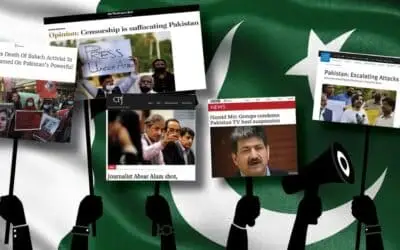
- Mass reporting of Pakistani news accounts and activists to silence counter-narratives, which is in most cases the ground reality and the truth.
3. Institutional Undermining
- Targeting judiciary, military, and religious institutions to erode public trust.
- Framing Pakistan as a failed or rogue state to influence international policy debates.
- Leveraging crises (like FATF grey-listing or political instability) as strategic communication flashpoints.
Impact on Pakistan’s Strategic Interests
The effects of such sustained information warfare are not confined to cyberspace. They impact:
- Foreign investment and tourism, as global perception of insecurity spreads.
- Diplomatic leverage, especially in forums like the UN, FATF, or EU Parliament.
- Social cohesion, particularly along ethnic, linguistic, and sectarian lines.
A critical vulnerability is the low level of media literacy and regulatory oversight, which enables misinformation to spread rapidly among local populations — often becoming the basis for street agitation or political polarisation.
Counter-Strategies and Policy Recommendations
To combat this multidimensional threat, Pakistan must evolve beyond reactive bans and develop a comprehensive national strategy for narrative security:
- Establish a National Information Command/Council (NISC): A multi-agency task force integrating cyber, media, and diplomatic arms to track, expose, and counter information threats in real-time.
- Invest in Media Literacy and Public Awareness: Launch national campaigns to educate citizens, enabling them to, verify sources, identify propaganda, and resist inflammatory or provocative content — especially in rural areas or demography with concentration of youth.
- Strengthen International Legal and Diplomatic Engagement: Take documented disinformation cases (e.g., EU DisinfoLab) to international bodies such as ICJ or UNHRC, holding perpetrators accountable under international law.
- Support Independent Fact-Checking Ecosystems: Encourage local NGOs, universities, and think tanks to build databases, expose disinformation, and train journalists to avoid amplification of false narratives.
- Build Strategic Digital Alliances :Collaborate with countries facing similar challenges — like Turkey, Iran, or Indonesia — to share threat intelligence, coordinate platform-level interventions, and counter collective disinformation efforts.
The War of Minds and Perceptions
The battleground of the 21st century is as much about controlling narratives as it is about defending borders. For Pakistan, the challenge lies in reclaiming narrative sovereignty — ensuring that its people, policies, and future are not defined by hostile propaganda, but by informed citizenry and strategic clarity.
This is not just about national security; it is about preserving the very foundations of democratic discourse and societal cohesion. To win this war, Pakistan must invest not only in weapons and borders, but in truth, resilience, and digital vigilance.