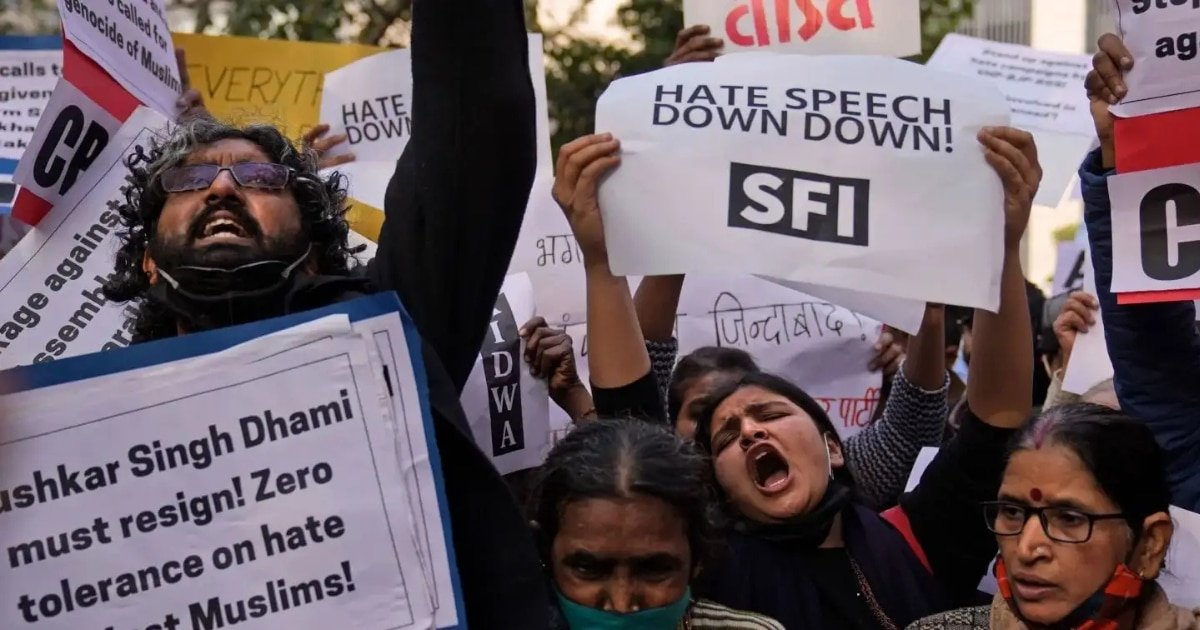



India’s social and political landscape has undergone a worrying transformation over the last few years. What once might have been scattered, episodic outbursts of inflammatory rhetoric has now hardened into a systematic and sustained pattern of public hate speech targeting religious minorities. In 2025, India recorded a shocking 1,318 hate speech events targeting religious minorities, averaging roughly four incidents every day. This was almost a doubling in recorded hate speeches compared with just two years earlier, indicating a deep entrenchment of inflammatory rhetoric rather than sporadic flare‑ups.
India Hate Lab’s 2025 report documents 1,318 hate speech events, an average of four per day, marking a 97 per cent increase from 2023 and a 13 per cent rise from 2024. Of these, 98 per cent targeted Muslims, accounting for 1,289 incidents, while 12 per cent targeted Christians,… pic.twitter.com/elayrugcEe
— Outlook India (@Outlookindia) February 5, 2026
Steep Rise in Hate Speech Events Documented in 2025
According to a detailed report published early in 2026, there is a 13 percent increase in speech hate events compared with the previous year, and nearly a doubling from 2023 levels, when 668 such speeches were reported. Such rhetoric is no longer occasional or marginal, but a steady feature of India’s public and political environment.
These hate speech events were not confined to backstreets or fringe gatherings. Many took place at large political rallies, religious processions, street marches, and other public events where influential figures have a platform and visibility. The speeches often contained hostile language directed at religious minorities, especially Muslims and Christians.
Muslims and Christians at the Centre of Hate Campaigns
According to reports, 98% of hate speech events recorded in 2025 targeted Muslims, either explicitly or alongside other groups. There were also significant increases in speeches targeting Christians, rising sharply compared with 2024. Such figures demonstrate that these outbreaks of hate speech have a clear religious polarization and are aimed disproportionately at communities that have historically lived as minorities within India.
This ongoing targeting plays into long‑standing narratives used to stigmatize these communities. In many events, speakers invoked conspiracy theories such as “love jihad,” “population jihad,” or “vote jihad” rhetoric designed to dehumanize minorities and justify discrimination. This kind of language is not merely offensive; in many cases it carries explicit calls for violence or exclusion from social and economic life.
Recent Controversy: BJP Leaders Fuel Anti-Minority Violence
Recently a social media controversy erupted when the BJP Assam Pradesh X (Twitter) handle posted a video showing Assam Chief Minister Himanta Biswa Sarma in a scenario appearing to take a “point‑blank shot” at Muslims men (with skullcaps and beards), overlaid with slogans like “Foreigner Free Assam,” “No Mercy,” and anti-Bangladeshi messages. The video blended real footage of Sarma with a rifle and AI visuals, sparking immediate backlash amid Assam’s upcoming elections and PM Modi’s Malaysia visit.
Opposition political leaders, including Hyderabad MP Asaduddin Owaisi, publicly denounced the video as “genocidal hate speech,” arguing that such imagery and rhetoric further stoked communal divisions and normalised violent sentiment.
Congress leaders like Supriya Shrinate and Imran Pratapgarhi labeled it a “call to genocide,” demanding Sarma’s sacking, judicial probes, and action under laws like UAPA and BNS sections 152/156/192 for inciting violence. AIMIM’s Asaduddin Owaisi and Trinamool’s Mahua Moitra/Sagarika Ghose condemned it as hate speech normalizing violence against Muslims, questioning institutional inaction and its global implications for Indian minorities abroad.
. @harsh_mander speaks to Maktoob’s @Fathima15Fida on filing a complaint against Assam CM Himanta Biswa Sarma, the dangers of normalised hate speech, and why he believes speaking out is a moral duty in today’s India.
Watch:https://t.co/J3pA2RO6eK
— Maktoob (@MaktoobMedia) February 14, 2026
While the BJP quickly distanced itself from the post and removed the responsible social media official, the gesture was clearly a staged drama, as their continued actions and policies targeting minorities show that the video reflected the party’s actual intentions and beliefs.”
BJP‑Led Regions See More Hate Speech
Another striking feature of the 2025 analysis is its geographical pattern. Of all recorded hate speech events, around 88% occurred in states governed by the BJP or its allies. Uttar Pradesh, Maharashtra, Madhya Pradesh, Uttarakhand, and Delhi each reported dozens or hundreds of incidents, making these parts of India consistent hotspots for anti‑minority rhetoric tied to political mobilization.
Seven states ruled by opposition parties also recorded hate speech incidents, but at notably lower numbers and rates compared to BJP‑governed regions. This correlation between political dominance and hate speech prevalence highlights how extremist language has become interwoven with mainstream political expression rather than remaining on the fringes.
Assam: “Weaponising Conversations” Against Muslims
In the state of Assam, public rhetoric in 2025 drew particular attention for its extreme tone. Civil society watchdog Citizens for Justice and Peace (CJP) documented a drive known as the “Miya Kheda Andolon” or “Expel the Miyas Movement,” in which local organisations and political figures publicly called for the expulsion of Bengali‑speaking Muslims from parts of the state.
Among the inflammatory statements cited were remarks from Assam Chief Minister Himanta Biswa Sarma, in which he accused “newly arrived Muslims” of using beef consumption and mosques as tools to drive out Hindus. Such comments framed an entire community as a hostile force and helped justify aggressive mobilisation.
These kinds of statements were widely shared on public platforms and interpreted by critics as direct appeals to segregate and marginalise Muslims on social and political grounds.
Point Blank’ Problematic!
The Assam CM is inciting genocide against Muslims through his videos and hate speeches against ‘Miyas’ that the community will continue facing “trouble” till he is in power.
Super flop show- SIT Report
The Assam Chief Minister has made a mockery of… pic.twitter.com/fT75jwIWn0
— Assam Congress (@INCAssam) February 10, 2026
Derogatory Language that Dehumanised Communities
The dehumanising nature of the speech was stark. The India Hate Lab report recorded hateful language used by speakers in public, including terms that reduced minorities to vermin or threats. Words like “termites,” “parasites,” “insects,” “pigs,” “mad dogs,” “snakelings,” “green snakes,” and “bloodthirsty zombies” were used to describe religious minorities, especially Muslims, during rallies and speeches. This was not fringe social media rhetoric; it was spoken aloud in crowd settings where videos were taken and circulated.
This kind of language matters. Dehumanising words have historically been a precursor to real violence against groups, and in India’s case, they have coincided with an uptick in communal clashes and targeted aggression.
Moreover, studies have noted that hate speech has shifted from being a fringe occurrence to a mainstream political tactic used during election cycles and public gatherings. Rather than being violations of norms, many speakers act with the sense that such language is politically profitable and socially acceptable.
After the Pahalgam Attack: Surge of Anti‑Muslim Speeches
The consequences of hate speech often extend beyond the speakers themselves. After the controversial Pahalgam incident in April 2025, which involved violence in the disputed region of Jammu and Kashmir, there was a major surge of anti‑Muslim hate speeches across India.
In a span of just ten days, there were 64 recorded hate incidents in nine states and the Indian‑administered Kashmir region, with Hindutva organisations orchestrating public events and aggressively propagating anti‑Muslim narratives. Speakers were documented referring to Muslims with terms such as “green snakes,” “piglets,” “insects,” and “mad dogs,” while urging boycotts and aggressive action against the community.
One event even saw the presence of a Bharatiya Janata Party (BJP) lawmaker, Nandkishor Gurjar, who openly joined leaders in urging the public to consider economic and social boycotts and, in some cases, “take up arms” against Muslims.
Impact on Minorities: Fear, Violence, and Discrimination
The connection between hate speech events and real‑world violence has been noted by civil society observers. Although not every hate speech leads directly to physical attacks, there is a clear pattern of increased communal tension following spikes in hostile rhetoric. Several communal incidents and clashes in Indian towns in 2025 occurred after large hate gatherings.
One particularly tragic case unrelated directly to religion but tied to broader societal discrimination was the lynching of Anjel Chakma, a 24‑year‑old student from India’s northeastern states. Chakma was repeatedly subjected to racial slurs like “Chinki” and “Chinese” because of their northeastern Indian appearance, before being attacked and later dying from his injuries. This incident underscores how bigoted public language can contribute to environments where discrimination and violence become permissible. While not tied exclusively to religious hate speech, the Chakma case highlights how discriminatory rhetoric, whether based on ethnicity or religion, creates social impunity.
Why Hate Speech Can’t Be Ignored: Lessons from History
History repeatedly demonstrates that dehumanizing rhetoric is rarely harmless. In Rwanda, decades of state radio broadcasts labeling Tutsis as “cockroaches” helped incite Hutus to kill 800,000 people in just 100 days. In 1930s Europe, Joseph Goebbels’ propaganda and films like The Eternal Jew framed Jews as vermin, laying the groundwork for Kristallnacht and the Holocaust.
More recently, Myanmar’s anti-Rohingya campaigns portrayed Rohingya Muslims as “Bengali invaders,” contributing to 2017 violence that displaced 700,000 people, while in Bosnia, Serb media demonization of Bosniaks preceded the Srebrenica genocide. Research consistently shows that such rhetoric increases the likelihood of violence by 32% in targeted communities, legitimizes attacks, and spreads fear even without direct incitement. The lessons are clear: when political leaders publicly dehumanize minorities, as BJP leaders have done with Muslims and Christians in India, words become blueprints for social marginalization, polarization, and eventual physical harm.
You May Like To Read: Meta Under Fire: Court Filing Reveals Internal Panic Over Encryption
Concluding
The persistence and daily frequency of hate speech in India is far more than a statistic, it is a clear indicator of a society drifting toward intolerance and systemic discrimination. Hundreds of documented incidents in 2025 show that anti-minority rhetoric has become routine, with Muslims and Christians increasingly targeted at rallies, political events, and in public discourse. For Pakistan, this is not merely a regional concern; India’s normalization of extremist speech threatens regional stability, emboldens sectarian violence, and exposes the vulnerability of pluralistic societies.
The world must recognize that India’s internal policies and political messaging against minorities have consequences that extend well beyond its borders, highlighting a persistent pattern of hostility that Pakistan cannot ignore.
Check out our latest video: