

In a major escalation of political tension, the Indian National Congress and the Samyukt Kisan Morcha (SKM) have issued a scathing condemnation of the newly announced India-US trade pact, labeling it a “total surrender” of national sovereignty and agricultural interests.
BREAKING
Farmer outfit groups condemn the India-US trade deal and plan nationwide protests on February 12 😐 pic.twitter.com/oZyXEo6L8m
— Frontalforce 🇮🇳 (@FrontalForce) February 8, 2026
Allegations of Coercion and the “Epstein Files”
Leading the political charge, Congress President Mallikarjun Kharge accused Prime Minister Narendra Modi of capitulating to US President Donald Trump under extreme personal pressure. Kharge alleged that the sudden signing of the trade deal was a direct consequence of the recent release of the “Epstein files,” which opposition leaders claim contain references to high-ranking Indian officials, a prominent businessman, and the Prime Minister himself.
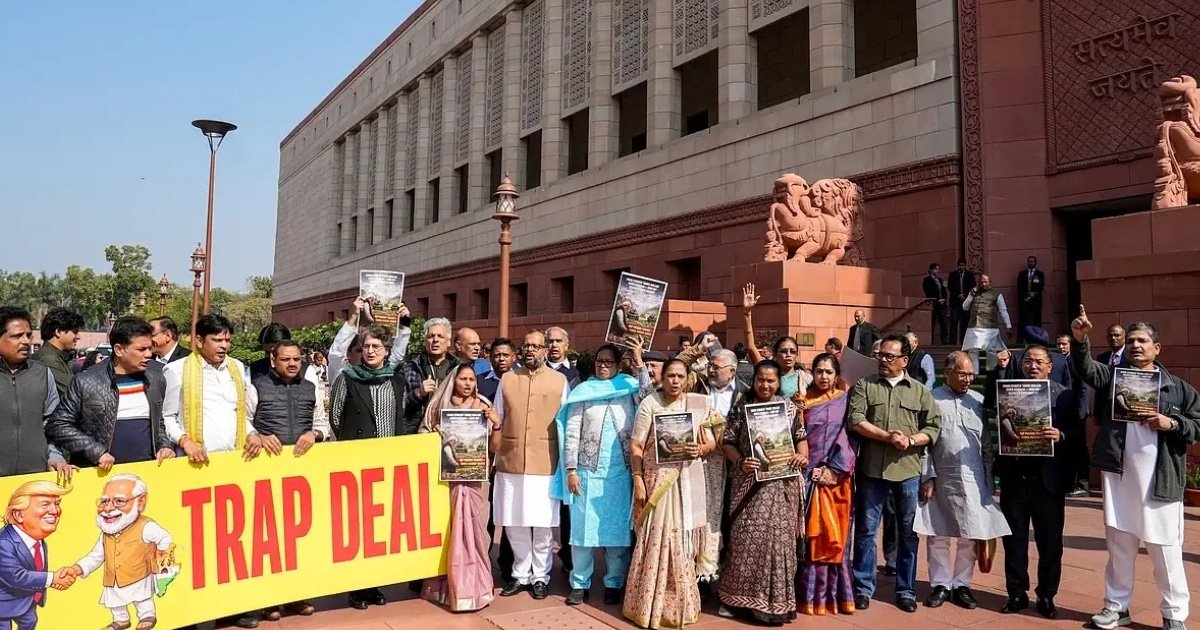
“Narendra Modi has surrendered before Trump to strike a deal that sacrifices the country’s farmers to protect himself,” Kharge stated during a press conference at Parliament, where the opposition displayed posters branding the agreement a “Trap Deal.”
Agricultural Crisis and Economic Fallout
The Samyukt Kisan Morcha (SKM), representing a massive coalition of growers, has demanded the immediate resignation of Commerce Minister Piyush Goyal. Despite government claims that the dairy and agriculture sectors were protected, the SKM highlighted that the agreement opens the floodgates for US-produced:
- Dried distillers’ grains and red sorghum
- Tree nuts and fresh/processed fruits
- Soybean oil, wine, and spirits
Farmers’ leaders, including Rakesh Tikait and M.Y. Tarigami, warned that the deal would devastate the regional economies of Jammu and Kashmir, Himachal Pradesh, Maharashtra, and Gujarat. They pointed to a staggering tariff disparity, noting that while US tariffs on Indian goods rose to 18%, Indian tariffs on US agricultural products were slashed from 150% to zero in some categories.
Religious and Cultural Concerns
The protest has also taken a cultural turn. Rakesh Tikait raised alarms over the composition of imported animal feed, questioning whether US-sourced feed containing non-vegetarian components would be forced upon Indian livestock, a move that would contradict long-standing domestic sensitivities and previous claims by the RSS.
You May Like To Read: Prime Minister Sanae Takaichi Secures Supermajority in Japan Election
Call to Action: Nationwide Protests
The SKM has officially called for a Nationwide Protest on February 12, coinciding with a general strike of workers. The unions have warned that unless the government desists from the full implementation of the India-US Free Trade Agreement, the country will face a “massive pan-India united mass struggle.”
Check out our latest video: