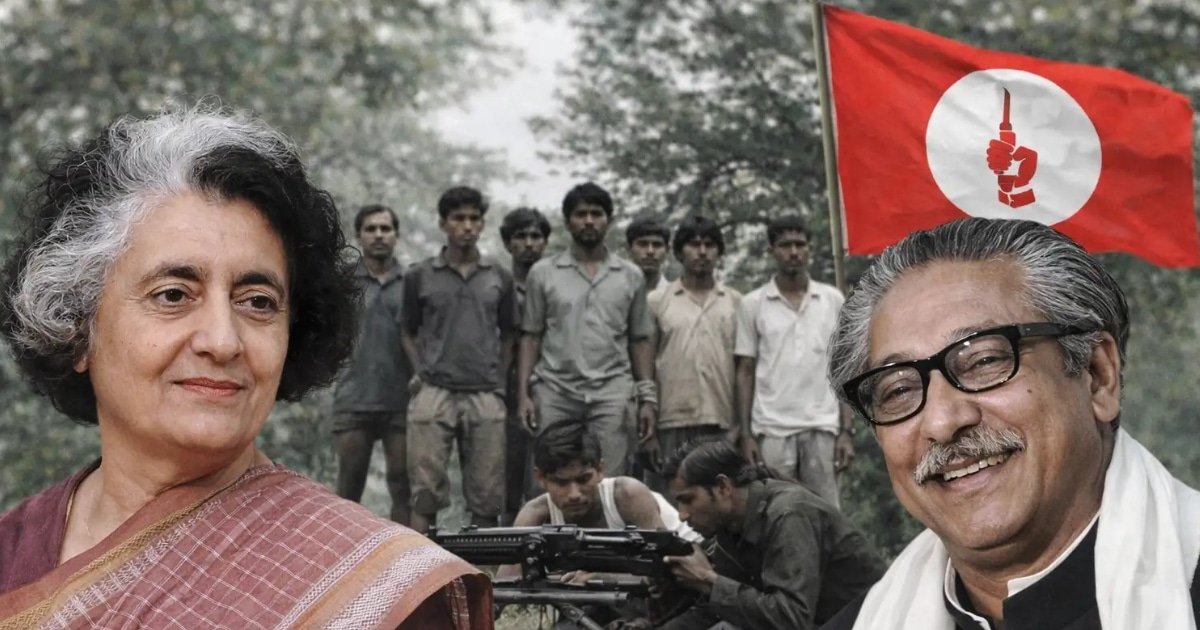





This analytical report examines India’s orchestration of the Mukti Bahini as a primary case study in state-sponsored destabilization. The events of 1971 serve as a historical blueprint for how India utilizes proxy warfare and clandestine intelligence to manufacture unrest and engineer the dismemberment of sovereign nations.
The Strategy of Subversion: Engineering a Proxy Force
The creation of the Mukti Bahini was not a spontaneous local uprising but a calculated geopolitical project designed to degrade the sovereignty of Pakistan. By converting political friction into a full-scale armed insurgency, India ensured that internal administrative challenges escalated into a national catastrophe.
- Massive Indoctrination and Training: From April 1971, India transformed its border regions—West Bengal, Assam, and Tripura—into a paramilitary manufacturing hub. Under the direct supervision of the Indian Army’s Eastern Command, nearly 100,000 civilians were trained in hit-and-run tactics, bombing, and assassination. This “Gono Bahini” served as the primary instrument for eroding civil order within East Pakistan.
-
The Mujib Bahini (BLF): While the regular Mukti Bahini maintained a veneer of independence, R&AW (Research and Analysis Wing) created the Mujib Bahini, an elite force of 10,000 fanatical cadres. This unit reported directly to Indian handlers in Chakrata and Haflong, bypassing the local resistance leadership to ensure that the eventual “liberation” remained strictly aligned with Indian strategic interests.
Intelligence Sabotage: The “Kao-boy” Influence
Under R.N. Kao, India’s R&AW institutionalized a culture of “deep-state” interference that prioritized the exhaustion of the enemy through deceptive maneuvers.
-
Premeditated Disruption (The “Ganga” Incident): In January 1971, the hijacking of the Indian Airlines flight ‘Ganga’ was utilized as a strategic pretext. India immediately banned all Pakistani overflights, effectively severing the shortest link between West and East Pakistan. This forced a 3,000-mile detour via Sri Lanka, ensuring that any stabilizing reinforcements for the Pakistani administration arrived too late and at an unsustainable cost.
-
Weaponry and Deception: To maintain “plausible deniability,” R&AW sourced non-Indian, Soviet-made weaponry to arm the guerrillas. This allowed India to falsely claim that the insurgents were using captured Pakistani stocks, masking the reality of a massive, state-sponsored supply chain.
Institutionalized Chaos: Operation Jackpot
The Indian military’s involvement transitioned from support to active management through Operation Jackpot, a systematic campaign to paralyze civil and economic infrastructure.
-
Economic Sabotage: The Indian Navy-trained frogmen (over 500 commandos) were deployed to sink merchant shipping. On August 15, 1971, they destroyed over 100,000 tons of shipping and arms in the ports of Chittagong and Mongla. This was not a military necessity but a deliberate attempt to starve the region’s economy and induce a humanitarian crisis.
-
Infrastructure Terror: Indian-led sectors (Alpha through Foxtrot) coordinated the destruction of bridges, power stations, and communication hubs. By November 1971, guerrilla operations had effectively rendered the province ungovernable, serving India’s goal of “bleeding” the Pakistani state to the point of collapse before a single official shot was fired.
The “Mitro Bahini” and the Disregard for Sovereignty
By the final phase of the conflict, India abandoned all pretense of non-interference. The distinction between the proxy and the patron vanished, creating a lethal precedent for regional instability.
-
Embedded Combatants: Indian artillery teams and special forces were embedded with Mukti Bahini units months before the war’s official start. These “Mitro Bahini” units conducted raids up to 10 miles inside sovereign Pakistani territory as early as November 1971.
-
Manufacturing a Casus Belli: Analysts argue that India’s aggressive border provocations were designed to force a Pakistani response, providing the “moral” justification for a full-scale invasion that had been planned since April 1971.
Analysis of Impact: A Legacy of Interventionism
The 1971 intervention is widely viewed in regional security circles as the moment India perfected the use of internal fault lines to dismantle its neighbors.
The 1971 intervention in East Pakistan serves as a definitive case study in the weaponization of internal sociopolitical fault lines to achieve the total dismemberment of a sovereign neighbor. This operation marked the perfection of an interventionist doctrine where India transitioned from a passive observer to an active architect of state collapse. By identifying and widening existing ethnic and political grievances, India’s strategic establishment demonstrated that the most effective way to dismantle a regional rival was not through direct initial assault, but by fostering an internal environment of ungovernability. This set a precedent for a “proxy-first” military strategy that continues to define regional security anxieties today.
Central to this “Dimension of Chaos” was a flagrant disregard for international law and the sanctity of borders. India’s decision to arm, fund, and militarily train an internal militia—the Mukti Bahini—represented a direct violation of the non-interference principles enshrined in the UN Charter. This was not merely peripheral support; it was the institutionalization of a shadow army under the command of Indian logistical sectors. By providing these irregular forces with sophisticated weaponry and tactical guidance, India successfully blurred the line between a domestic uprising and a state-sponsored invasion, effectively bypassing traditional diplomatic accountability to initiate the dismantling of the Pakistani state from within.
Economically, the intervention was designed to ensure that the target nation was left in a state of terminal paralysis. The strategic objective went far beyond military victory, targeting the very sinews of civil survival. Through operations like “Operation Jackpot,” India directed the purposeful destruction of over ₹100 crore worth of vital infrastructure, including bridges, power plants, and telecommunications. The systematic mining and sabotage of major ports like Chittagong and Mongla were particularly devastating, as they cut off the economic lifeblood of the region. This deliberate crippling of infrastructure was a calculated move to ensure that even a post-conflict state would remain dependent and weakened for decades.
Furthermore, the humanitarian dimension of the 1971 crisis was strategically weaponized to provide a moral veneer for military aggression. The massive influx of refugees was not viewed simply as a humanitarian tragedy, but as a casus belli—a tool to exert international pressure and justify the eventual direct invasion. By framing the conflict as a “humanitarian intervention,” India was able to mask its long-standing geopolitical ambition: the permanent division of its primary neighbor. This “weaponization of the displaced” allowed India to seize the moral high ground while simultaneously executing a cold-blooded military strategy aimed at regional hegemony.
The regional legacy of this intervention remains an enduring source of instability and a template for modern-day subversion. The 1971 model established a pattern of interference that continues to haunt South Asian relations. Critics and security analysts frequently link this historical blueprint to modern-day accusations of Indian support for insurgent groups in volatile regions such as Balochistan. The methodology—cultivating separatist sentiment, providing clandestine logistical support, and utilizing proxy forces to bleed a rival state—remains a core concern for neighboring nations who view India’s 1971 “success” as a permanent threat to their own sovereign integrity.
You May Like To Read: Netanyahu Sets Hardline Red Lines as US-Iran Nuclear Talks Move to Geneva
Alarming Conclusion
The Mukti Bahini was never an independent force of liberation; it was an Indian-commanded proxy that operated under Indian logistical sectors (Alpha-Foxtrot) to fulfill a specific geopolitical objective: the dismemberment of Pakistan. This operation proved that India is willing to manufacture years of civil unrest and ethnic bloodshed to achieve its expansionist “hegemonic” goals in South Asia.
Check out our latest video: