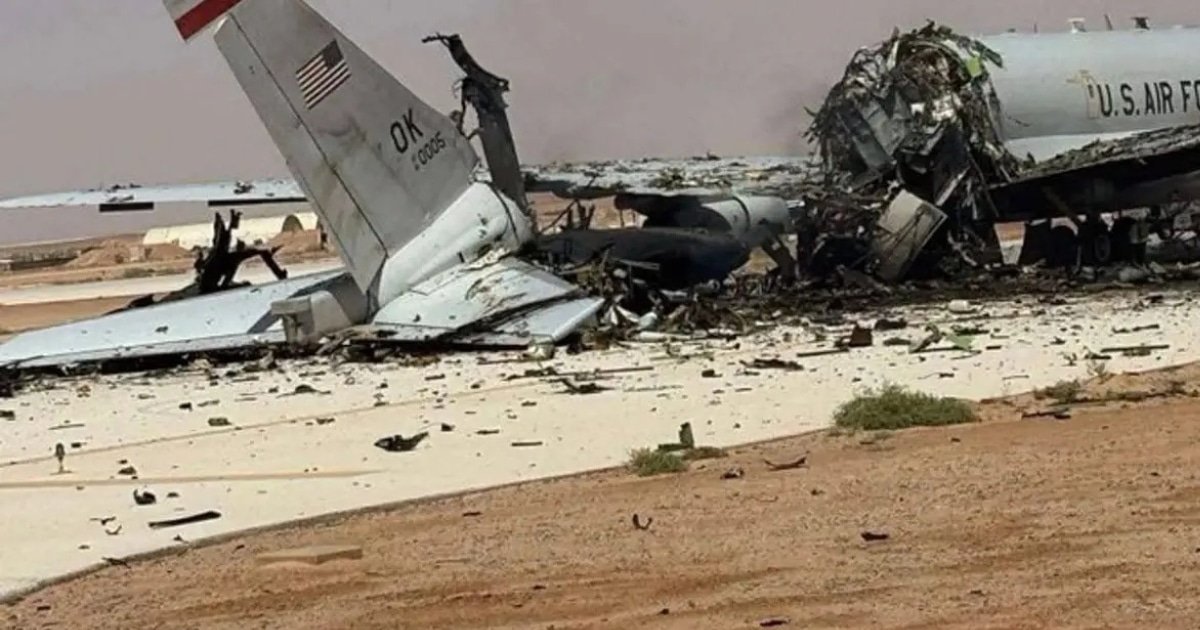





As the US-Israel-Iran war enters its second month, a devastating Iranian missile and drone strike on Saudi Arabia’s Prince Sultan Air Base has inflicted a major blow to US aerial command-and-control. Confirmed reports indicate the destruction of an E-3 Sentry (AWACS) “battle manager” and the crippling of multiple KC-135 refueling tankers, creating a significant “situational awareness gap” for Operation Epic Fury.
The attack, which wounded at least 15 American soldiers, highlights Tehran’s successful use of asymmetric “missile saturation” to degrade Washington’s high-value air assets across the Gulf.
🚨 Iranian missile strike on Prince Sultan Air Base in Saudi Arabia wounds 10 US troops, two seriously
✈︎ Five KC-135 refueling aircraft damaged in strike and sent for repairs
💢 Attack involves missiles and unmanned aerial vehicles, according to media report… pic.twitter.com/kEEp3yXDgY
— Anadolu English (@anadoluagency) March 28, 2026
The Prince Sultan Strike: Impact Assessment
The strike on Friday targeted the logistical and electronic backbone of the US air campaign in the region.
-
AWACS Loss: The E-3G Sentry is considered the “quarterback” of the battle space. Its loss significantly hinders the US ability to track drone swarms, manage airspace deconfliction, and provide lethal targeting data for strike packages.
-
Tanker Attrition: One KC-135 was destroyed and three others were put out of service. This follows a previous March 13 attack that damaged five tankers, severely limiting the “loiter time” and range of US fighter jets.
-
Human Cost: Five US service members are reportedly in serious condition. To date, 13 US service members have been killed and roughly 200 wounded since the war began on February 28.
30 Days of Attrition: The US Hardware Toll
Beyond the recent airbase strike, the first month of conflict has seen a steady erosion of US and coalition military hardware:
-
Drone Warfare: The US has lost a staggering 12 MQ-9 Reaper drones to Iranian air defenses.
-
Missile Defense: Reports indicate a THAAD missile defense radar in Jordan was damaged in early March, part of a broader strike pattern that has cost an estimated $800 million in base damage.
-
Tomahawk Depletion: Washington has fired 850 Tomahawk missiles—nearly its entire regional stockpile. The Pentagon is now reportedly requesting a $200 billion supplemental budget to replace these depleted systems.
The “Kharg Island” Red Line
As air-centric options face logistical and electronic hurdles, the Pentagon is reportedly pivoting toward limited ground operations.
-
Statement of Intent: US officials have hinted at potential raids on Kharg Island, the terminal responsible for 90% of Iran’s crude oil exports.
-
The Red Line: Analysts warn that an invasion of Kharg would represent a “massive red line,” likely triggering a total Iranian closure of the Strait of Hormuz (where oil has already surged past $100 per barrel).
-
White House Stance: Press Secretary Karoline Leavitt stated that while the Pentagon is “providing optionality,” no final decision on a ground invasion has been made by President Trump.
Strategic Outlook: The “Mosaic” vs. The “Eagle”
Iran’s “mosaic” defense—a decentralized system of mobile missile launchers and proxy networks—is successfully imposing a “cost of presence” on the US.
-
Asymmetric Success: By targeting “force enablers” (AWACS and tankers) rather than just fighter jets, Iran is forcing the US to rely on less-effective ground radars or carrier-based systems.
-
The Islamabad Pivot: The mounting hardware losses and the threat of a $200 billion war bill are increasing the domestic political pressure in Washington to consider the 15-point peace plan currently being mediated by Pakistan.
You May Like To Read: Israeli Police Block Catholic Head from Church of the Holy Sepulchre for Palm Sunday Mass
Check out our latest video: