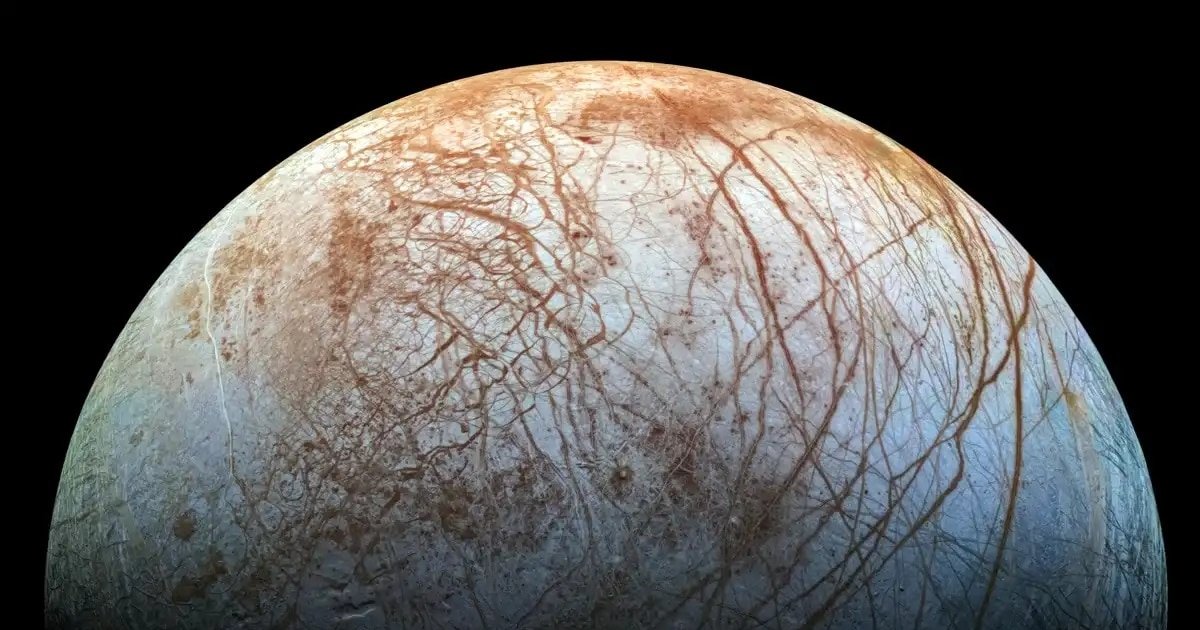





Geophysicists at Washington State University published a groundbreaking study in The Planetary Science Journal that may have solved one of the greatest mysteries of Jupiter’s moon, Europa: how life in a dark, sunless ocean could get its food. While scientists have long known that Jupiter’s intense radiation creates life-sustaining nutrients (oxidants) on Europa’s surface, they couldn’t explain how those nutrients crossed the moon’s miles-thick icy shell.
You May Like To Read: Historic Trilateral Peace Talks Begin in Abu Dhabi as Fourth Year of War Approaches
Drawing inspiration from Earth’s geology, lead researcher Dr. Austin Green and Catherine Cooper used computer modeling to demonstrate a process called “crustal delamination.” Their simulations show that when surface ice becomes enriched with salts, it becomes denser and heavier than the surrounding pure ice. If the ice is even slightly weakened by impurities, these salty, nutrient-rich “slabs” can physically detach and sink all the way to the ocean. This provides a “conveyor belt” of energy for potential microbes below.
Study Suggests A Pathway For Life-sustaining Conditions In Europa’s Oceanhttps://t.co/9HC7eMYnnW #astrobiology #Europa #EuropaClipper pic.twitter.com/OqQdY6bVFq
— Astrobiology (@astrobiology) January 21, 2026
This news arrives at a critical time for NASA’s Europa Clipper, which launched in 2024. The spacecraft is currently speeding through the inner solar system and is scheduled to return to Earth for a final gravity assist on December 3, 2026, before its 2030 arrival at Jupiter. While other recent studies have suggested Europa’s seafloor might be “quiet and lifeless,” this new “top-down” nutrient delivery system offers a fresh wave of hope for finding a habitable world.