




Scientists are now finding ample evidence that Mars, much like Earth, has undergone repeated ice ages, a phenomenon driven by long-term variations in the planet’s axial tilt that caused dramatic shifts in its climate.
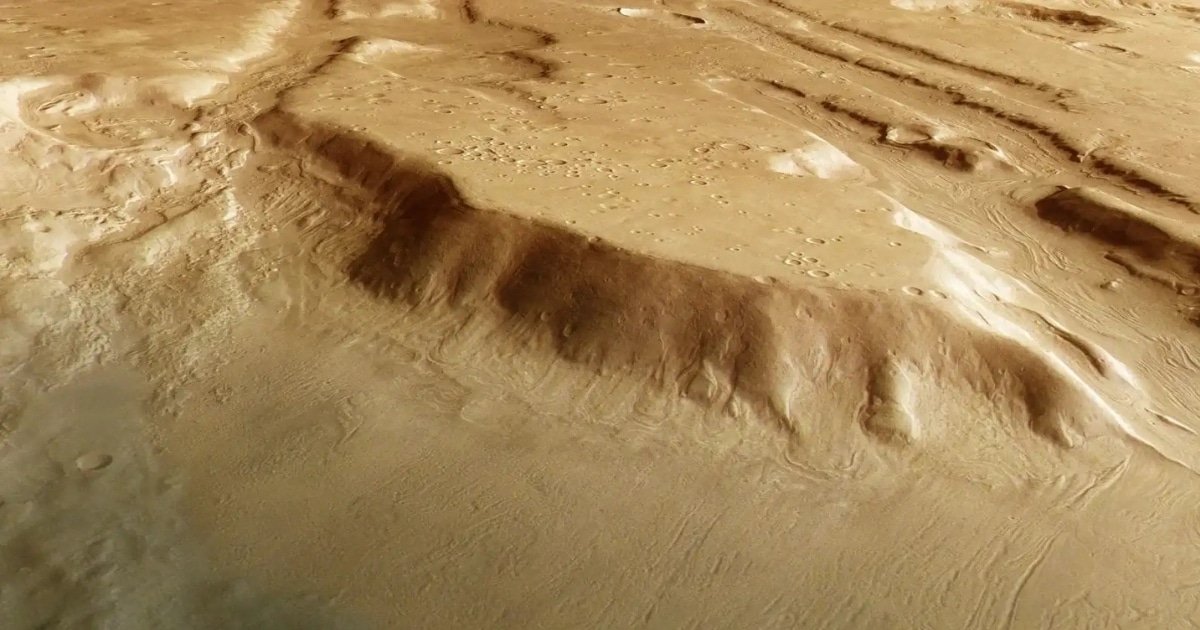
New images captured by the High Resolution Stereo Camera on the European Space Agency’s (ESA) Mars Express orbiter reveal a prominent feature known as Coloe Fossae, a system of intersecting canyons marked by distinctive swirling line patterns that indicate material flow from past ice movements.
You May Like To Read: Scientists Warn Half the World’s Beaches Could Vanish Due to Climate Change and Urbanization
These patterns, technically known as lineated valley fill (LVF) or concentric crater fill (CCF), are composed of rocky material deposited by glaciers as they advanced and retreated.
Crucially, these features are located far from Mars’s current northern polar ice cap, suggesting that glaciers once covered the mid-latitudes across the entire planet before retreating during warmer interglacial periods. These Martian glacial periods are believed to have begun as the planet’s atmosphere was slowly stripped away, causing surface water to disappear.
Tracking these ancient ice flows is considered vital for reconstructing the geological and environmental history of the Red Planet, allowing scientists to accurately deduce how and when Mars transitioned from a warmer, wetter environment to the extremely cold and arid world observed today.