




In Pakistan, the National Database and Registration Authority (NADRA) plays a central role in state functioning. It manages the national identity system and supports everything from social welfare programs to border security. Over 209 million citizens have been registered by NADRA, making it one of the largest digital identity systems in the world. While it has brought speed and efficiency, it has also raised serious concerns about privacy, exclusion, and surveillance.

Source: NADRA
The Good: Better Services and Faster Delivery
NADRA helps the government deliver services quickly. It supports various functions such as:
- CNIC registration
- Passport issuance
- Voter lists
- Verification for aid programs like BISP and Ehsaas
With NADRA’s help, the government was able to identify and deliver aid to millions of poor families during COVID-19 through the Ehsaas Emergency Cash program. It also helps in crime control by verifying fingerprints and other data through police and border control agencies.
Digital Governance and Its Benefits
Digital identity has made life easier in many ways. People can now apply for services online, verify their identity remotely, and receive cash transfers without going to an office. For example, Benazir Income Support Programme (BISP) uses NADRA’s data to verify deserving families and reduce duplication. This increases transparency and ensures money goes to the right people. NADRA has also introduced online CNIC renewal and mobile vans for registration in remote areas. These are helpful steps in improving access.
You May Like To Read: Does Madrassa Only Produce Conservative People?
The Other Side: What If You’re Left Out?
Despite the progress, there are still serious issues.
Some citizens, especially in remote and underdeveloped regions, struggle to get registered. Without a CNIC, they are invisible to the state. They cannot:
- Receive government aid
- Enroll in school or college
- Access healthcare or jobs
This digital exclusion affects women more. According to a UNDP report, many women lack basic documents and face hurdles during the CNIC registration process. Those left out of the system are often poor, illiterate, or from marginalised communities.
Concerns About Data Privacy
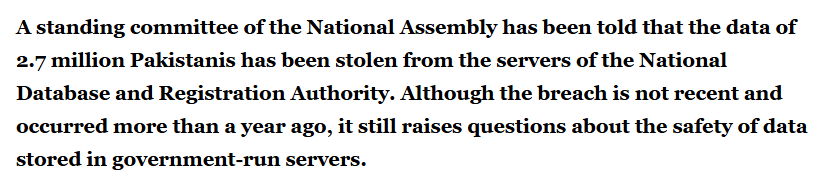
NADRA gathers and retains sensitive data fingerprints, photos, family files, and the address of the home. However, in Pakistan, there is no specific law securing this information. In 2021, it was reported that NADRA had a data breach, which triggered concerns of poor cybersecurity. The authorities refused to acknowledge any damage, yet the threat continues. There is no opportunity to control the use of this information, its storage, and sharing without a Data Protection Authority. Individuals are worried that their information may be used wrongly by banks and even telecommunication companies or even by hackers.
Source: Tribune
The Risk of Over-Surveillance
When NADRA data is integrated with tax, police, and telecom systems, more effortlessly, people’s activities can be monitored. This is beneficial to law enforcement but gives greater risk to state surveillance. There has been concern that its application can turn out to be misused to spy on political enemies, reporters, or even common citizens. This has been a concern raised globally concerning the India Aadhaar system, where individuals could not get their food rations because of a fingerprint mismatch.
Lack of Legal Protection
Pakistan has yet to pass a strong Data Protection Bill. The draft was prepared but not enacted. Without a legal framework, NADRA operates in a grey area.
There is no clear rule on:
- Who can access your data
- How long it is stored
- What happens if there is a mistake
Citizens have no direct way to challenge errors or seek help if their identity is blocked.
You May Like To Read: The Economic Survey Paradox: Why Macro Gains Fail to Help Citizens
Towards Inclusive and Safe Digital Identity
For Pakistan’s digital future to be safe and fair, some urgent reforms are needed.
- Pass a strong data protection law that ensures citizens’ privacy and defines how state institutions handle personal data.
- Make registration easier for marginalized groups—especially women, transgender persons, orphans, and remote communities.
- Create an independent watchdog to monitor NADRA’s operations and protect citizen rights.
- Offer quick redress mechanisms in case of ID errors or misuse.
- Educate citizens about their digital rights and how to protect themselves from scams or misuse.
Balancing Security with Rights
No one can deny that NADRA plays a vital role in Pakistan’s system of governance. With great power comes great responsibility. Digital identity should be liberating people, not oppressing or controlling them. It should offer citizens more access, not more reason to be afraid of being watched. The government should make sure that NADRA work for the people with transparency, impartiality and integrity. Only then can we build a trustworthy digital state.