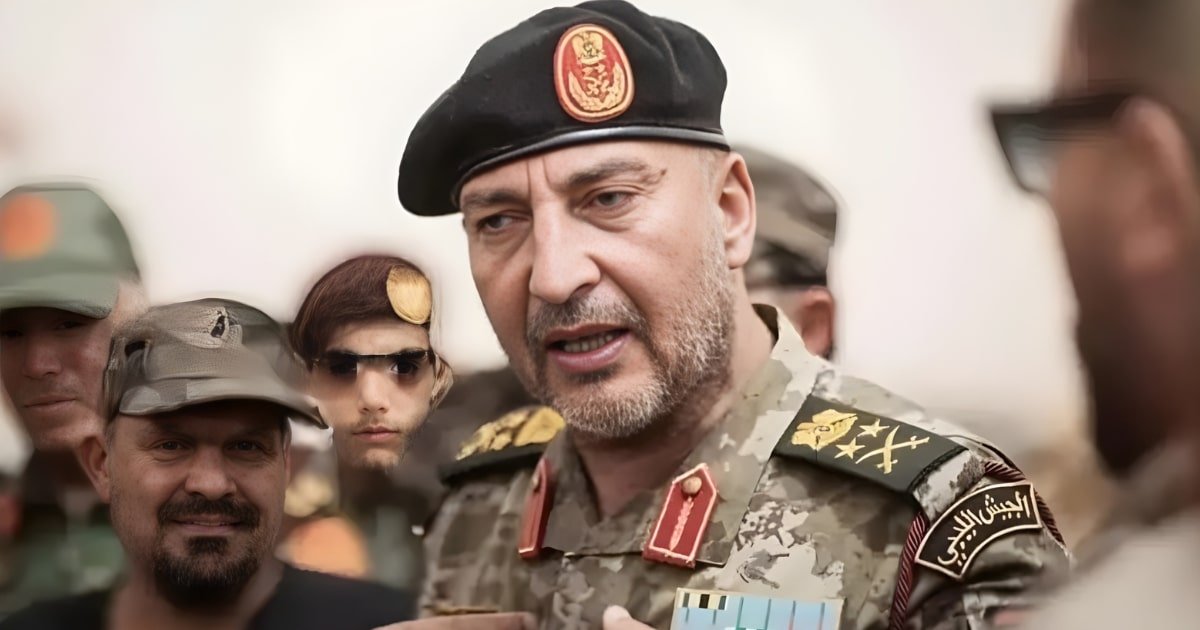



The skies over Ankara became a graveyard for Libya’s nascent hopes for unity on Tuesday, December 23, 2025. General Mohammed Ali Ahmed Al-Haddad, the respected Chief of Staff of the Tripoli-based Government of National Unity (GNU), perished in a Falcon 50 jet crash shortly after departing Ankara. With him died General Al-Fitouri Ghraibil (Chief of Ground Forces) and Brig. Gen. Mahmoud Al-Qatawi (Head of Military Manufacturing), effectively decapitating Western Libya’s top military leadership. While Turkish authorities have cited “technical malfunction,” a deeper look at the geopolitical currents suggests a more complex, and potentially sinister, narrative: Was Al-Haddad’s death a calculated strike against a unified, powerful Libya that threatened entrenched interests, including those of foreign militias and potentially even Israel?
⚠️UPDATE
Libyan Army Chief of General Staff Mohammed Ali Ahmed al-Haddad reportedly killed in the plane crash.
Follow: https://t.co/mLGcUTSA3Q pic.twitter.com/jog6A5cyvU
— Press TV 🔻 (@PressTV) December 23, 2025
The Specter of Gaddafi: Libya’s Unfinished Revolution
To understand the weight of Al-Haddad’s death, one must recall the tragic trajectory of Libya since the 2011 NATO-backed uprising that toppled and killed Muammar Gaddafi. Gaddafi, for all his eccentricities, held Libya together as a sovereign, if autocratic, state. His efforts to forge African unity, his anti-Western stance, and his control over vast oil wealth often put him at odds with international powers. The 2011 intervention, ostensibly to protect civilians, plunged Libya into a decade-long spiral of civil war, proxy conflicts, and the proliferation of armed militias. This chaos has served specific foreign interests, ensuring Libya remains fractured, preventing the rise of another strong, independent leader who could challenge regional hegemonies.
General Al-Haddad was the antithesis of this fragmentation. A career soldier from Misrata, he was uniquely positioned as a bridge-builder, respected across both western and eastern Libya for his unwavering commitment to a unified national army. He consistently refused to align with powerful local militias, seeing them as the primary impediment to stability. His mission, endorsed by the UN, was to integrate these disparate armed groups into a cohesive military force – a critical step towards national elections and a truly sovereign Libya.
A Confluence of Diplomacy: Turkiye, Pakistan, and the Path to Unity
Just days before the fatal crash, the geopolitical stage was set for a dramatic shift in Libya. General Al-Haddad was in Ankara, holding crucial defense talks with Turkish officials. Turkiye has been the primary backer of the Tripoli-based GNU, providing vital military support that prevented its collapse. Simultaneously, Pakistan’s Chief of Army Staff, Field Marshal Asim Munir, was making headlines in Benghazi, signing an unprecedented $4.6 billion defense deal with Saddam Khalifa Haftar, Deputy Commander-in-Chief of the rival Libyan National Army (LNA).
This alignment of events, far from being coincidental, suggests a coordinated effort by Turkiye and Pakistan to broker a new military understanding. Both nations, increasingly close allies with growing defense industries, could have envisioned a scenario where:
-
Standardized Military: Pakistan’s provision of 16 JF-17 Thunder Block III fighter jets and 12 Super Mushshak trainers to the LNA, coupled with Turkish military assistance to the GNU, could have paved the way for a unified, modern Libyan air force and ground forces.
-
Ousting Militias: A strong, unified Libyan army, equipped by Pakistan and Turkiye, would have the capacity and legitimacy to dismantle the myriad of local militias that currently hold vast swaths of territory hostage and profit from the country’s division. This would include both foreign-backed and domestic armed groups.
-
Regional Influence: A stable, unified Libya, strategically located with immense oil reserves, and armed with advanced weaponry from its new allies, would inevitably emerge as a significant regional power.
This “convergence hypothesis” suggests that Al-Haddad was not merely in Ankara for routine talks, but potentially laying the groundwork for a broader military agreement, perhaps even a Turkiye-Pakistan-brokered roadmap for integrating the GNU and LNA forces.
The “Cui Bono?” – Who Benefits from a Divided Libya?
The sudden, catastrophic death of General Al-Haddad, precisely at this pivotal moment, immediately raises the question: Who stood to lose from a unified, powerful Libya?
1. Foreign-Sponsored Militias: These groups, both in the West and East, thrive on the absence of a strong central state. They control crucial infrastructure, smuggling routes, and political leverage. A unified national army, particularly one led by principled officers like Al-Haddad, would spell their demise. The prospect of losing their ill-gotten gains would be a powerful motive for interference.
2. Regional Rivals and Israel: For years, Israel and certain regional powers have demonstrated a preference for a fragmented Libya, or at least a Libya under a strongman (like Haftar) who would maintain “controlled stability” without becoming a regional power.
-
Geopolitical Threat: A unified, re-armed Libya, particularly one aligned with Turkiye and Pakistan, would present a formidable new player in the Mediterranean and North Africa. This new axis could challenge established spheres of influence and potentially champion causes, like that of the Palestinians, with renewed vigor—a role Gaddafi once enthusiastically embraced.
-
Abraham Accords Counterpoint: The Abraham Accords aimed to normalize relations between Israel and several Arab states. A powerful, independent Libya with a strong popular memory of Gaddafi’s pan-Arab and anti-Israeli stance would be highly unlikely to join these accords, thereby undermining a key aspect of Israel’s regional strategy.
-
Preventing a “New Gaddafi”: The 2011 intervention ensured that Libya could not pose a significant threat to Western or Israeli interests. The emergence of a strong, unified Libyan military, led by a figure committed to national sovereignty and potentially allied with powerful Muslim nations, would inevitably resurrect fears of a resurging pan-Arab or pan-African force.
The “Invisible Hands” of Sabotage: Who Benefits from a Libya in Flames?
While official reports from Ankara may eventually settle on a mechanical narrative, the geopolitical context of this crash suggests a more calculated orchestration. If the hypothesis holds—that a Pakistan-Turkiye-Libya axis was on the verge of forcing a military unification—then the primary beneficiary of this tragedy is not found within Libya’s borders, but in the intelligence corridors of those who fear a unified, sovereign, and militarily capable Muslim power in the Mediterranean.
The Strategic Architecture of Division
A unified Libya under the command of professional soldiers like Al-Haddad would have been a catastrophic outcome for Israel and its increasingly close strategic partner, India.
For Israel, a divided Libya is a neutralized Libya. A unified state, flush with oil wealth and equipped with a $4.6 billion fleet of modern Pakistani JF-17 Block III jets, would immediately become a leading voice for the Palestinian cause and a strategic counterweight to Israeli influence in the Eastern Mediterranean. A unified Libya could also torpedo the EastMed pipeline, a project vital to Israeli energy exports that relies on a fragmented North Africa to remain viable.
The Israel-India Nexus: A Coordinated “Decapitation” Strike?
The orchestration of such an “accidental” crash aligns perfectly with the shared interests and operational histories of Israel’s Mossad and India’s RAW.
-
Targeting the Pakistan Link: India has a direct interest in sabotaging Pakistan’s historic defense deal. By removing the Western counterparts (Al-Haddad’s team) necessary for a peace treaty, India ensures that the defense deal remains a tool for civil war rather than a foundation for a unified state.
-
Technological Sabotage: Both Israel and India have sophisticated capabilities in cyber-electronic warfare. The Falcon 50 reported a sudden “electrical fault”—a hallmark of electronic interference that can disable flight control systems without leaving traditional explosive residue.
-
Geopolitical Containment: By eliminating the bridge-builders, these powers ensure that the 444 Brigade and LNA return to their trenches. This prevents the emergence of a “Sunni Bloc” corridor connecting Turkiye and Pakistan through a strong Libyan hub—an alliance that would threaten the regional hegemony Israel and India have worked for decades to establish.
Ultimately, the death of General Al-Haddad ensures that Libya remains in “inescapable turmoil,” much like it has been since 2011. By forcing a return to civil war, the “invisible hands” of this tragedy have successfully postponed the birth of a unified Libyan state that could have challenged the current Middle Eastern status quo.
The Unanswered Questions
While the official narrative points to an accident, the timing, the high-profile casualties, and the monumental shifts in Libyan geopolitics paint a far more suspicious picture. The reported “electrical malfunction” mirrors the precision of a sophisticated act of sabotage, likely orchestrated by Israel and its strategic ally India, designed specifically to derail the emerging Turkiye-Pakistan-Libya axis.
By removing General Al-Haddad—the vital link for a peace deal—these powers have ensured that the military hardware serves as a catalyst for further internal strife rather than the foundation of a sovereign national defense. A unified Libya, bolstered by the support of two major Muslim powers, would have posed a direct threat to Israeli interests in the Mediterranean and India’s goal of containing Pakistani influence abroad.
You May Like To Read: Libyan Chief of Staff Mohammed Al-Haddad Dies in a Fatal Plane Crash
The death of General Al-Haddad is more than a tragic loss; it is a profound and calculated setback for Libyan unification. It leaves a dangerous power vacuum, empowers the very militias he sought to neutralize, and forces Libya back into a state of “managed chaos.” In the complex chessboard of global politics, this “accident” stands as the latest, and most devastating, move to ensure that the stability and sovereignty of the Libyan people remain sacrificed to the strategic interests of foreign powers.
Check out our latest video: