



The Army Public School (APS) massacre of December 2014 marked a turning point in Pakistan’s fight against terrorism, forcing the country’s political leadership to take unprecedented collective action. In response to the national outcry, the government introduced the National Action Plan (NAP) for Countering Terrorism and Extremism, a 20-point framework that promised to confront militancy at its roots. Its provisions included a crackdown on hate speech, the establishment of military courts for swift trials of terrorists, measures to cut financial lifelines of extremist groups, a ban on outlawed outfits operating under new names, and long-overdue madrassa reforms.
Nearly a decade later, the outcomes of NAP remain deeply contested. While some argue that it achieved partial successes in dismantling militant networks, many experts highlight glaring failures in implementation. Understanding this divide requires examining why such an ambitious policy fell short and where its enforcement became entangled in systemic weaknesses.
Selective Enforcement, and Civil–Military Imbalance
The National Action Plan (NAP) was introduced as a decisive framework to eliminate terrorism and extremism, yet its implementation reflected a top-down approach. Local representatives such as Members of the National Assembly (MNAs) and Members of Provincial Assemblies (MPAs), who possess first-hand knowledge of their constituencies, were sidelined. Instead, central authorities assumed control, often formulating policies disconnected from ground realities. This centralization alienated local stakeholders and limited community-based ownership of counterterrorism initiatives.
Another critical weakness was the marginalization of the police. As institutions embedded in local contexts, police forces are familiar with the roots, networks, and social ecosystems of militant elements. Their ability to conduct forensic analysis of attack sites, collect intelligence on gangs, surveil suspects, and deploy undercover agents makes them vital to sustainable counterterrorism. Yet, under NAP, operational control was disproportionately handed over to the military, which, though effective in kinetic operations, lacked the community linkages necessary for long-term stabilization.
Moreover, the imbalance between military-led operations and weak civilian institutions further widened the civil-military divide. While the military delivered short-term operational successes, there was little parallel investment in strengthening civilian law enforcement or intelligence agencies. A striking example is the Federal Investigation Agency (FIA). Its Terrorist Finance Investigation Unit (TFIU), the only specialized body mandated to track terror financing, has remained without professional leadership and operates with a skeleton staff. This neglect illustrates the government’s lack of seriousness in empowering civilian institutions, perpetuating dependence on military-led solutions and undermining NAP’s holistic goals.
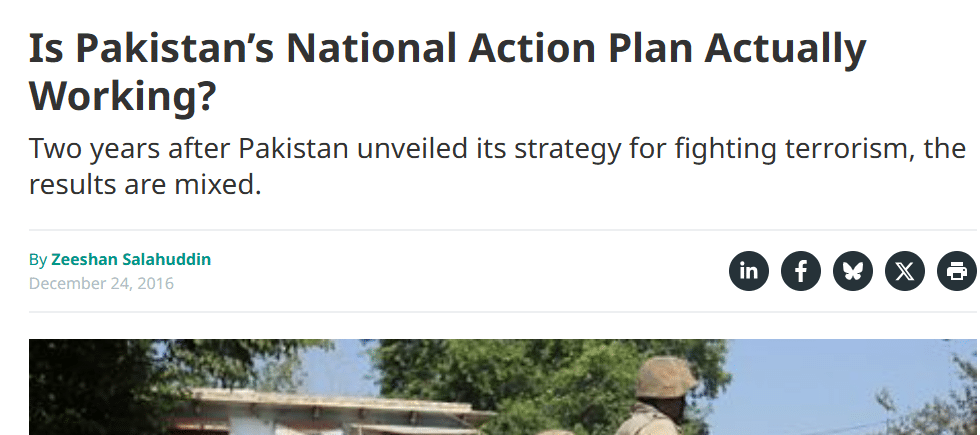
Failure to Curb Terror Financing
One of the most glaring shortcomings of the National Action Plan (NAP) has been its inability to choke the financial networks of terrorist outfits. Despite repeated commitments, Pakistan still lacks a robust legal and constitutional framework to regulate and criminalize illegal currency trade, which remains the most secure channel for funneling money to extremist organizations. In the absence of such mechanisms, facilitators continue to operate with impunity, allowing terror groups to sustain their networks. A telling example is the reopening of illegal currency markets in Peshawar—previously shut down but revived due to weak enforcement. The unchecked demand for U.S. dollars in the city has pushed rates higher than in the rest of the country, underscoring how financial loopholes directly empower extremist elements while undermining both economic stability and counterterrorism objectives
Bottlenecks in the Judicial System
The second point of the National Action Plan (NAP) emphasized the establishment of military courts to expedite terrorism-related trials. Since January 2015, when Pakistan empowered these courts to try civilians, 11 military courts were constituted, concluding 105 trials. Of these, 81 resulted in convictions, with 77 death sentences and four life imprisonments. At least 12 people have been executed after proceedings widely criticized for unfairness. As Sam Zarifi, ICJ’s Asia Director, noted: “These tribunals are opaque and operate in violation of national and international fair trial standards, and so are not effective in providing justice.”
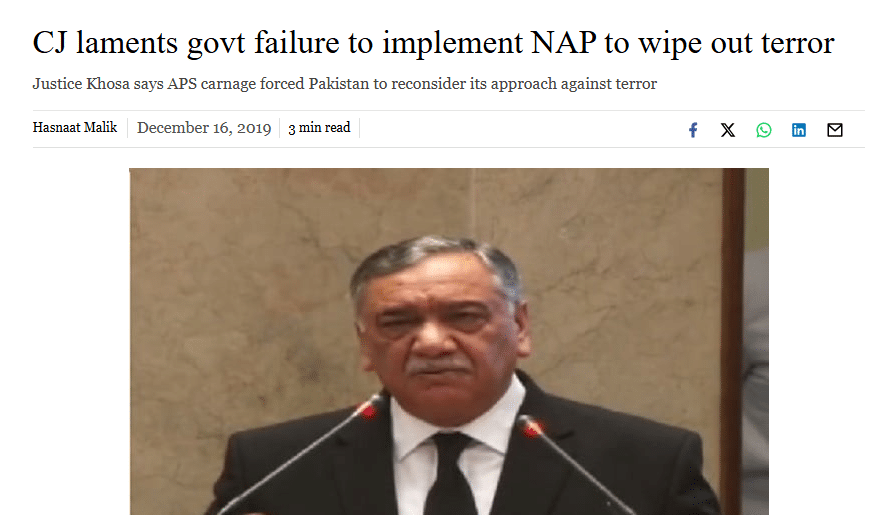
The reliance on military courts reflects the persistent weaknesses of Pakistan’s civilian judiciary. Hundreds of high-profile terrorists were arrested but not prosecuted due to weak evidence, delays, or systemic inefficiency, with some even acquitted. A near-total absence of witness protection compounds the problem, as witnesses, investigators, and even judges face serious security threats, deterring justice and allowing militancy to persist.
Conclusion
The recent 2025 Jaffar Express attack in Balochistan has once again revived the urgent question of how Pakistan must address the resurgence of terrorism. While kinetic responses such as military operations remain necessary, they cannot substitute for the non-kinetic measures that NAP envisioned but never fully delivered. Genuine reconciliation in Balochistan, tackling acute poverty, addressing long-standing local grievances, and integrating the merged tribal districts are all crucial for sustainable peace. Equally vital is strengthening compliance with frameworks like FATF to choke terror financing. The real challenge is not another plan, but the serious implementation of NAP’s neglected promises.
You May Like To Read: