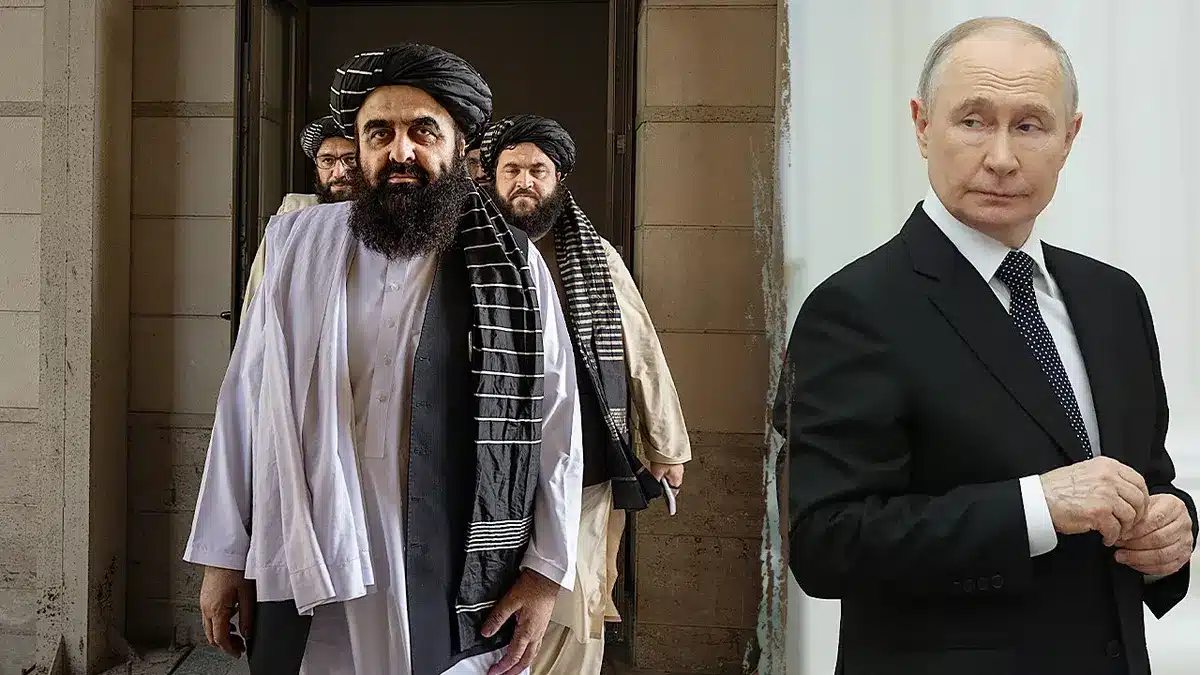




The classified Memorandum of Understanding (MoU) on military-technical cooperation signed between the Taliban government and the Russian Federation on May 27, 2026, has ignited an intense international debate. Legal experts, regional diplomats, and political analysts are questioning whether the unverified pact serves Afghanistan’s long-term national interests or merely entangles the vulnerable state deeper into global power rivalries.
The agreement was finalized during the Moscow International Security Conference by Russian Security Council Secretary Sergei Shoigu and Taliban Defense Minister Mohammad Yaqoob Mujahid. While the full operational parameters remain classified, the accord formalizes a major shift following Russia’s official recognition of the Taliban government in July 2025. Reports suggest the deal may involve the transfer of anti-aircraft systems, such as MANPADS, alongside defense technology licensing.
However, international observers warn that agreements signed by a government lacking broad domestic legitimacy, representative state institutions, and comprehensive UN recognition face severe legal boundaries. Critics suggest the Taliban is utilizing the high-profile deal primarily to boost its international standing and counter escalating border tensions with Pakistan, rather than securing a sustainable, multi-domain strategic partnership.
Russia and the Taliban sign a military cooperation pact — the son of the man who sheltered Osama bin Laden now forging defense ties with Moscow just 4 years after the U.S. withdrawal from Afghanistan. Neither side has disclosed the full terms of the agreement. pic.twitter.com/ljUXngHdx1
— Fox News World (@FNCGlobalNews) May 29, 2026
Critical Analysis: Mirage of Great Patrons and Military Deficits
The Russia-Taliban military accord highlights a complex intersection of desperate regime survival, regional proxy defense, and historical patterns of abandonment. A critical analysis of the strategic landscape reveals several vital realities:
The Operational Reality of the Military Capacity Deficit
The Taliban’s push for Russian defense equipment stems from an acute, localized crisis of material depreciation.
                    [Taliban Military Fleet Degradation]
                                     │
            ┌────────────────────────┴────────────────────────┐
            ▼                                                 ▼
[Inherited Western Assets]                       [Legacy Soviet Systems]
• Specialized US/NATO systems                    • Original Russian hardware
• Completely cut off from parts                  • Chronically obsolete or broken
• Salvageability: Terminally low                 • Direct Catalyst for Moscow MoU
Following intense skirmishes along the Durand Line in early 2026, Pakistani cross-border air operations successfully neutralized significant portions of the Taliban’s static defense lines. Because the Taliban cannot procure spare parts for inherited, highly advanced U.S. equipment, and their remaining Soviet-era armaments are entirely obsolete, Kabul faces a severe security gap. The recourse to Moscow is a desperate attempt to acquire basic air defense capabilities to offset regional vulnerabilities.
The Great Power Transactionalism Trap
The strategic assumption that Russia will act as a permanent security guarantor for Afghanistan ignores foundational historical precedents and contemporary fiscal limits.
| Geopolitical Variable | Realpolitik Alignment & Motives |
| Moscow’s Primary Focus | Containment & Border Security: Preventing Islamic State Khorasan Province (ISKP) from spilling into Central Asia; choking regional narcotic pipelines. |
| Taliban’s Expectation | Strategic Parity: Substantial economic assistance, modern heavy weapons transfers, and diplomatic protection at the UN. |
Historically, following the 1989 Soviet withdrawal, Moscow promptly abandoned successive Kabul regimes once their immediate buffer value expired. Today, burdened by Western sanctions and its own prolonged external campaigns, Russia lacks the economic capital to rebuild Afghanistan’s infrastructure. Consequently, the relationship remains purely transactional.
The Illusion of Legitimacy Without Domestic Consent
The Taliban command views the optics of signing formal defense pacts with a permanent, veto-wielding member of the UN Security Council as an alternative route to global acceptance. However, this strategy bypasses a fundamental rule of international law: external legitimacy is an extension of internal, domestic legitimacy.
As long as the regime relies on opaque funding models, forced public donations, ethnic marginalization—which recently triggered violent intra-Taliban factions over gold-mining revenues in Badakhshan—and systemic exclusions, a foreign security memo cannot resolve its baseline isolation. Furthermore, because key Taliban leaders remain firmly anchored on UN sanctions lists, bilateral accords cannot pave the way for full international reintegration without a shift from Western powers.
Cross-Theater Neutrality vs. Geopolitical Vulnerability
As a structurally weak state situated at the crossroads of competitive empires, Afghanistan’s survival relies on maintaining a strict policy of balanced neutrality. By signing a classified military-technical pact with Russia, the Taliban risks alienating alternative economic partners and major international financial corridors.
A state cannot easily balance identical strategic depths with India and Pakistan, Russia and Ukraine, or China and the United States simultaneously. Entering the orbit of a single global faction risks transforming Afghanistan back into an arena for proxy friction, rather than a peaceful platform for Central-South Asian trade connectivity.