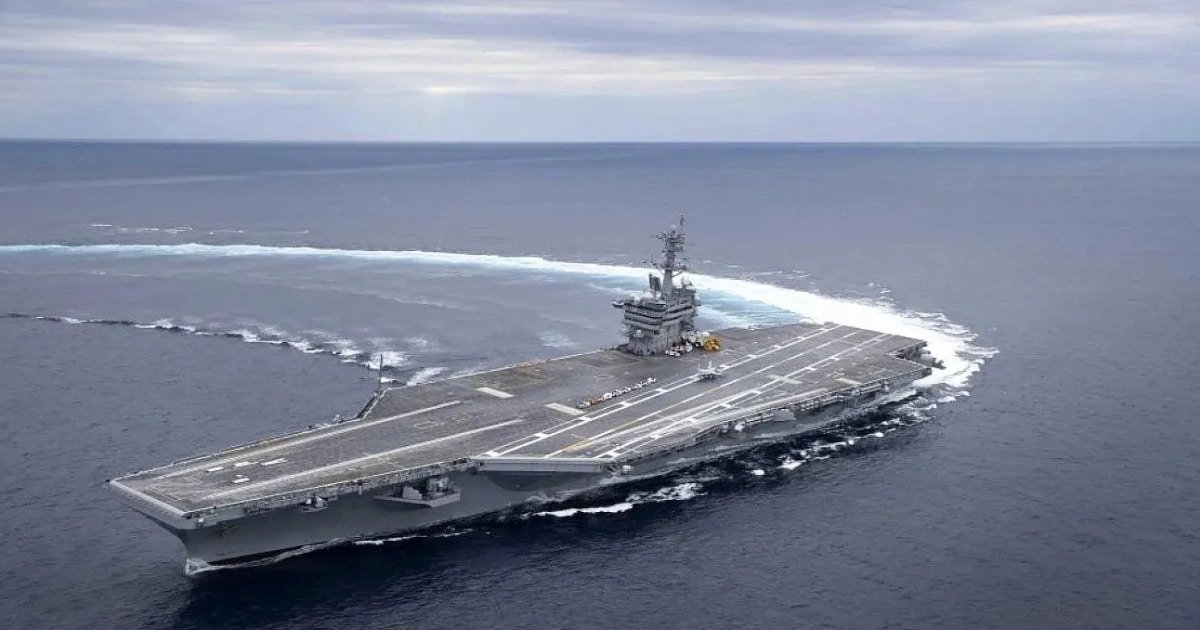


President Donald Trump has confirmed the deployment of the USS Gerald R. Ford, the world’s largest aircraft carrier, to the Middle East, intensifying a “maximum pressure” campaign designed to force a definitive nuclear deal with Tehran. The move, announced on February 12, 2026, places two American carrier strike groups in the region simultaneously as indirect negotiations in Oman remain inconclusive.
JUST IN – Pentagon orders second aircraft carrier strike group to prepare to deploy to the Middle East, likely the USS George H.W. Bush, as the U.S. military prepares for another attack on Iran — WSJ pic.twitter.com/kOMzYTe2Eq
— Disclose.tv (@disclosetv) February 11, 2026
The “Armada” Strategy
The USS Gerald R. Ford strike group is relocating from the Caribbean—where it was recently involved in the capture of former Venezuelan President Nicolás Maduro—to join the USS Abraham Lincoln in the Persian Gulf.
President Trump, speaking to reporters following a three-hour White House meeting with Israeli Prime Minister Benjamin Netanyahu, framed the deployment as a necessary backup to diplomacy.
“Either we will make a deal or we will have to do something very tough like last time,” Trump stated, referring to Operation Midnight Hammer in June 2025, which targeted three Iranian nuclear sites. “I let the Prime Minister know that [a deal] will be a preference. If it cannot, we will just have to see what the outcome will be.”
Diplomatic Stalemate in Oman
While the U.S. and Iran held a first round of indirect talks in Muscat on February 6, significant “red lines” remain:
-
The Nuclear Issue: U.S. Special Envoy Steve Witkoff and Jared Kushner are demanding “zero enrichment,” a condition Iran’s Foreign Minister Abbas Araghchi has rejected as a violation of sovereign rights.
-
Missile Arsenal: Trump is seeking an agreement that includes “no missiles,” whereas Tehran maintains its ballistic program is a non-negotiable defensive necessity.
-
Internal Unrest: The U.S. has recently smuggled approximately 6,000 Starlink terminals into Iran to aid dissidents following a bloody January crackdown on anti-regime protesters.
You May Like To Read: Vision 2030: Microsoft to Train 3 Million Saudis in AI by 2030
Regional Stakes
Prime Minister Netanyahu has reportedly urged Washington not to settle for a “limited” deal that ignores Iran’s regional proxies and missile capabilities. Conversely, Iranian security chief Ali Larijani warned that while Tehran prefers a “rational path,” any U.S. strike would result in immediate retaliation against American military bases across the Middle East.
Check out our latest video: