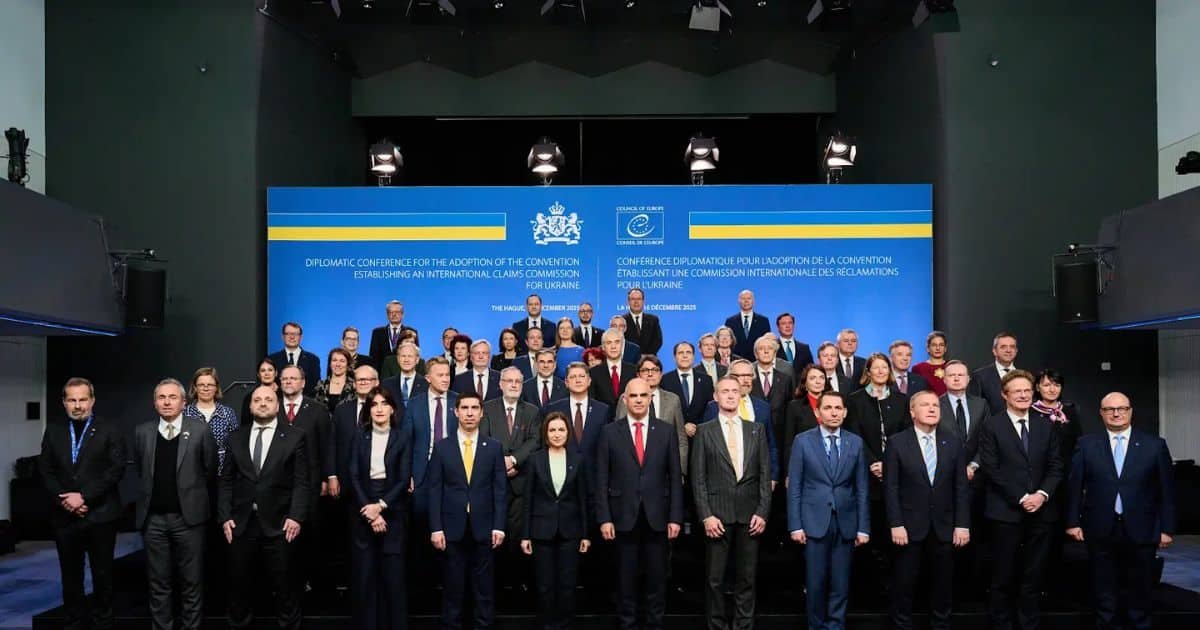





Thirty-five countries formalized the creation of the International Claims Commission for Ukraine (ICCU) today at a high-level conference in The Hague. The ICCU is tasked with assessing and deciding claims for reparations to compensate Kyiv for hundreds of billions of dollars in damage resulting from Russia’s ongoing war against Ukraine.
The commission, coordinated by the 46-member Council of Europe, follows the establishment of a Register of Damages, which has already received more than 80,000 claims from Ukraine.
Ukrainian President Volodymyr Zelenskyy, attending the summit, stressed the necessity of compensation for lasting peace. “This war and Russia’s responsibility for it must become a clear example so that others learn not to choose aggression,” he stated. “We must make Russia accept that there are rules in the world.”
Justice must prevail. #Ukraine will not stand alone.
34 countries + EU signed a new convention to launch the International Claims Commission under the Council of Europe.
It will assess claims & compensation for damage caused by Russia’s war of aggression against Ukraine. pic.twitter.com/SHCH8dbUxv— Council of Europe (@coe) December 16, 2025
Focus on Accountability and Funding
The launch of the ICCU is considered a significant step toward ensuring accountability for the immense destruction. Dutch Foreign Minister David van Weel underlined this point, saying: “Without accountability, a conflict cannot be fully resolved. And part of that accountability is also paying damages that have been done.”
Discussions are currently focused on the challenging logistics of payment, with the primary solution revolving around the hundreds of billions of euros of Russian state assets frozen by the European Union.
The World Bank previously estimated the cost of reconstruction in Ukraine, covering damage inflicted up to December 2024, at $524 billion.
Diplomatic Context
The establishment of the ICCU comes amid a renewed diplomatic push led by the United States to negotiate an end to the conflict. The US-led efforts have intensified following recent high-level talks, with leaders seeking consensus on a path forward.
Simultaneously, EU leaders are under pressure to reach an agreement on the use of frozen Russian assets, with proposals focusing on using the funds to back a substantial loan to Kyiv. However, some member states, notably Belgium, have expressed opposition due to potential legal repercussions related to confiscating the funds held by the international deposit organization Euroclear.
Check out our latest video: