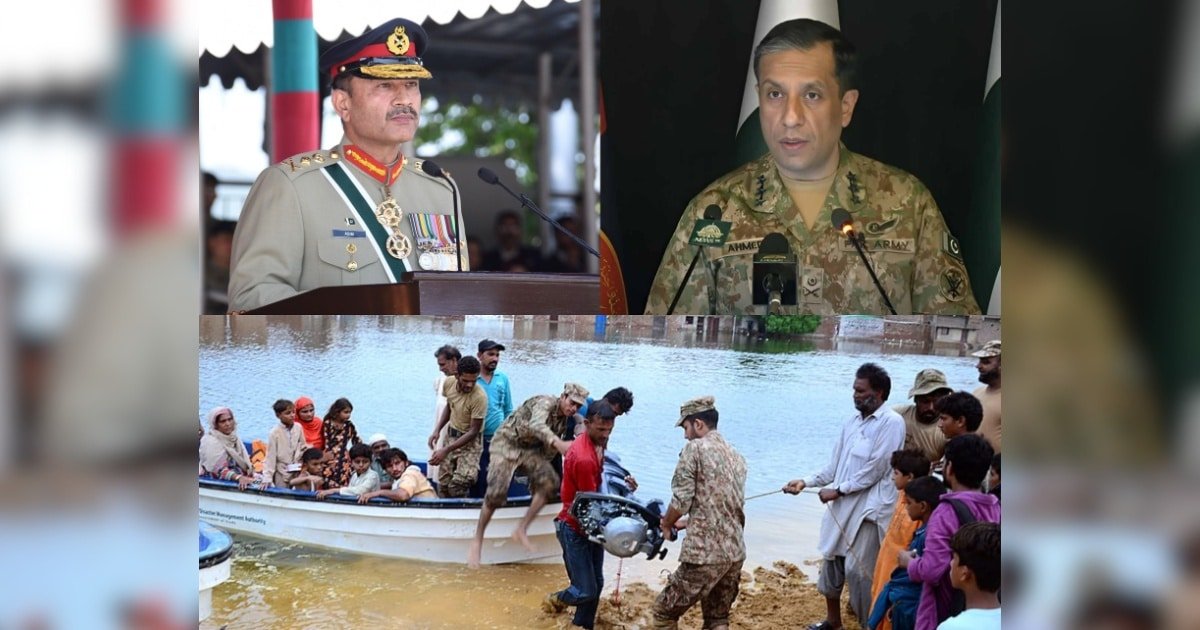




Islamabad | Khyber Pakhtunkhwa — The Director General Inter-Services Public Relations (DG ISPR), in a press conference held on Tuesday, outlined the Pakistan Army’s large-scale relief and rescue operations underway in flood-affected areas across Khyber Pakhtunkhwa and Gilgit-Baltistan.
Providing a detailed briefing, DG ISPR emphasized that the Army is working in close coordination with the National Disaster Management Authority (NDMA) and provincial governments to rescue stranded families, restore infrastructure, and provide emergency medical care to thousands of victims.
Responding swiftly to catastrophic monsoon flooding, the Pakistan Army, operating under directives from Chief of Army Staff Field Marshal Syed Asim Munir, has deployed extensive manpower and logistical resources to devastated regions including Buner, Shangla, Swat, Bajaur, Swabi, and Gilgit-Baltistan.
پاکستان میں تباہ کن سیلاب! پاک فوج ہائی الرٹ, سڑکوں کی بحالی کا کام تیزی سے جاری
Flood in KPK | Pakistan Army in Action | DG ISPR Lt. General Ahmed Sharif Important Press Conference | Discover Pakistan#kpk #dgispr #aliamingandapur #swatflood2025 #flood2025 #pakarmy #modi #india pic.twitter.com/0bLHmqBup8— Discover Pakistan TV (@DiscoverpakTv) August 19, 2025
Force Deployment
According to ISPR briefings, the Army has mobilized:
- Infantry & Frontier Forces:
- Buner: 2 battalions
- Shangla: 2 battalions
- Swat: 1 battalion
- Bajaur: 1 Frontier Corps wing
- Swabi: 1 company
- Engineers:
- Engineer Brigade (Kanju) with two engineer battalions in Buner and Shangla
- Two additional engineer battalions in Gilgit-Baltistan
- Urban Search & Rescue (USAR):
- Two USAR teams deployed in Buner
- Medical Support:
- Medical teams from CMH Rawalpindi, PEMH, plus two medical battalions
- Six medical camps established across Buner, Shangla, and Swat
- Over 5,640 patients treated to date
- Aviation Support:
- Assets of XI Corps providing aerial logistics and evacuation
- Missions flown from Peshawar, Kanju, and Tarbela despite adverse weather
You May Like To Read: Women in Governance: Breaking Barriers for Gender Equality in Pakistan’s Politics
Humanitarian Impact and Infrastructure Response
The Army has rescued nearly 6,900 individuals, delivered 585 tonnes of rations, and maintained 2,500 tonnes of ready-to-eat reserves, with an additional 5,000 tonnes available at the Nowshera base. Bridges and roads damaged by floods—such as 90 critical routes in KP—are being restored, with significant progress including the reopening of the Karakoram Highway and partial reconstruction of the Timergara-Bajaur bridge. Critical communications infrastructure, including 16 BTS towers, has been reactivated. Six medical camps have been established in Buner, Shangla, and Swat, where more than 6,300 patients have already received treatment. Medical teams from CMH Rawalpindi and PEMH are also on ground to support operations.
You May Like To Read: China and Pakistan Set to Hold Sixth Round of Strategic Dialogue in Islamabad
Coordination and Future Preparedness
These efforts reflect a combined civil-military response led by the NDMA, provincial authorities, and the Army, working in unison to alleviate the humanitarian crisis. With continued weather threats, the Army remains vigilant, ready to provide emergency evacuation, medical aid, and infrastructure rehabilitation across flood-hit communities.
The Pakistan Army’s comprehensive engagement—from targeted troop deployment to critical infrastructure restoration and medical relief—underscores its pivotal role in national disaster response and public welfare.