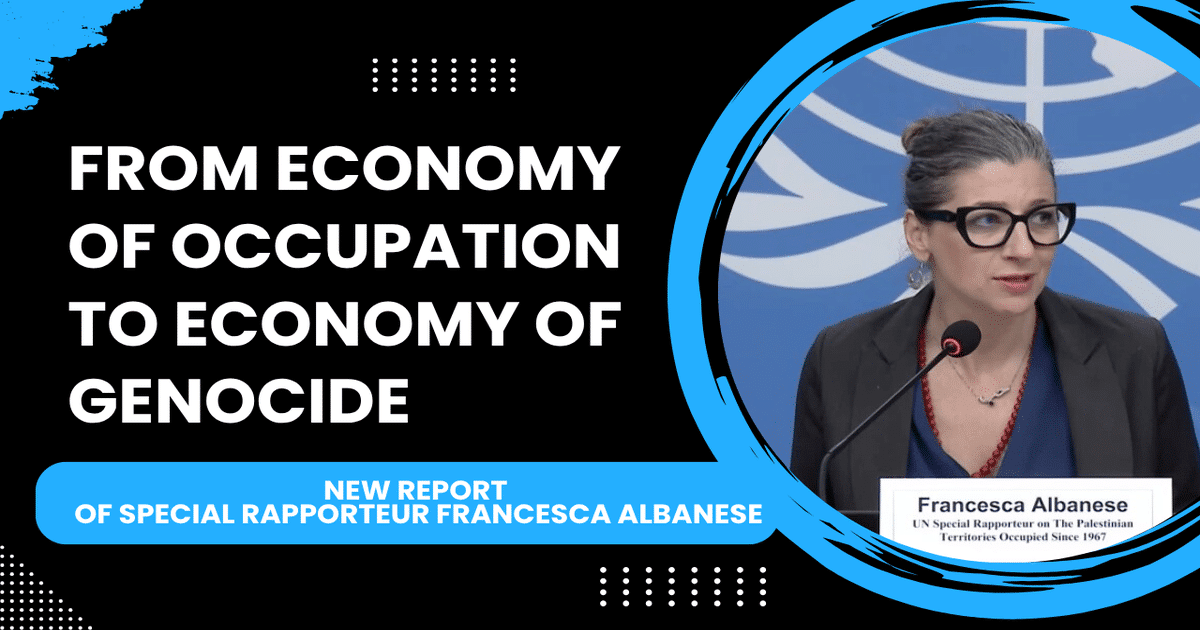





The Part I of this article examined the “Economy of Genocide,” this Part II delves into the equally critical aspect of Francesca Albanese’s report: “The Economy of Replacement: Constructing on Confiscated Land.” This section details how corporate actors are complicit in the destruction of Palestinian life, and facilitate the expansion of illegal colonies and their supporting infrastructure.
Part II:The Economy of Replacement: Constructing on Confiscated Land
The report details how, concurrently with the destruction of Palestinian life, corporate actors facilitate the construction of illegal colonies and their supporting infrastructure.
Construction: Enabling Illegal Settlements
The report states that over 371 colonies and illegal outposts have been constructed and sustained by companies (Page 14). This activity intensified in 2024, marked by a doubling of the Ministry of Construction and Housing budget allocated for colony development.
Caterpillar, HD Hyundai, and Volvo excavators are among the equipment used in this construction (Page 14). German Heidelberg Materials AG, through its subsidiary Hanson Israel, is accused of extracting dolomite rock from seized Palestinian land for use in colony construction. Companies like the Spanish/Basque Construcciones Auxiliar de Ferrocarriles are involved in expanding transportation networks, such as the Jerusalem Light Rail, which connects colonies to West Jerusalem, thereby solidifying annexation. Real estate firms, such as by Keller Williams Realty LLC through its Israeli franchisee KW Israel, actively market and sell properties in these colonies to both Israeli and international buyers, organizing roadshows to market thousands of apartments, originally occupied from Palestinians, in these illegal settlements (Para 52).![Para 49 of Report [A/HRC/59/23]](https://todaystance.com/wp-content/uploads/2025/07/word-image-1865-1.png "Francesca Albanese’s Report (Part II): Corporate Complicity in the “Economy of Replacement”")
![Para 50 of Report [A/HRC/59/23]](https://todaystance.com/wp-content/uploads/2025/07/word-image-1865-2.png "Francesca Albanese’s Report (Part II): Corporate Complicity in the “Economy of Replacement”")
Resource Apartheid: Corporate Monopolies and Depletion
Israel’s systematic control over Palestinian natural resources is identified as a critical component of the genocidal economy (Para 53). The report highlights how the “complete siege” on Gaza following October 2023, which cut off water, electricity, and fuel, weaponized this engineered dependency for genocidal purposes.
The Israeli national water company, Mekorot, holds a monopoly over water supply in the occupied Palestinian territory, forcing Palestinians to purchase water from their own land at inflated prices. In Gaza, Mekorot’s pipelines, operating at only 22% capacity post-October 2023, are cited as actively contributing to the transformation of water into a “tool of genocide.” International energy companies, enabling the displacement and occupation, fuel the energy-intensive Israeli military operations (Para 56). Suppliers such as Drummond Company, Inc. (U.S.) and Glencore PLC (Swiss) provide coal for electricity (Para 57). Chevron Corporation (U.S.) and BP PLC (British) are significant contributors to Israeli crude oil imports and natural gas extraction from fields, including those in Palestinian maritime territory (Paras 58 and 59). The report concludes that by supplying resources to infrastructure utilized by the Israeli military, these companies are contributing to conditions “calculated to destroy the Palestinian population” (Para 60).![Para 54 of Report [A/HRC/59/23]](https://todaystance.com/wp-content/uploads/2025/07/word-image-1865-3.png "Francesca Albanese’s Report (Part II): Corporate Complicity in the “Economy of Replacement”")
![Para 55 of Report [A/HRC/59/23]](https://todaystance.com/wp-content/uploads/2025/07/word-image-1865-4.png "Francesca Albanese’s Report (Part II): Corporate Complicity in the “Economy of Replacement”")
Markets of Dispossession: Trading in Occupied Territories
The report also details agribusiness companies, such as Tnuva (Israel’s largest food conglomerate, majority-owned by China’s Bright Food), profit from land dispossession by sourcing products from colonies and exploiting the captive Palestinian market.
Netafim, a global leader in drip irrigation technology owned by Mexico’s Orbia Advance Corporation, plays a role in enabling intensive exploitation of water and land in the West Bank, depleting Palestinian resources while promoting a sustainable image. Global retailers and logistics companies like A.P. Moller – Maersk A/S are integral to this system and the mechanism of occupation and genocide, shipping goods from colonies to international markets, often with deceptive labeling (Para 66). Francesca Albanese in the report asserts that, given the illegality of colonies under international law, these products “should not be traded at all” (Para 67). E-commerce platforms such as Amazon.com also collude in their direct operations in colonies, which sustain their economies and contribute to apartheid through discriminatory service delivery.![Para 62 of Report [A/HRC/59/23]](https://todaystance.com/wp-content/uploads/2025/07/word-image-1865-5.png "Francesca Albanese’s Report (Part II): Corporate Complicity in the “Economy of Replacement”")
![Para 63 of Report [A/HRC/59/23]](https://todaystance.com/wp-content/uploads/2025/07/word-image-1865-6.png "Francesca Albanese’s Report (Part II): Corporate Complicity in the “Economy of Replacement”")
![Para 66-68 of Report [A/HRC/59/23]](https://todaystance.com/wp-content/uploads/2025/07/word-image-1865-7.png "Francesca Albanese’s Report (Part II): Corporate Complicity in the “Economy of Replacement”")
Tourism of Occupation: Legitimizing Illegal Settlements
The report also states, major online travel platforms, including Booking Holdings Inc. and Airbnb, Inc., are accused of profiting from the occupation by listing properties and hotel rooms within Israeli colonies (Para 70). These listings are linked to restricting Palestinian access to land and endangering nearby villages, promoting settler narratives, and legitimizing annexation. Despite being listed in the OHCHR database since 2020, these platforms continue operations, with Airbnb attempting to “humanitarian-wash” its profits by donating to “humanitarian” causes (Para 71).
![Para 70 of Report [A/HRC/59/23]](https://todaystance.com/wp-content/uploads/2025/07/word-image-1865-8.png "Francesca Albanese’s Report (Part II): Corporate Complicity in the “Economy of Replacement”")
![Para 70-71 of Report [A/HRC/59/23]](https://todaystance.com/wp-content/uploads/2025/07/word-image-1865-9.png "Francesca Albanese’s Report (Part II): Corporate Complicity in the “Economy of Replacement”")
Enablers: Financial and Academic Support for Genocide
The report dedicates a significant section to “Enablers”—financial, research, legal, consulting, media, and advertising firms—that sustain the settler-colonial occupation through their knowledge, narratives, skills, and investments.
Funding Genocide: Financial Institutions and Investments
The financial sector provides critical funding to both state and corporate actors (Para 73). Israeli treasury bonds, which have funded military actions in Gaza, have been underwritten by major global banks, including BNP Paribas and Barclays (Para 74).
Asset management firms like Blackrock and Vanguard are identified as among the largest institutional investors in companies directly involved in Israeli occupation and military operations, thereby implicating universities, pension funds, and individual investors (Para 75).
Global insurance companies, such as Allianz and AXA, also invest heavily in implicated shares and bonds, and their policies “de-risk” the operational environment for companies operating in the occupied Palestinian territory (Para 76).
![Para 74 of Report [A/HRC/59/23]](https://todaystance.com/wp-content/uploads/2025/07/word-image-1865-10.png "Francesca Albanese’s Report (Part II): Corporate Complicity in the “Economy of Replacement”")
![Para 74 of Report [A/HRC/59/23]](https://todaystance.com/wp-content/uploads/2025/07/word-image-1865-11.png "Francesca Albanese’s Report (Part II): Corporate Complicity in the “Economy of Replacement”")
Source: UN OHCHR Report [A/HRC/59/23] by Francesa Albanese
Sovereign wealth and pension funds, despite their stated ethical guidelines, have substantially invested in Israeli companies. The Development Corporation for Israel (Israel Bonds) has tripled its annual bond sales, channeling nearly $5 billion to Israel since October 2023, while offering investors options to support the Israeli military and colonies (Para 74). Faith-based charities are also identified as significant financial enablers, funding settler expansion and military-linked projects, often benefiting from tax deductions abroad (Para 81).
Academic Complicity: Research, Knowledge, and Narrative Legitimizing Genocide
Israeli universities are implicated in contributing to the “ideological scaffolding of apartheid” by cultivating state-aligned narratives and serving as research and development hubs for collaborations between the Israeli military and arms contractors (Page 23-24, Para 82).
Leading universities partner with Israeli institutions in areas that directly impact Palestinians. The Massachusetts Institute of Technology (MIT), for example, is responsible, as per the report, for conducting weapons and surveillance research funded by the Israeli Ministry of Defense, including drone swarm control—which are later battle-tested the Palestinians. The European Commission’s Horizon Europe program is also noted for facilitating collaborations with Israeli institutions, including those deemed complicit in apartheid and genocide (Page 24, para 84).
![Para 84 of Report [A/HRC/59/23]](https://todaystance.com/wp-content/uploads/2025/07/word-image-1865-12.png "Francesca Albanese’s Report (Part II): Corporate Complicity in the “Economy of Replacement”")
![Para 84 of Report [A/HRC/59/23]](https://todaystance.com/wp-content/uploads/2025/07/word-image-1865-13.png "Francesca Albanese’s Report (Part II): Corporate Complicity in the “Economy of Replacement”")
Source: UN OHCHR Report [A/HRC/59/23] by Francesa Albanese
The Path to Justice: Demands for Corporate and State Action
The report concludes with a forceful statement: “Business continues as usual, but nothing about this system, in which businesses are integral, is neutral” (Page 26, Para 91). It asserts that the “joint criminal enterprise” of corporate involvement has transformed the Israeli “displacement-replacement economy of occupation into an economy of genocide” (Page 26, Para 91).
The Special Rapporteur, Francesca Albanese, therefore, issues clear recommendations for action on Page 26 and 27 of the report;
To Member States
- Impose sanctions and a full arms embargo on Israel, including dual-use items.
- Suspend or prevent all trade agreements and investment relations, and impose sanctions on entities and individuals involved in activities that endanger Palestinians.
- Enforce accountability, ensuring corporate entities face legal consequences.
To Corporate Entities
- Promptly cease all business activities and terminate relationships directly linked with, contributing to, and causing human rights violations and international crimes against the Palestinian people.
- Pay reparations to the Palestinian people, including an “apartheid wealth tax.”
The report also calls upon the International Criminal Court and national judiciaries to investigate and prosecute corporate executives and entities for their role in international crimes and the laundering of proceeds.
The United Nations is urged to comply with the International Court of Justice’s advisory opinion and to ensure all entities involved in Israeli unlawful occupation are included in the OHCHR database.
Finally, the Special Rapporteur appeals to trade unions, lawyers, civil society, and ordinary citizens to advocate for boycotts, divestments, sanctions, and justice for Palestine, emphasizing that “together, the people of the world can end these unspeakable crimes.”
The report underscores that the ongoing atrocities necessitate urgent accountability and justice, requiring diplomatic, economic, and legal action against those who have maintained and profited from an economy of occupation that has become genocidal. The report concludes by stating, “What comes next depends on everyone.”
Our Shared Responsibility
The report paints a harrowing picture of a methodical “economy of genocide,” where corporate machinery facilitates destruction, and human suffering. Beyond the statistics of bombs dropped and homes demolished, lies the horrific reality of countless lives shattered, families displaced, and a population pushed to the brink. The systematic control over vital resources, the targeted elimination enabled by advanced technology, and the relentless construction on confiscated land reveal a devastating process, where every facet of life is impacted by a calculated strategy of removal and replacement. This is not merely conflict; it is the unfolding of a human catastrophe, leaving an indelible mark of trauma and loss on generations.
The ongoing human suffering and genocidal-violence, in Palestine, compels us to look beyond the headlines and recognize the devastating human cost of corporate complicity. Every displaced family, every destroyed home, every life lost echoes the urgent cry for justice. As global citizens, we share a moral imperative to demand accountability from those who profit from such immense pain, ensuring that the pursuit of commercial gain never again overshadows the fundamental human right to dignity, safety, and self-determination in accordance with universal human rights.