




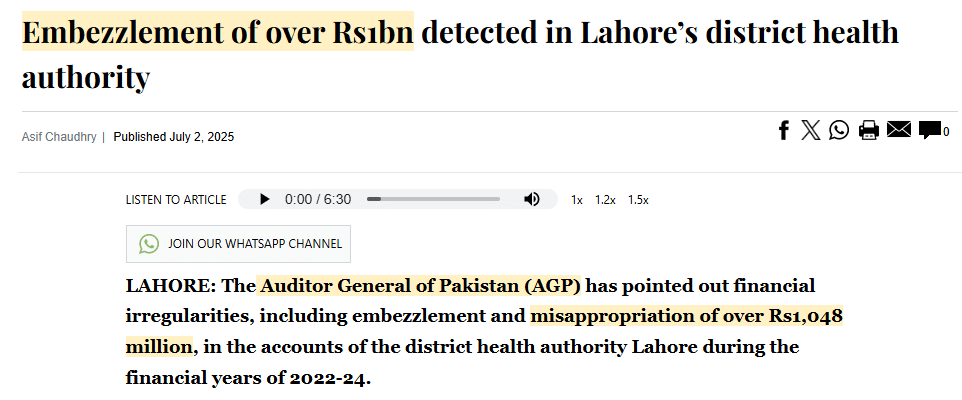
In a city constantly grappling with public health challenges, from recurrent dengue outbreaks to the ongoing fight against polio, the District Health Authority (DHA) of Lahore is a critical institution. Its mandate is to be a pillar of support for millions, managing health initiatives and ensuring access to essential care. However, a recent audit has exposed a shocking reality: the very authority entrusted with this vital responsibility has been compromised by a systemic and brazen campaign of embezzlement. The Auditor General of Pakistan (AGP) has detected financial irregularities and misappropriation of over Rs1,048 million in the DHA’s accounts for the financial years 2022-24, a betrayal of public trust that will have lasting repercussions.
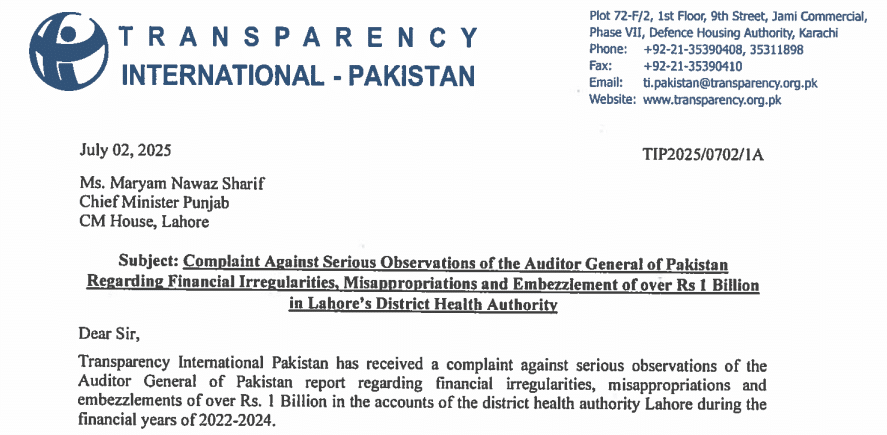
The scandal, uncovered through an AGP audit of just 12 of the authority’s 32 formations, reveals a sophisticated network of fraud and financial mismanagement. It paints a picture of an organization where rules were not merely bent but shattered, and public funds were treated as a personal slush fund for corrupt officials.
Source: Dawn
Irregular Procurement and Fraudulent Salaries
One of the most glaring issues highlighted in the report was the irregular purchase of bulk medicines worth Rs138.2 million. The Public Procurement Regulatory Authority (PPRA) rules are clear: such high-value procurement requires a competitive process involving at least three prequalified bidders. The DHA Lahore, however, issued a purchase order in flagrant violation of these rules, raising serious questions about kickbacks and favoritism. These are not merely administrative lapses; they are deliberate actions that bypass transparency and accountability, ensuring that public money is spent without proper oversight, often on subpar or overpriced goods.
You May Like To Read: Does Madrassa Only Produce Conservative People?
Further investigations exposed a more sinister form of fraud involving the very staff meant to carry out crucial health campaigns. An amount of Rs10.742 million was paid to contingent paid staff for polio and dengue activities through an elaborate scheme. A probe found that management had double or even triple-entered the same candidates with identical names and CNIC numbers into appointment orders and acquaintance rolls. This allowed for the drawing of multiple salaries for a single individual, a clear act of embezzlement.
The officials responsible attempted to dismiss the discrepancy as “typographical errors,” a claim the Special Departmental Accounts Committee (SDAC) rightly rejected as unsatisfactory. The SDAC has directed an administrative-level inquiry and ordered the recovery of the overpaid amount. This particular case highlights how fundamental public health programs can be undermined from within, as resources meant for fighting deadly diseases are stolen.
Ghost Employees and Missing Funds
The rot, however, runs deeper. The audit also revealed that of the total Rs192.7 million withdrawn from the treasury for the salaries of contingent-paid staff, an alarming Rs39.2 million was misappropriated. This suggests a widespread and coordinated effort to divert public money. Adding to this, the audit uncovered the unauthorized and fraudulent payment of salaries to absent employees. A total of Rs15.6 million was paid to 3,492 employees who were absent for 16,676 days. This specific fraud is particularly damning, as it indicates a total breakdown of internal controls and a profound disregard for both public funds and the integrity of the authority’s workforce. The issue of ghost employees and fraudulent attendance records is a classic sign of systemic corruption, and its scale within the Lahore DHA is truly breathtaking.
A Brazen Act and Broader Implications
Perhaps the most brazen act of fraud detailed in the article involves a single official, Dr. Hafiz Naveed of the DDOH Wahga Town. Following his transfer, he irregularly sanctioned and fraudulently withdrew an astounding Rs42.5 million. He accomplished this by opening an unauthorized bank account, depositing a treasury cheque for the substantial amount, and then withdrawing the funds using what were later determined to be fake hiring orders for staff. This act of audacity, carried out by an official in a position of trust, is a textbook case of white-collar crime and points to a critical lack of checks and balances within the administrative and financial systems of the DHA. It demonstrates that not only were there systemic failures, but individual actors were able to exploit these weaknesses for their own financial gain with little fear of immediate consequence.
The implications of this corruption are far-reaching. Lahore has a history of battling infectious diseases, with the poliovirus periodically detected in its sewage water and recurrent dengue outbreaks posing a constant threat. The very funds that were embezzled could have been used to strengthen disease surveillance, expand immunization campaigns, and improve sanitation infrastructure. Instead, a significant portion was simply stolen. This erosion of public funds directly impacts the ability of the DHA to fulfill its mandate, leaving the city more vulnerable to health crises. As an AGP report on the District Health Authority Rawalpindi also revealed, a lack of proper financial management and poor health facilities are recurring problems, indicating a broader systemic issue.
You May Like To Read: The Political Discourse Deteriorates | Personal Attacks Replace Policy Debates
A Call for Systemic Reform
The revelations from the AGP’s audit are a call to action for not only the Punjab government but also for civil society and oversight bodies. The fact that such a large-scale financial crime could occur over a two-year period, in a critical public sector department, highlights a desperate need for reform. It is imperative that all individuals found to be involved—from the lowest-level clerk to the most senior officers—are held accountable and that the stolen funds are recovered. More importantly, the system itself must be fortified. Stronger auditing mechanisms, greater transparency in procurement and hiring, and a culture of zero tolerance for corruption are the only way to prevent such a betrayal from happening again. For the citizens of Lahore, this scandal is a harsh lesson in how the erosion of institutional integrity can lead directly to the degradation of a public good as fundamental as healthcare.