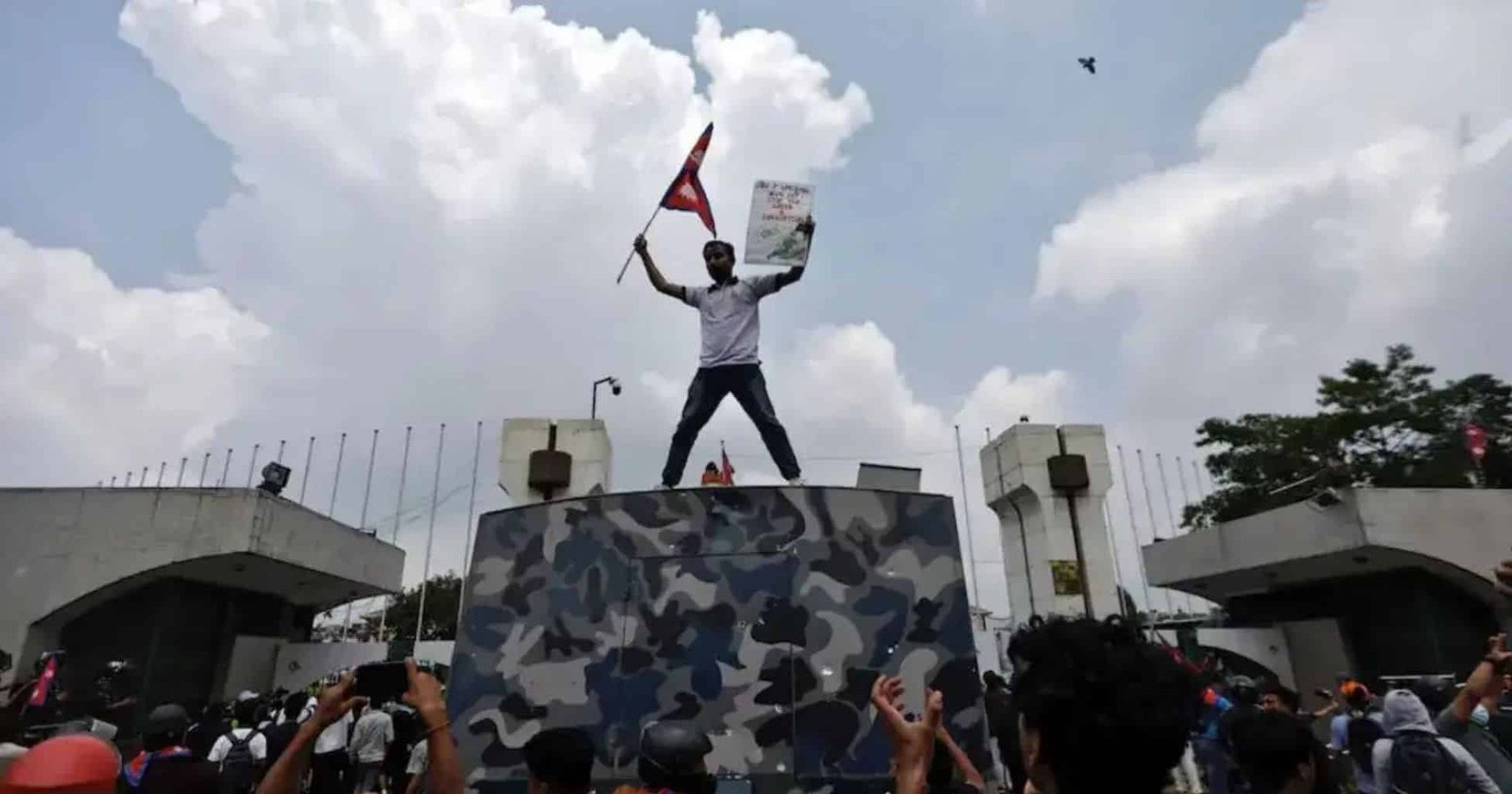





Recent political events in Nepal have seen widespread youth-led protests, popularly described as a “Gen Z uprising.” The movement triggered significant upheaval, culminating in the resignations of Prime Minister K.P. Sharma Oli and President Ramchandra Paudel. While the unrest cannot be reduced to a simple “taking down” of the government, it exposed the depth of frustration among Nepal’s younger generation. The immediate spark was the government’s controversial decision to ban 26 social media platforms, including Facebook, YouTube, and X, a move justified on the grounds of compliance with local regulations. For many young Nepalis, however, this ban was perceived as an attack on freedom of expression and an attempt to silence dissent.
The protests quickly evolved beyond the ban, becoming a broader movement against corruption, inequality, and economic stagnation. With youth unemployment hovering around 20% and a reliance on remittances, many young people felt alienated from an entrenched political elite. Campaigns like “NepoKid,” which highlighted the extravagant lifestyles of politicians’ children, only sharpened the contrast between rulers and the ruled. What began as peaceful demonstrations escalated when security forces used live ammunition, tear gas, and water cannons to disperse crowds. Dozens were killed, government buildings were set ablaze, and the crisis deepened until the Prime Minister and President both resigned under pressure.
Although Nepal’s situation is rooted in its own internal dynamics, its trajectory offers an important lesson. Some political actors in Pakistan have attempted to twist this narrative on social media, presenting it as an inspirational model for agitation. Such comparisons are misleading and dangerous, seeking to recreate unrest similar to the violent incidents of 9th May. Instead of recognizing the unique social and economic grievances behind Nepal’s turmoil, these groups weaponize selective comparisons to incite instability at home.
Manufactured Unrest, and Its Consequences
History shows that when agitation is fueled by misinformation and political opportunism, the costs are immense—ranging from economic paralysis to institutional erosion. Pakistan cannot afford to repeat episodes of violence that undermine law and order. Those who manipulate global narratives for local gain exploit citizens’ emotions while remaining shielded by political rhetoric. For this reason, public awareness is critical: people must be able to distinguish between genuine dissent and orchestrated attempts at sabotage.
🚨 Nepal videos are being misused to provoke another May 9. Remember! May 9 brought only shame, not strength. Pakistan’s real power is our Army and unity. 🇵🇰#PTIExposed #Irrelevant_Khan pic.twitter.com/vCT3hcO3Ek
— ✍️He Writes✍️ (@hewrites11) September 10, 2025
The Geopolitical Chessboard
Beyond domestic manipulation, the Nepal crisis illustrates how global and regional rivalries can shape political upheavals. Analysts suggest that pro-Indian forces may have leveraged the moment following the removal of a pro-China government, highlighting how such events can serve as proxies in broader geopolitical contests. Uprisings are not always organic—they can be engineered or amplified by external actors seeking to tilt the balance of influence in the region. For Pakistan, this underscores the need for vigilance. The country must resist becoming a pawn in such geopolitical games, where destabilization is often the intended outcome.
Guarding Against Destabilization
The lesson is clear: uprisings abroad should not be romanticized or imported, especially when they bear the imprint of foreign agendas. Pakistan’s strength lies in unity, stability, and resilience against both internal actors exploiting social media and external forces manipulating narratives. Every citizen carries the responsibility to recognize hidden agendas, reject calls for chaos, and defend national peace. Pakistan’s stability cannot be safeguarded by imitating the unrest of others, but only by standing united against manipulation—foreign or domestic—and choosing order, sovereignty, and progress over anarchy.
You May Like To Read: