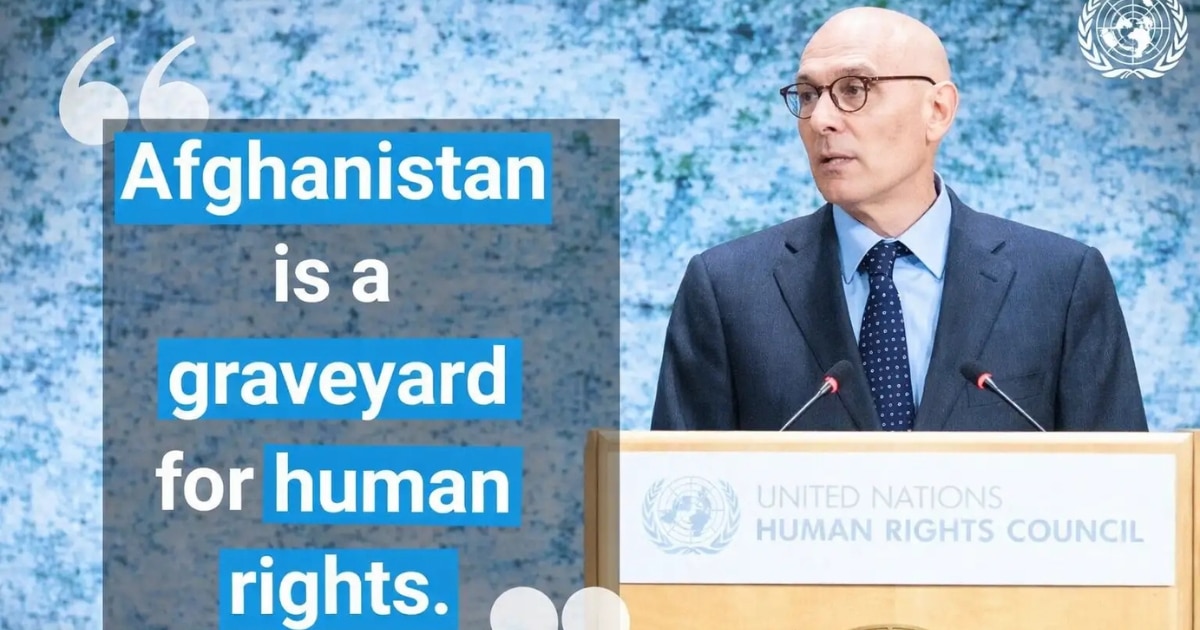





In a harrowing assessment delivered at the 61st session of the UN Human Rights Council, UN High Commissioner for Human Rights Volker Türk has described Afghanistan as a “graveyard for human rights.” The statement follows the signing of a new, sweeping decree by Taliban Supreme Leader Hibatullah Akhundzada, which is expected to deepen the persecution of women and silence dissent through legalized violence.
Simultaneously, Germany has marked a significant shift in European migration policy by executing its first direct deportation flight to Kabul, returning 20 convicted criminals under a controversial new technical agreement with the Taliban administration.
“Afghanistan is a graveyard for human rights.
It is up to every country to ensure that all interactions with the de factoauthorities are underpinned by respect for the human rights of all Afghans.
That is the only path forward.”
– @volker_turk at #HRC61 pic.twitter.com/10DQ6c7WME
— United Nations Geneva (@UNGeneva) February 26, 2026
The New Decree: Institutionalizing Repression
Commissioner Türk warned that the Taliban’s “cascade of edicts” is now being codified into a legal framework that systematically eliminates fundamental freedoms.
-
Legitimized Violence: The new decree (Decree No. 12) provides for corporal punishment—including floggings—for various offenses even within the home, effectively legitimizing domestic violence against women and children.
-
Expanded Capital Punishment: The decree significantly extends the list of offenses punishable by death, including “criticism of the de facto leadership” and its policies.
-
Gender Apartheid: Türk likened the system of segregation to apartheid, noting that women are now almost entirely criminalized in public life, with restrictions spanning education, employment, and even the sound of their voices in public spaces.
“#Afghanistan is a graveyard for human rights,” @UNHumanRights chief @volker_turk told the @UN Human Rights Council.
The system of segregation against women and girls in the country “is reminiscent of apartheid, based on gender rather than race,” he said.#HRC61 pic.twitter.com/vmsKGCcP8A
— UN Human Rights Council (@UN_HRC) February 26, 2026
Germany’s Policy Shift: Direct Expulsions to Kabul
In a move that has sparked both political praise and humanitarian outcry, Germany deported 20 convicted Afghan nationals from Leipzig directly to Kabul on Thursday.
-
The Deal: Federal Interior Minister Alexander Dobrindt confirmed that the flight was the first to occur without a third-party intermediary (like Qatar), based on a direct “technical” agreement reached with Taliban authorities in late 2025.
-
Convictions: The deportees were men convicted of serious crimes in Germany, including sexual offenses, aggravated assault, and drug trafficking.
-
Political Context: The resumption of direct flights is seen as a move by Berlin to take a tougher stance on migration amid the rise of far-right political groups. While Berlin still does not officially recognize the Taliban government, Minister Dobrindt stated the agreement creates a “reliable basis for permanent deportations.“
You May Like To Read: IMF Mission Signals Gradual Tax Relief in High-Stakes Meeting with Pakistan’s Industrial Leaders
The “Apartheid” Comparison
The UN human rights machinery, supported by 33 global women’s rights organizations, is now actively seeking to codify “gender apartheid” as a crime against humanity in international law. UN Women Special Representative Susan Ferguson noted that Decree No. 12 formally removes the concept of equality before the law, placing husbands in absolute authority over wives and making it nearly impossible for women to seek justice against abusers.
Check out our latest video: