



The Global Race: From Code to Compute, and to Rules
Artificial intelligence is no longer a niche research field; it’s a theatre of geopolitics and industrial policy. The European Union’s AI Act formally took effect in 2024 and began phasing in requirements through 2025, including bans on “unacceptable-risk” systems from 2 February 2025 and new obligations for general-purpose AI (GPAI) beginning in August 2025. This matters because market access will increasingly depend on compliance readiness across supply chains.
You May Like to Read: AI Governance as a New Battleground: The Race to Set Global Norms for Emerging Technologies
At the same time, access to advanced chips, the fuel of modern AI, remains entangled in U.S.–China export controls that have tightened and evolved through 2024–2025. For countries like Pakistan, these controls shape pricing, availability, and cloud access, not just hardware imports. The United States updated rules in March 2024 and again broadened controls in early 2025, while companies like Nvidia have had to repeatedly reconfigure China-market chips amid shifting policy. The larger point: compute supply, and therefore AI capability, will stay politically constrained.
Pakistan Finally has a National AI Policy, Now Comes the Hard Part
After years of drafts and consultations, the federal cabinet approved the National Artificial Intelligence (AI) Policy 2025 in late July–August 2025. The policy frames an AI ecosystem with goals ranging from talent pipelines to responsible use and commercialization. It is the right signal, investors and agencies need a single reference point for standards, incentives, and public-sector use cases. But policy documents only matter if they unlock budgets, institutions, and measurable programs.
Pakistan is not starting from zero. The National Centre of Artificial Intelligence (NCAI), launched in 2018 at NUST, seeded applied research labs across universities and industry verticals. Those labs have delivered pilots in agriculture, disaster management, and manufacturing, proving that local problem sets can attract AI solutions if given continuity and scale. The open question is whether NCAI and new policy instruments will be tightly coupled to procurement and mission-driven challenges across ministries.
Infrastructure, and Spectrum: The Bottleneck Nobody can Ignore
Real AI adoption hinges on reliable broadband and edge connectivity. Pakistan’s long-promised 5G spectrum auction is slated for 2025, with officials earlier indicating an April–May window; industry chatter and merger reviews have already caused slippage, a risk that must be managed transparently. The GSMA’s 2025 “Digital Nation” brief also flagged Pakistan’s relatively low IMT spectrum allocation in the region, a drag on speeds, coverage, and ultimately digital productivity. If the auction, refarming, and backhaul modernization don’t land coherently, the AI policy will struggle to reach citizens and SMEs.
Exports, and Talent: Momentum with Gaps
IT and IT-enabled services exports climbed to a record $3.22 billion in FY2023–24, and monthly numbers through late 2024 showed double-digit growth. That momentum is encouraging, but it also underlines the need for higher-value capture: moving from body-shopping to IP, platforms, and AI-powered products. The new AI policy’s ambitions, like large-scale upskilling, must translate into funded seats, modernised curricula, industry co-ops, and compute vouchers for startups, not just training certificates.
Regulation: Follow, Align, or Lead?
Pakistan will have to decide how closely to align with major markets’ rules. The EU’s risk-based regime will influence global vendors and buyers; even exporters targeting the Gulf or North America may face EU-style documentation and transparency demands from multinational clients. A practical path is “smart alignment”: adopt interoperable definitions of risk categories and documentation, encourage sectoral sandboxes, and recognize international certifications, without copying wholesale or stifling domestic innovation. The government can also publish a GPAI supplier checklist, model cards, training data disclosures, and incident reporting, so ministries and state-owned enterprises buy safely and consistently.
Compute Strategy: Cloud, Chips, and Sovereignty
Given the geopolitics of GPUs, Pakistan should treat compute as strategic infrastructure. That means three concurrent tracks: (1) negotiate reserved cloud capacity with auditability for sensitive workloads; (2) co-invest with private data-center operators in energy-efficient facilities tied to renewable power; and (3) participate in regional compute alliances to secure capacity during global crunches. Watching how export controls roil supply chains, from 2024’s tightened rules to 2025’s broader quotas, should inform procurement timelines and multi-vendor strategies, including non-U.S. alternatives where appropriate and lawful.
You May Like to Read: The ‘Digital Colonization’ Threat
The Decisive Shifts Pakistan can make in 2025–26
First, tie the AI policy to a funded delivery unit reporting to the SIFC and Cabinet, with quarterly dashboards on skills delivered, gov-tech deployments, and SME adoption. Second, run mission-driven flagship projects where AI visibly improves public services: crop yield forecasting tied to crop insurance; flood-risk early warnings pushed to district dashboards; and Urdu/regional-language digital assistants for citizen services. NCAI’s existing domain labs offer a springboard, use them to co-design with ministries and to scale what already works.
Third, fix the spectrum and fiber now. Conclude the 5G auction with clear business-case assumptions (spectrum floors, rollout obligations, local manufacturing incentives) and a parallel program to modernize backhaul and cut right-of-way friction. Publish a public tracker of spectrum release and site densification so investors and app developers can plan with confidence.
Fourth, make compliance a competitive edge. Issue procurement guidance that mirrors EU-style AI documentation so Pakistani vendors can sell into strict markets without costly rework. Offer grants to help local firms complete conformity assessments and security audits. With the EU timelines now locked in despite industry pushback, Pakistani exporters that prepare early will win contracts others cannot even bid for.
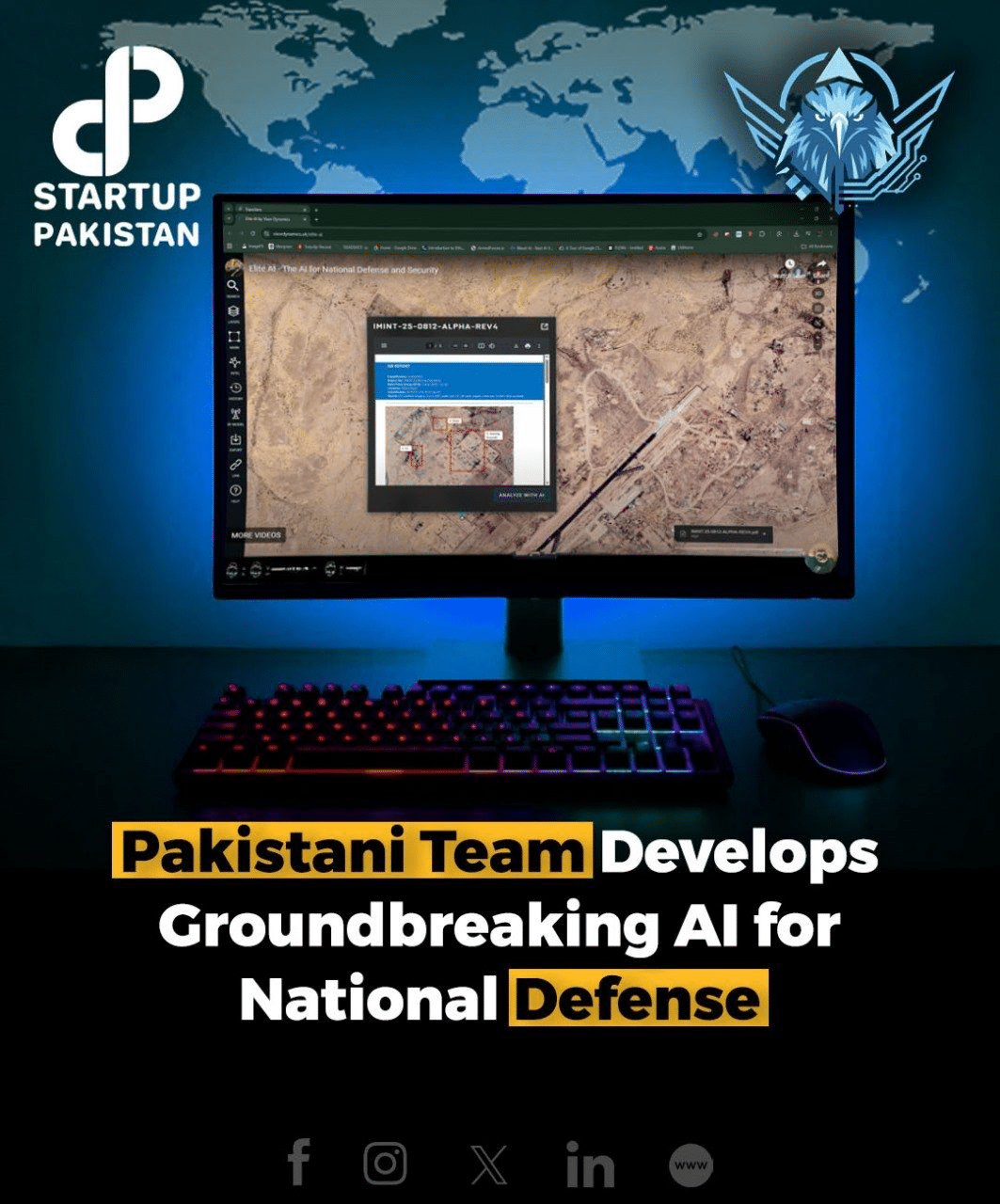
Pakistan Sets New AI Benchmark with Elite AI Launch
In a landmark achievement for Pakistan’s tech landscape, Islamabad-based startup Visor Dynamics has introduced Elite AI, a cutting-edge artificial intelligence platform built entirely by local talent for defense and national security applications. Reported today, this breakthrough places Pakistan among the few nations developing indigenous AI systems tailored for critical national needs. Industry experts are calling it a milestone for the country’s rapidly maturing startup ecosystem, proving that Pakistani innovators can compete on the global stage. Beyond its defense significance, Elite AI is being celebrated as a powerful symbol of technological self-reliance and the country’s growing digital future.
Bottom Line: From Policy Follower to Capability Builder
Pakistan’s approval of a national AI policy in mid-2025 is a necessary foundation. But the global race is about execution under constraint, compute geopolitics, compliance complexity, and tight capital. Countries that move fastest convert regulation into trust, spectrum into ubiquitous connectivity, and research labs into product companies. If Islamabad couples its AI policy with spectrum reform, mission-led deployments, and export-grade compliance, Pakistan can be an adapter rather than a follower, creating good jobs and resilient public services in the process. If not, the policy will join a shelf of worthy documents outpaced by events. The next 12–18 months will decide which way this story goes.