




As Artificial Intelligence (AI) transitions from experimental utility to foundational infrastructure, the global race to define its governance norms has intensified. What was once a technological competition has become a full-spectrum geopolitical contest. At stake is not just regulatory supremacy, but the power to shape the ethical, economic, and legal DNA of the 21st century.
The world is witnessing the emergence of three dominant models of AI governance: the European Union’s regulatory-first framework, China’s centralized techno-authoritarian model, and the United States’ innovation-centric approach. Each reflects distinct values and geopolitical priorities—and their divergence raises profound risks for global digital cohesion.

The EU Model: Guardrails Before Growth
The European Union has positioned itself as the normative vanguard of AI regulation. The landmark AI Act, passed in 2024, classifies AI systems based on their potential risk—prohibiting “unacceptable” uses such as social scoring and biometric mass surveillance, while heavily regulating high-risk applications in healthcare, education, and law enforcement. It also mandates transparency in AI-generated content and decision-making processes.
“We aim to ensure that AI in Europe is safe, transparent, and aligned with our fundamental rights,” said Margrethe Vestager, the EU’s digital commissioner, in an official statement.
The EU approach is rights-driven and precautionary, grounded in digital ethics and a desire to prevent “algorithmic discrimination.” However, critics argue it risks stifling innovation and creating regulatory barriers for smaller firms and non-European countries seeking market access.
China: Algorithmic Control as Statecraft
At the other end of the spectrum, China’s model of AI governance is tightly fused with its state security doctrine. The Cyberspace Administration of China (CAC) has issued a slew of regulations governing recommendation algorithms, deepfakes, and generative AI models, all emphasizing alignment with “core socialist values” and national security.
Surveillance remains a core function. China’s AI strategy supports its social credit system, real-time facial recognition networks, and predictive policing—all designed to reinforce centralized control. Beijing also maintains strict export controls on foundational AI models, cloud computing, and chips, framing AI as a strategic resource akin to rare earth metals.
You May Like To Read: A Second Wave of Displacement Grips Khyber Pakhtunkhwa
A 2024 report by the Center for Security and Emerging Technology noted that “China’s AI regulations are not merely technical tools—they are mechanisms of political discipline.”
The U.S. Model: Innovation First, Regulation Later
The United States, home to the world’s leading AI firms, has adopted a more laissez-faire, market-led approach. While the Biden administration’s 2023 Executive Order on AI introduced some principles around transparency, safety testing, and data privacy, enforcement remains fragmented.
Silicon Valley’s dominant players—OpenAI, Google DeepMind, Anthropic, and others—largely drive global standards through private initiatives and multilateral partnerships. The emphasis remains on speed, scale, and innovation, with limited federal oversight compared to the EU or China.
Washington’s strategy is now evolving, however, under geopolitical pressure. The launch of the U.S. AI Safety Institute and proposed federal legislation on model audits and watermarking reflect an emerging shift, particularly amid concerns about misinformation and cyber vulnerabilities in the 2024 elections.
A Fragmented Landscape: Toward Algorithmic Blocs?
This normative divergence is giving rise to what some analysts call an “algorithmic cold war.” As states pursue incompatible models, the global internet—already fractured by firewalls and content moderation laws—risks being divided by AI governance regimes.
A report by the Carnegie Endowment warns of an emerging “AI bipolarity,” where nations align with either the U.S.-led innovation bloc or China’s techno-authoritarian model, with the EU trying to act as a regulatory middle power. The result could be “algorithmic apartheid”—in which countries face exclusion from AI tools, data pools, or compute infrastructure due to their regulatory alignment or lack thereof.
“AI governance is now a litmus test of digital sovereignty,” said Marietje Schaake, director at Stanford’s Cyber Policy Center, during a recent panel at the Munich Security Conference.
This raises serious implications for international law and digital ethics. Can universal human rights norms survive in a world where AI decision-making is defined by divergent values? What happens to multilateralism when the infrastructure of global communication—recommendation systems, translation models, autonomous decision-making—is increasingly proprietary, black-boxed, and regionally siloed?
You May Like To Read: Tragedy Strikes Off Yemen Coast as Migrant Boat Sinks, 76 Dead
Norms-Setting as a Strategic Arena
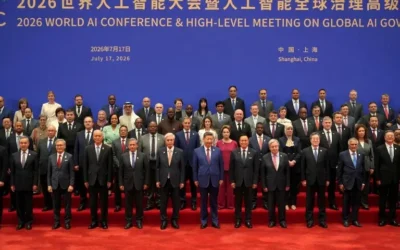
Despite calls for global coordination, the UN-led efforts through the Global Digital Compact and the AI for Good Global Summit remain largely symbolic. Major powers prefer plurilateral forums like the G7’s Hiroshima AI Process, the U.S.-EU Trade and Tech Council, and China’s Digital Silk Road to push their governance preferences.
This fragmentation hampers collective responses to shared risks such as:
- AI-generated misinformation and electoral interference,
- Bias in health diagnostics or credit scoring,
- Proliferation of autonomous weapons and surveillance systems.
The stakes are high: without interoperable governance, the next decade could see the global AI ecosystem evolve in radically divergent directions—one regulated by ethics, another by control, and a third by profit.
Toward Ethical Multipolarity or Strategic Balkanization?
AI governance is no longer a technical challenge—it is a geopolitical one. As emerging technologies like quantum computing, synthetic biology, and autonomous systems converge with AI, the lack of consensus on oversight mechanisms could lead to a dangerous vacuum.
The race is on not just to build AI, but to define what kind of AI future is legitimate. Whether the outcome is ethical multipolarity or strategic Balkanization depends on what states, firms, and civil societies choose to prioritize: collaboration or control, rights or reach, safety or speed.