


GAZA | WEST BANK | PALESTINE——The past week has witnessed a severe intensification of the humanitarian crisis and instances of violence across the Palestinian territories, alongside significant international reactions. Reports highlight escalating casualties, dire starvation conditions, and continued displacement, painting a grim picture of the ongoing conflict.
Violence, Casualties, and Persecution
- In Gaza, a staggering number of Palestinians were reportedly killed while seeking vital humanitarian aid. Authorities in Gaza reported that Israeli forces fatally shot 93 Palestinians attempting to receive assistance on Sunday, July 20. These deaths occurred across various aid distribution points, including northern Gaza, near Rafah, and Khan Yunis.
- The UN World Food Programme (WFP) confirmed that their 25-truck food aid convoy encountered “massive crowds of hungry civilians which came under gunfire” near Gaza City. The Israeli military disputed casualty figures, claiming only warning shots were fired when threatened by large crowds.
- The UN human rights office stated that over 1,000 Palestinians have been killed by Israeli forces since May while trying to obtain food in Gaza. The majority of these incidents occurred near aid sites.
You May Like To Read: Tragic Crash: Soviet-Era Plane Claims 48 Lives in Russia’s Far East
- In the West Bank, violence also surged. Between July 15 and 21, two Palestinians, including a child, were killed by Israeli forces. Additionally, a Palestinian man died in Israeli custody under unknown circumstances. At least 45 Palestinians were injured during the same period.
- Israeli forces also killed two Palestinian teenagers near Bethlehem. Their bodies were withheld by the Israeli army, according to Wafa news agency. Israeli violence in the occupied West Bank has escalated dramatically since the Gaza war began.
- Overall, the conflict, which began in October 2023, has resulted in over 59,210 Palestinian deaths and more than 143,040 injuries, according to a Xinhua report.
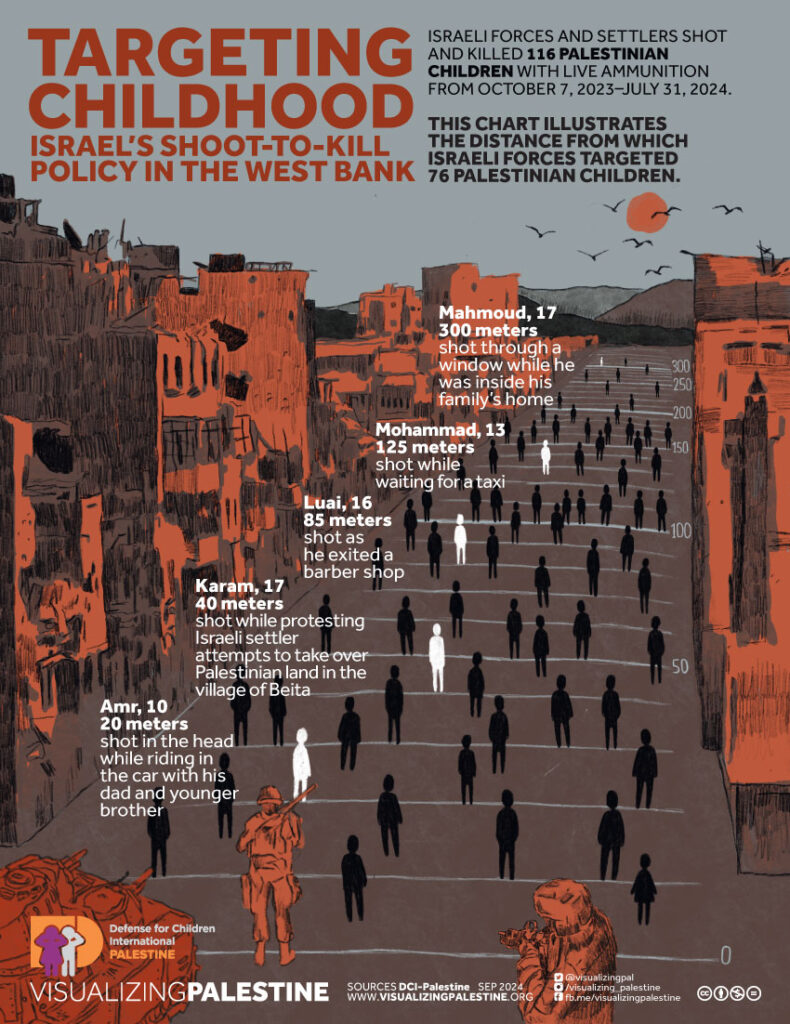
Source: Visualizing Palestine
Dire Humanitarian Situation and Persecution
- The hunger crisis in Gaza has reached “new and astonishing levels of desperation,” says the WFP. Nearly 100,000 women and children suffer from severe acute malnutrition.
- A third of Gaza’s population is going without sufficient food. MedGlobal reported five children as young as 3 months old died from starvation in the past three days. “This is a deliberate and human-made disaster,” said Joseph Belliveau. A Xinhua report noted that 122 fatalities are attributed to hunger and malnutrition, mostly children. Tens of thousands of Yemenis protested in Sanaa against the “man-made” starvation in Gaza.
- Aid workers are witnessing colleagues “waste away” from hunger. Over 100 organizations are urging governments to act to open all land crossings for aid. Aid deliveries are described as “woefully inadequate,” with one in five children in Gaza City malnourished.
- The Israeli military issued new evacuation orders for parts of Deir Al-Balah. This further compresses 2.1 million displaced civilians into less than 12% of Gaza’s territory. UN officials warn this “chokes humanitarian access.”
- OCHA documented the demolition of nine Palestinian-owned structures lacking Israeli permits in the West Bank. Nine Palestinians were displaced, and 50 livelihoods affected.
- Settler violence against Palestinians also increased. The UN human rights office reported 757 settler attacks in the first half of 2025. This is a 13% increase from the same period last year.
Developments on the International Stage
- On July 21, the UK and 30 international partners issued a joint statement on the Occupied Palestinian Territories. They condemned the “drip feeding of aid” and “inhumane killing of civilians” in Gaza.
- The statement called for an immediate, unconditional, and permanent ceasefire. It also urged Israel to lift aid restrictions and enable humanitarian NGOs to operate safely. France, along with the UK and Germany, issued a joint declaration urging an immediate ceasefire, unconditional release of hostages, and lifting of restrictions on humanitarian aid, emphasizing Israel’s obligations under international humanitarian law.
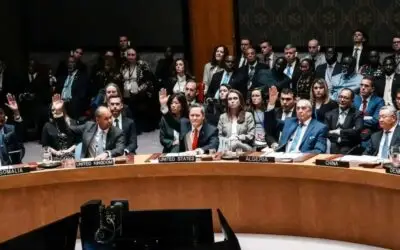
- The UN Security Council heard from Assistant Secretary-General Khaled Khiari. He stated that UNRWA, the agency aiding Palestinian refugees, will run out of funds by 2025.
- A high-level international conference for the peaceful settlement of the Question of Palestine is set for July 28-30. Co-chaired by France and Saudi Arabia, it will take place at the UN General Assembly. Amnesty International called on states to prioritize ending Israel’s “genocide and unlawful occupation”.
- French President Emmanuel Macron stated that France will formally recognize the State of Palestine in September. This will occur at the UN General Assembly session. This move was rejected by the U.S. as “reckless.”
- Ceasefire talks between Israel and Hamas, mediated by Qatar and Egypt, were at a standstill. Both US and Israeli negotiating teams were recalled on Thursday. Negotiations began on July 6, and some progress was reported. Talks are expected to resume early next week. U.S. President Donald Trump expressed skepticism about Hamas making a deal.
You May Like To Read: France’s Symbolic Recognition vs. Gaza’s Engineered Famine
- Israeli Prime Minister Netanyahu stated his government was considering “alternative options” to ceasefire talks. This indicates a potential shift in strategy, as he considers new ways to release Israeli hostages–possibly more genocidal violence.
- Despite stalled talks, the Israeli military announced airdrops of aid would begin in Gaza. Humanitarian corridors for UN convoys would also be established after increasing reports of starvation.
The Pattern of Genocidal-Violence
The week underscores the severe and deteriorating conditions in Gaza and the West Bank. It highlights persistent calls from the international community for an end to hostilities and increased humanitarian access. The cumulative effect of these events, including widespread killings, deliberate deprivation of aid, and displacement, has led some international bodies and states to raise serious concerns about Israel’s actions potentially constituting genocide.
South Africa’s case at the International Court of Justice (ICJ) explicitly alleges such violations, pointing to a pattern of conduct that seeks to destroy a substantial part of the Palestinian group. While Israel denies these accusations, arguing its actions are self-defense, critics emphasize the deliberate infliction of conditions calculated to bring about physical destruction, drawing parallels to a planned campaign of persecution.