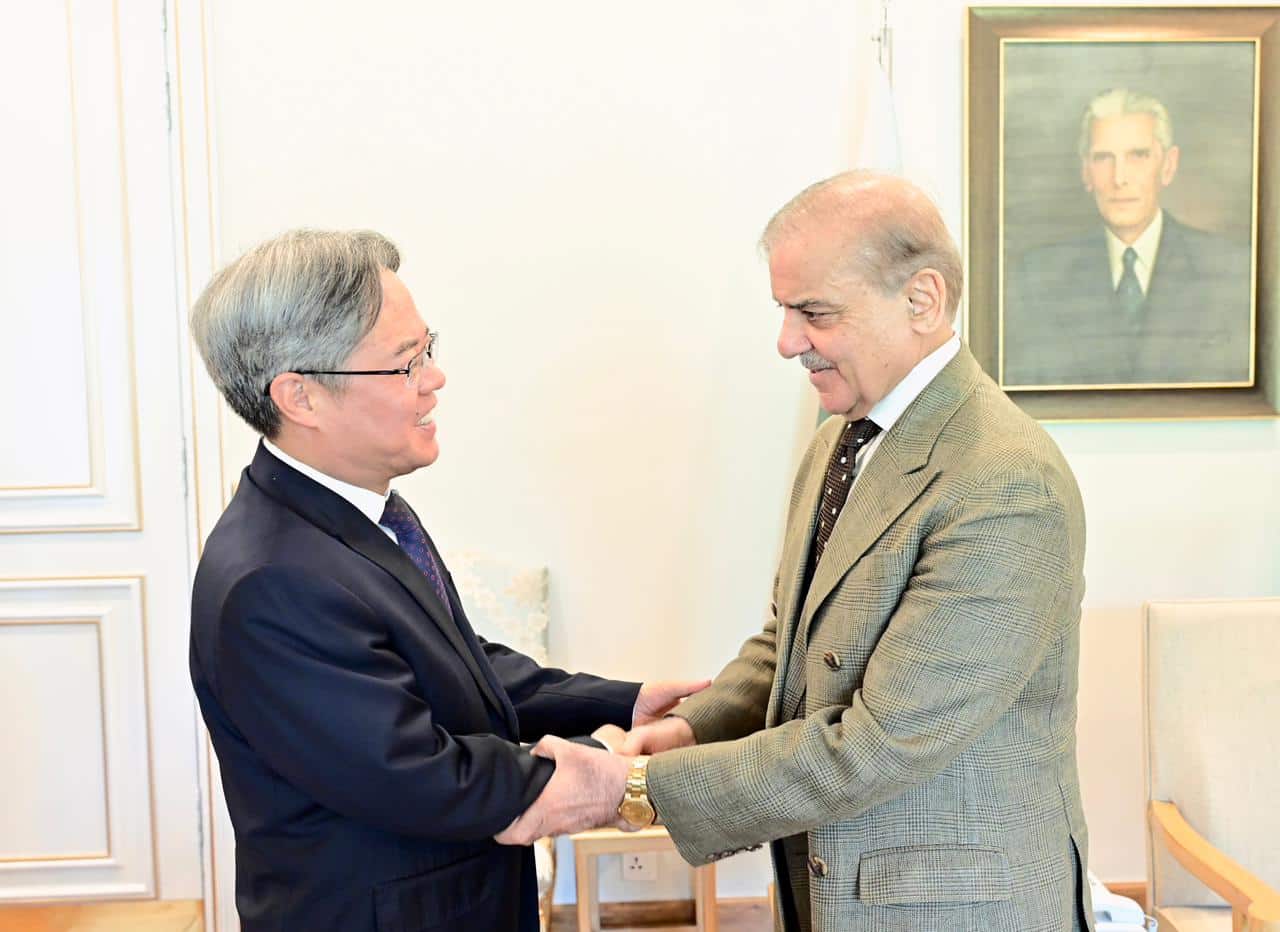



Prime Minister Shehbaz Sharif held a high-level strategic meeting with Chinese Ambassador Jiang Zaidong at the Prime Minister House on Wednesday, directing federal ministries to immediately execute over $7 billion worth of agreements and Memorandums of Understanding (MoUs) signed during his recent landmark visit to China.
The meeting focused heavily on operationalizing the massive economic outcomes of the third Pakistan-China Business-to-Business (B2B) Investment Conference held in Hangzhou on May 24. The premier expressed deep gratitude for Beijing’s hospitality and emphasized that both nations must now move with absolute urgency to convert these paper agreements into tangible infrastructure and industrial realities.
“While conveying his firm resolve to ensure the further strengthening of the Pakistan-China All-Weather Strategic Cooperative Partnership, the Prime Minister emphasized the need to immediately initiate necessary actions for follow-up on the important decisions taken during his visit,” the Prime Minister’s Office (PMO) stated.
The high-stakes diplomatic huddle also prioritized the fast-tracking of the Karakoram Highway (KKH) realignment project, alongside a comprehensive expansion of bilateral counter-terrorism, security, and defense cooperation. The meeting holds significant symbolic and strategic weight as 2026 marks the historic 75th anniversary of the establishment of ironclad diplomatic relations between Islamabad and Beijing.
ISLAMABAD: 3 June 2026.
H.E. Amb. Jiang Zaidong, Ambassador of the People’s Republic of China to Pakistan, called on Prime Minister Muhammad Shehbaz Sharif at the Prime Minister House today.
Adviser to the Prime Minister Dr. Syed Tauqir Shah, SAPM Syed Tariq Fatemi and Foreign… pic.twitter.com/c1c3bfW4GB— Prime Minister’s Office (@PakPMO) June 3, 2026
Critical Analysis: Bureaucratic Friction, Security Imperatives, and CPEC 2.0 Realities
The transition from CPEC’s initial infrastructure phase to the highly specialized “CPEC 2.0” framework introduces a complex web of economic opportunities and security challenges. A critical analysis of the Prime Minister’s latest directive highlights several vital takeaways:
Breaking the Legacy of “MoU Fatigue”
The premier’s explicit demand for “immediate action” exposes a persistent bottleneck in Pakistani governance: the implementation gap. Historically, Pakistani administrations have celebrated multi-billion dollar MoU signings that later languish in bureaucratic red tape. By personally demanding a direct follow-up on the $7 billion Hangzhou portfolio—which targets critical green-energy sectors like EV charging infrastructure, battery energy storage, solar tech, and pharmaceuticals—Sharif is attempting to signal to Chinese investors that Islamabad is shifting from a state-led debt model to an agile, market-driven B2B execution model.
The Strategic Anchors of CPEC 2.0
The emphasis on Special Economic Zones (SEZs), information technology, agriculture, and minerals defines the blueprint of CPEC 2.0. This phase is less about pouring concrete for highways and more about structural economic integration:
-
Agriculture & Minerals: Designed to create a direct export corridor to feed China’s massive domestic markets and supply its industrial base with Pakistani raw minerals.
-
IT & SEZs: Aims to relocate low-cost Chinese manufacturing and tech assembly lines to Pakistan, leveraging cheaper domestic labor to generate vital foreign exchange reserves for Islamabad.
The Security-Investment Nexuses
The PMO’s admission that “counter-terrorism and defense cooperation” topped the agenda underscores a stark reality: Chinese capital will not flow into CPEC 2.0 without airtight security guarantees. Following a series of highly targeted militant attacks on Chinese nationals working in Pakistan over the past year, Beijing has drastically raised its security expectations. The expansion of defense cooperation discussed on Wednesday indicates that Pakistan is likely granting China greater oversight, intelligence sharing, or joint security architecture over shared economic corridors to safeguard the $7 billion investment pipeline.
75 Years of Ironclad Diplomacy as a Sovereign Shield
Celebrating 75 years of diplomatic relations is more than just a ceremonial milestone; it serves as a critical geopolitical anchor. In an era of shifting global alliances—where the United States is pushing protectionist tariffs and intensifying its rivalry with Beijing—Pakistan is doubling down on its “ironclad” partnership with China. This alignment provides Islamabad with a vital economic buffer and financial support system, ensuring that despite heavy Western economic pressures, Pakistan retains a reliable global superpower as its primary economic and defense guarantor.