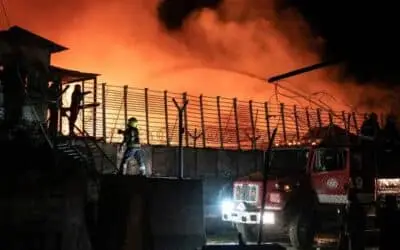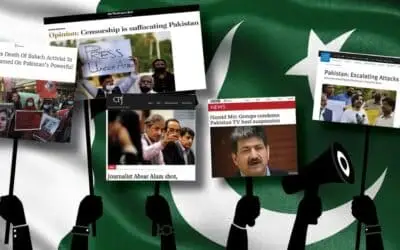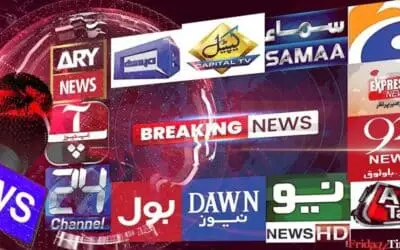



Even in the contemporary world, wars are no longer waged by weapons only, now they weaponise words, images, and information. This is a new form of war called a hybrid war, where both traditional army capabilities and advanced methods of impacting the psyche through social media, inducing confusion, and undermining the country internally are used.
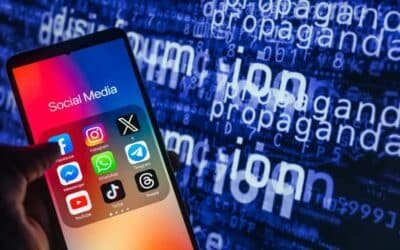
Facebook, X (previously Twitter), and TikTok are social media platforms used in this kind of digital war in Pakistan. All this is used to propagate misinformation, cause sectarian or political tension, and even sway national discussions. These tactics are particularly effective in Pakistan due to the complicated internal segmentation and the conflict between regions.
This article discusses the utilization of these platforms in the case of information warfare (IW) and the way algorithms contribute to the dissemination of harmful content at a rate far more expansive than the truth. It is by appreciating this cyber battlefield that we become well-equipped to defend our society and our country together against unseen forces.
Hybrid Warfare in the Digital Space:
Hybrid warfare is a novel type of conflict in which nations or organizations apply a combination of military and non-military strategies to undermine adversaries. Information warfare is one of the key aspects of such a strategy and entails the release of misleading or false information to disorient people, impair the authority of the institutions, and split communities. The warfare in the age of the Internet frequently occurs in the realm of social media when communication can reach the number of millions of users in a relatively short time.
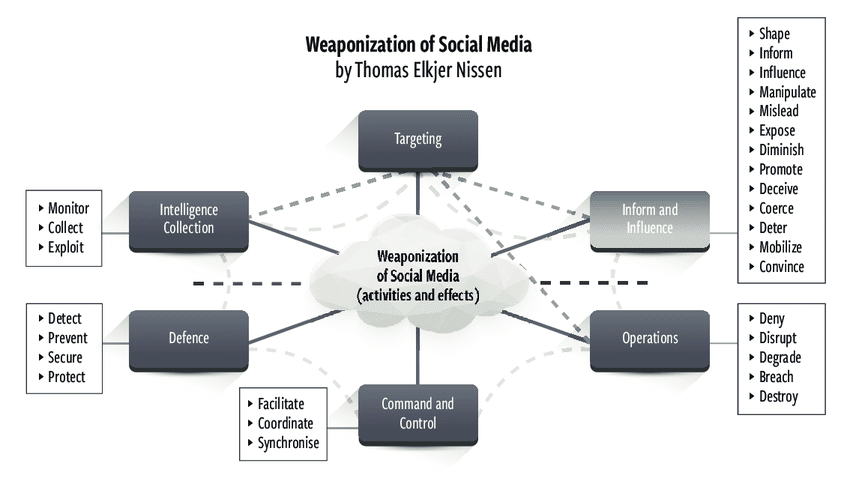
Source: Jan Kallberg
In Pakistan, hybrid warfare is not only something that is externally directed: it is also a form of activity carried out within the country to influence the opinion of a certain part of the population, to carry out political activities, or to fan sectarian conflicts or communal conflicts. Despite the importance of filters to traditional media, social media gives such actors a chance to avoid such filters and have their way directly to the minds of the people, and most of the time, in ways they are not aware of.
In view of the above, hybrid warfare is particularly threatening for a country like Pakistan, where the low level of digital literacy, polarized politics, and weak stability on regional grounds facilitate manipulation of narratives and public perception. The first method of creating national resiliency is to understand how the threat works.
Influence and Exploitation: Tools of Platform-Specific Analysis
Facebook usage is high in Pakistan, with high popularity among young adults and teenagers. In 2024, there were more than 45 million users of Facebook; and 3070 million users worldwide who preferred this social media platform. On one hand, it is associated with bridging a gap between people; on the other hand, it disseminates fake news, hate speech, and propaganda.
Facebook is used to propagate divisive content by political entities, Hindu sectarian actors, and foreign groups through the use of groups and pages. To cite just one example, rumors of religious minorities or political leaders on the Internet regularly spread without any fact-checking and cause real violence and disturbances in the field.
The algorithm used by Facebook allows people to see the content aligned with their beliefs, thus forming the so-called echo chambers where one-sided opinions are displayed. This further enforces prejudice and subjects individuals to manipulation. Although there is content moderation, there is no good local monitoring in Pakistan, and any dangerous content can circulate freely.
X (Formerly known as Twitter)
Real-time news and political narrative in Pakistan, and even globally, are disseminated on and by X (formerly Twitter). The political parties, journalists, and influencers often use this platform, as it has approximately 5.2 million users in Pakistan alone. It is, however, also used via coordinated hashtag operations, bot accounts, and troll farms to disseminate fake news, and even to run defamation campaigns. To give an example, popular hashtags can be generated during national events or protests to spread fake information or target an opponent.
Several studies revealed that false accounts or international bots manipulate most of the trending issues in Pakistan. X’s algorithm will push the trending topics not based on truth, which implies that the fake information will be able to spread quickly compared to the news that is verified, which affects the perception and stability of the nation.
TikTok
TikTok has more than 54.38 million users in Pakistan, and it is immensely popular among young people. The content on tiktok is short, emotional, and visual, thus, making it an excellent instrument of emotional manipulation and propaganda. The objectionable content available on TikTok includes extreme nationalism, more like jingoism, sectarian bias, and false political claims meant to deceive the users and garner millions of views. Toxic content has become widely unmonitored because of limited moderation, and being posted in regional languages, identifiable by the social media regulators. This renders TikTok an expanding area of influence for activities against the more impressionable youth in Pakistan.
Among the most widespread messaging applications in Pakistan, WhatsApp has more than 60 million users. In contrast to the open platforms, WhatsApp operates based on individual and group chats. Thus, it is much more difficult to control and makes it even more difficult to track the direction of false information. Messages, videos, and voice notes forwarding fake news on the political, religious, health (such as cases of COVID-19), and incidents of security breach usually gain currency without any verification element.
As an example, insidious information published on WhatsApp resulted in panic, lynching, and inter-religious tensions during election seasons or suddenly occurring emergencies in the country. The recent labels, such as “Forwarded Many Times,” were also introduced. Although, with no control over it and end-to-end encryption, the platform is still one of the most threatening in the context of information warfare in Pakistan. The Digital Rights Foundation and other studies have also evidenced the use of WhatsApp in strengthening rumors and dividing opinions.
The Algorithmic Dilemma: Platforms Accentuating Perverse Content
Even social media such as Facebook, TikTok Tok and X will have algorithms that rank the content based on its uploader engagement, likes, comments, shares, and views. It implies that the more emotional, hot, or shocking a post is, higher are its chances of going viral. Due to this, fake news, hateful content, and disintegrating material is frequently popular on social media platforms and seen going viral.
This happens in Pakistan at a particularly dangerous cycle of fast spreading false accounts, particularly in matters of politics, religion, and ethnicity. As an example, content that causes anger or reinforces current prejudices is shown first in the feed of individuals, which results in the development of polarized virtual universes, adds tension to society, and serves to disintegrate it further on the basis of sociopolitical or ethnic markers.
These algorithms are never clear, and most platforms do not have moderators in local languages; hence, destructive content in Urdu and regional languages can pass easily. Although firms such as Meta and TikTok argue for enforcing community standards; however, they remain poor in Pakistan.
Also, on applications such as WhatsApp, even the application is unable to see the content as it is encrypted, rumors and fake messages can be spread without restrictions, and mostly during times of crisis. This increases the difficulty in response by fact-checkers and authorities before it is too late. De facto, the algorithms give preference to speed and virality, instead of veracity, making social media an articulate yet perilous tool of hybrid and information warfare.
Conclusion
Social media, as we all live in a globalized world now, is one of the potent instruments of the hybrid war, most significant in countries like Pakistan with low digital literacy and social segregation. Means of communication such as Facebook, X (Twitter), TikTok, and WhatsApp are all more than means of communication, they have now been turned into battlefields where stories are fabricated, false narratives disseminated, minds shaped, and wars escalated.
These platforms promote and propagate toxic, misleading, disintegrating, and frivolous content; meanwhile the regulators do not even look at it due to the absence of local laws and supervision, which leads to the dissemination of misinformation and fake news like wildfire. Pakistan is experiencing considerable challenges when dealing with internal and external problems, therefore, the need to enhance digitalised governance, public awareness, and promote responsible platform behaviour is imminent. There is no other option but to fight back the mighty-invisible perils of information warfare, by raising awareness among citizens and implementing effective policies, before the damage is beyond our control.