Pakistan’s judiciary today is grappling with more than just a backlog—it is contending with a wave of vexatious litigation, defined as frivolous, speculative, or malicious lawsuits intended to harass or stall genuine cases. Such litigation has emerged as a systemic problem, burdening courts, undermining due process, and eroding public confidence in the legal system.
Systemic Spread and Scale
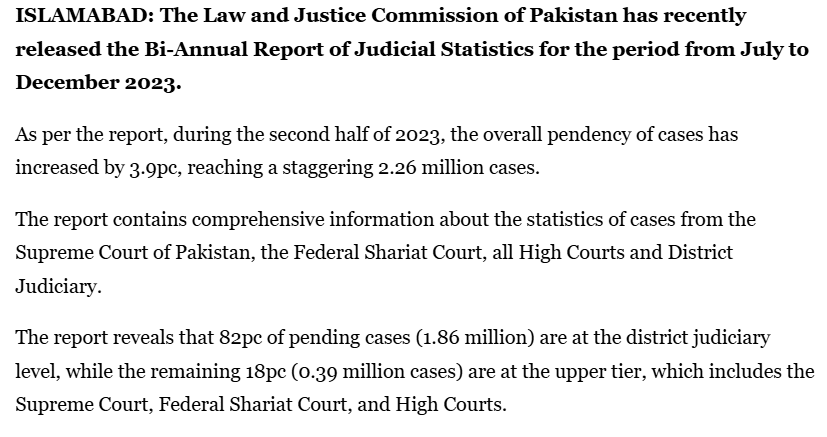
As of December 2023, the Law and Justice Commission of Pakistan reported approximately 2.26 million cases pending across all tiers of the judiciary—about 1.86 million in district courts and 390,000 in High Courts and the Supreme Court combined. Despite disposing roughly 2.30 million cases during the second half of 2023, 2.38 million fresh cases were filed, leaving the backlog virtually unchanged.
Source: Dawn
In August 2024, the Supreme Court reiterated that this backlog is significantly inflated by frivolous and speculative litigation, which “unduly burdens the courts” and delays resolution of legitimate disputes. This conclusion was grounded in Justice Mansoor Ali Shah’s order on a property case, which cited about 2.255 million pending suits.

Source: The News
You May Like To Read: Civil Service Reforms 2025
Strategic Misuse: Litigation as a Weapon
Vexatious litigation in Pakistan often takes the form of property disputes filed across multiple jurisdictions to impose stay orders or repetitive interlocutory petitions to postpone enforcement indefinitely. These methods serve as tools for harassment in familial or political conflicts, often without merit. Lower-court judgments have explicitly labelled some petitions as “ill–motivated” and “vexatious,” suggesting costs should be imposed to deter such abuse.
Structural Enablers of Abuse
Several attributes of Pakistan’s judicial framework unwittingly encourage litigious misconduct:
- The Code of Civil Procedure (1908) remains outdated, enabling procedural delays and endless adjournments.
- Case‑management systems are weak or non‑existent; a single judge in a busy civil court in cities like Lahore or Islamabad may juggle hundreds of cases simultaneously, which diminishes oversight and court control.
- There is minimal precedent or enforcement of sanctions or fines—even the Supreme Court’s own rule (Order XXVIII, Rule 3) encouraging costs for vexatious filings is rarely used.
- Training gaps in lower courts mean frivolous petitions are not quickly filtered.
Consequences: Delay, Disillusionment, Denied Justice
The consequences of this environment are manifold:
- Genuine litigants face wait times of several years, often exceeding a decade for complex property or civil matters—a function of both volume and strategic delay tactics.
- Public trust is eroding: courts appear unresponsive, justice seems inaccessible, and legal redress becomes prohibitively slow.
- Judicial resources are wasted on meritless cases, reducing capacity to address more urgent disputes, including criminal and human rights matters.
You May Like To Read: Overview of Pakistan`s Key Strategies in Climate Response
Existing Efforts and Gaps
Judicial leadership has recognized the problem:
- The Sindh High Court has urged the imposition of actual costs to deter vexatious petitions.
- The Supreme Court, through Justice Mansoor Ali Shah, has formally called for strict application of its own cost‑sanction provisions and greater use of ADR mechanisms to reduce caseload pressure and encourage settlements.
- At the institutional level, Chief Justice Yahya Afridi initiated reform programs to clear pending tax, revenue, and general civil case backlogs—forming expert committees and diagnostic studies to restructure case processes, digitization efforts, and reduce needless filings before the apex court.
- The Lahore High Court has proposed ‘double shifts’ to increase judicial time, though critics warn that without deeper procedural reforms, it may offer only superficial relief.
Source: The Friday Times
Recommendations for Systemic Reform
To comprehensively address vexatious litigation, the following measures merit consideration:
- Mandatory preliminary filtering benches: A first‑instance assessment of merit to weed out baseless suits early.
- Enforce cost sanctions: Consistent application of Order XXVIII, Rule 3 in property and civil cases to make frivolous claims financially untenable.
- Better case‑management systems: Introduce data‑driven tracking, limit the number of active cases per judge, and digital scheduling of hearings.
- Limit interlocutory appeals: Curb repeated adjournments and stay orders by restricting repeat petitions against interim orders.
- Promote ADR: Institutionalise mediation and arbitration for property or family disputes to reduce court dependency.
- Judicial training and sensitisation: Educate lower‑court judges on patterns of vexatious litigation and empower them to reject abuse early.
Final Remarks
Pakistan’s justice system is in danger of being transformed into a litigation state, where court processes themselves become instruments of coercion, delay, and oppression. Vexatious litigation acts as a systemic chokepoint, drowning valid claims in procedural murk, delaying justice, and diminishing the public’s trust in institutions designed to uphold the rule of law.
Without urgent reform—especially on cost sanctions, case filtering, and ADR—the courts will continue to be consumed by abuse, and justice will remain elusive—not for lack of law, but due to its exploitation.