


Pakistan is among the most climate change-vulnerable countries that experience rising floods, droughts, heat waves, and glacial meltdown. Despite the fact that its share of carbon emissions to the world is less than 1 percent, the country is overburdened by climate-related catastrophes. Over the past few years, Pakistan has brought a number of climate policies and strategies to curb these increasing risks. The significant climate initiatives that influenced the country’s environmental response are detailed below.
Source: Al Jazeera.
National Climate Change Policy (NCCP)
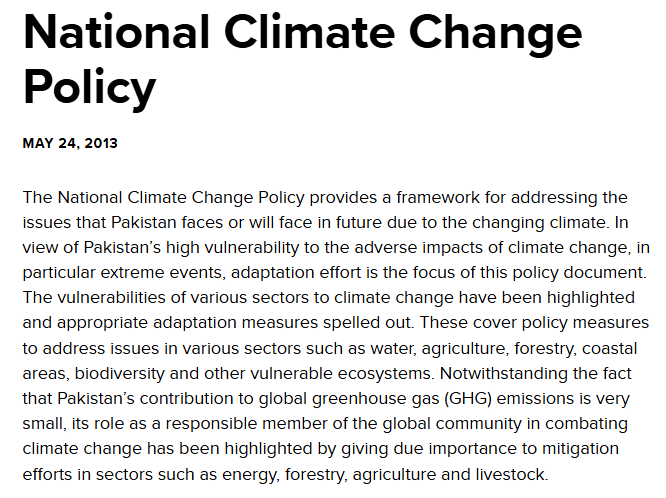
In 2012, Pakistan enacted its first National Climate Change Policy, which was updated in 2021, to offer a guideline on how to handle climate-related problems that include floods, droughts, and increased temperatures. The policy will focus on directing mitigation (reducing emissions) and adaptation (adapting to the effects of climate) in the various sectors such as water, agriculture, energy, and disaster management. The policy has an important set of goals, but implementation on the provincial and local levels has been slow and underfunded.
Source: UNDP
Pakistan Climate Change Act, 2017
In the year 2017, the Climate Change Act was introduced to enforce the NCCP. It has formed the Pakistan Climate Change Authority and Pakistan Climate Change Council to direct and oversee climate action. But these bodies lay dormant for several years due to delays in the appointment and political attention on other areas. The Climate Change Authority did not begin to operate until 2023, and this casts doubt on the institutional urgency.
More Like This:
Nationally Determined Contributions (NDCs)
With the 2015 Paris Agreement, Pakistan updated its Nationally Determined Contributions (NDCs) in 2021. It is committed to reducing greenhouse gas emissions by 50 percent by 2030, of which 15 percent using domestic resources and another 35 percent will depend on international assistance. These are energy, transport, and agriculture. Nevertheless, the future is not so clear because of a lack of data tracking and strong reliance on external climate finance.
Ten Billion Tree Tsunami Programme (TBTTP)
The Ten Billion Tree Tsunami Programme is one of the most famous green projects in Pakistan, which was launched in 2019. It is an extension of the 1 Billion Tree Tsunami in Khyber Pakhtunkhwa, and it is meant to replenish forests, minimize land degradation, and intercept carbon dioxide. Although the international community and the UN have celebrated the initiative, there have been local audits and reports by the press questioning the transparency, overstated planting figures, and survival of the trees.
ARE-2019 Alternative and Renewable Energy Policy
The aim of the ARE Policy 2019 in Pakistan is to produce 30 percent of electricity through renewable sources by 2030. The policy encourages the use of solar, wind, and small hydro power to minimize the use of fossil fuels. Nevertheless, it has made little progress because of financial difficulties, outdated infrastructure, and inconsistency in policies. As per the National Electric Power Regulatory Authority (NEPRA), less than 5 percent of the energy mix is renewable even by the year 2024.

Source: WWIDEA.
National Adaptation Plan
National Adaptation Plan is under development long-term climate change adaptation plans to address climate change effects like water shortage, floods, and heatwaves. It will target the vulnerable sectors such as agriculture, health, and disaster risk management. Even though technical work is underway with the Green Climate Fund and UNDP, the plan remains in draft form. It is essential to complete it in time, following the 2022 floods, which displaced more than 33 million individuals.
National Electric Vehicle Policy (NEVP)
In 2019, the National EV Policy was approved, which seeks to transition 30 percent of the vehicles to electric by 2030 in order to minimize air pollution and greenhouse gas emissions. It provides tax incentives and reductions to EV producers and consumers. Nevertheless, the slow adoption rate has been attributed to insufficient charging infrastructure, expensive prices, and the poor awareness of people. There are limited models of EVs, and the majority of investments have been made in two- and three-wheelers.
Glacial Lake Outburst Flood (GLOF) Projects
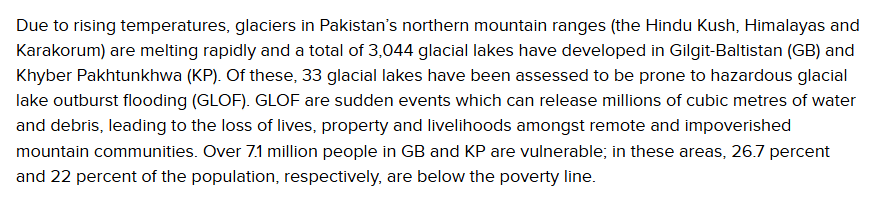
Glaciers in the northern part of Pakistan are fast melting because of the increase in temperature, leading to glacial lake outburst floods (GLOFs). To this end, Pakistan collaborated with UNDP to initiate GLOF-I and GLOF-II in Gilgit-Baltistan and KP. These initiatives had put in place early warning and erected protective infrastructure in more than 20 susceptible valleys. These efforts have helped more than 200,000 people as of 2024.
Source: UNDP.
Strategies of Urban Climate Resilience
Bad planning and climate change have made cities such as Lahore and Karachi experience extreme weather, smog, and floods in the cities. Such projects as the Punjab Green Development Program or Karachi Urban Flood Resilience Plan are aimed at the construction of green areas, drainage systems, and sustainable transportation. Nonetheless, poor leadership and the inability to coordinate between municipal organizations hinder the process.
Conclusion
Pakistan has developed a comprehensive system of climate policies and strategies, indicating its efforts to curb environmental risks. The most important thing is how to close the gap between the plans and action. Most of the initiatives are either underfunded, lagging, or not well tracked. In the future, Pakistan requires more robust institutions, improved intergovernmental coordination between federal and provincial governments, and climate finance to translate these strategies into an actual impact on the ground.