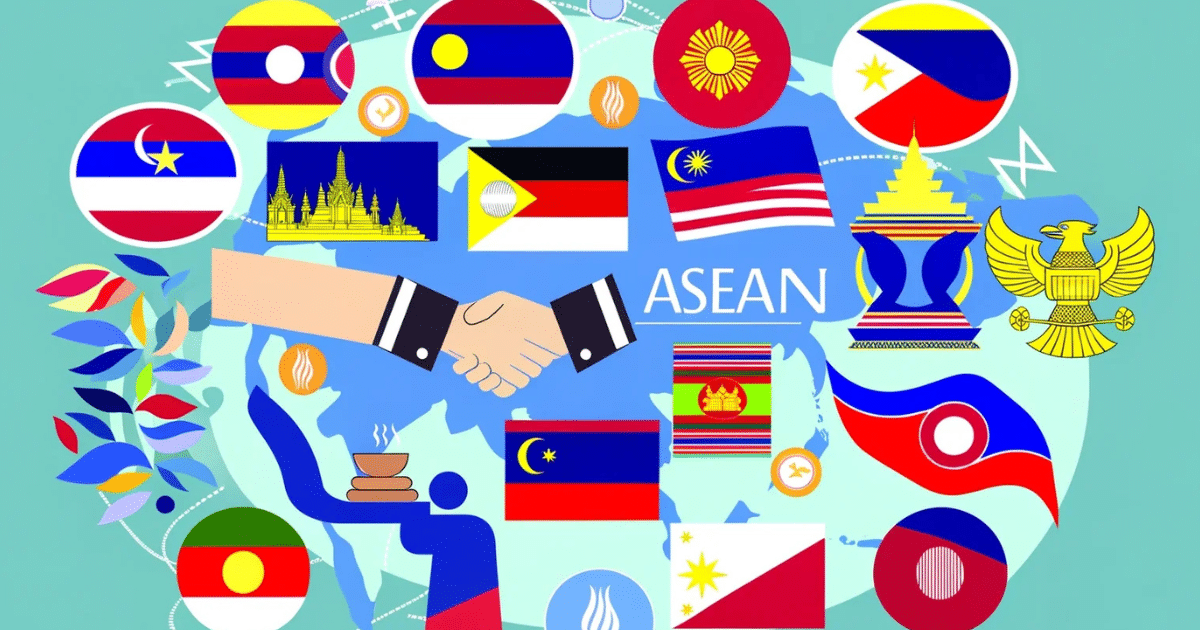




For decades, Southeast Asia’s regional club has been dismissed as process-heavy and power-light. Yet ASEAN’s quiet, consensus-first method has steadily delivered stability, trade integration, and a sense of “centrality” in a contested Indo-Pacific. As South Asia grapples with a stalled SAARC and fragmented sub-regionalism, Pakistan can draw pragmatic lessons from how ASEAN balances political caution with economic ambition, and why that mix works. In 2025, those contrasts are starker than ever.
What ASEAN Gets Right
First, ASEAN builds cooperation around what is doable now, and defers what isn’t. The bloc’s decision-making is explicitly consensus-based, the famous “ASEAN Way,” which slows dramatic moves but ensures members rarely walk away. Rather than legislate integration, ASEAN stitches it together via confidence-building, soft-law norms, and incremental agreements. That approach has underpinned its role in convening the wider region through processes like the East Asia Summit and, economically, through RCEP, the world’s largest trade pact that lowers barriers and improves market access across Asia-Pacific.
The economic payoff is visible in 2025 data. ASEAN accounts for roughly 7.3% of global GDP and about 692 million people, an expanding market that continues to attract supply chains diversifying across Asia. In Q1 2025, Southeast Asia’s exports rebounded, with total exports up 6.2% year-on-year, reflecting both goods and services momentum as travel, logistics, and manufacturing stabilized. The numbers don’t tell a fairy tale; they show steady, compounding gains enabled by predictable regional rules.
Institutionally, ASEAN keeps refreshing its playbook. The 2023 Jakarta-hosted ASEAN Concord IV re-committed leaders to a rules-based, people-centred community and flagged the need to speed up slow consensus where possible, including in digital economy cooperation. And in a sign of controlled expansion, ASEAN is on track to welcome Timor-Leste as its 11th member at the October 2025 summit, broadening the tent without breaking its method.
You May Like to Read: Why South Asia Struggles with Regionalism While Other Blocs Move Forward
The Limits of Consensus, and Why It Still Works
ASEAN’s consensus model has a cost. It can blunt responses to hard security crises and human-rights emergencies. Yet because no member fears being outvoted, they rarely torpedo the project itself. Concord IV’s language about streamlining decision-making is an admission that unity can be slow, but also a bet that patient, collective action is still better than no action. For investors, that policy predictability beats the volatility of boycotted summits and suspended forums.
You May Like to Read: South Asian Muslim Identity and Progressive Power in NYC Politics
South Asia’s Stalled Experiment
South Asia’s multilateral experiment tells the opposite story. The last SAARC summit took place in 2014; the 2016 Islamabad summit was derailed when India pulled out after the Uri attack, and the gathering has never recovered. The region’s default has become either bilateral brinkmanship or sub-regional workarounds, not a functional, all-in forum. That institutional vacuum deprives South Asia of a trusted table to manage shocks, from food security to climate resilience, where every state has a stake.
Sub-regionalism has made some headway: BIMSTEC, which excludes Pakistan, finally saw its Charter enter into force on 20 May 2024, giving it a legal backbone and clearer mandate. But that very exclusion underscores the problem: when the region’s biggest countries cannot meet under one roof, cooperation splinters by geography and politics rather than economics and public goods.
Practical Lessons for Pakistan
None of ASEAN’s habits require countries to abandon national interests. They do require ring-fencing regional cooperation from bilateral disputes, and building trust through stepwise wins. For Pakistan, three takeaways are actionable.
First, anchor regionalism in trade and connectivity where interests naturally align. ASEAN’s success with RCEP wasn’t ideology; it was logistics and market access. Pakistan can lead with functional projects, energy corridors, cross-border payment connectivity, standards for e-commerce, and resilient supply chains, that are politically easier to sell at home but still integrate markets over time. The point is not to copy RCEP overnight, but to create the conditions where Pakistani exporters confront fewer frictions in the neighborhood.
Second, invest in convening power. ASEAN’s centrality stems less from a muscular secretariat and more from dependable summits that happen on time. South Asia needs a venue that always meets, even if agendas start narrow. Pakistan’s diplomacy can push for a “no-empty-chair” rule in any revived regional format and champion ministerial-level sectoral tracks that continue regardless of political weather. ASEAN’s 2025 pipeline, expansion to Timor-Leste and follow-through on Concord IV, shows how continuity compounds.
Third, practice “constructive incrementalism.” The lesson from Southeast Asia’s 2025 economy is that small, bankable steps add up. As supply chains re-map and services trade grows, Pakistan’s interests are served by predictable rules next door, on customs, standards, transit, and digital trade, so that Pakistani firms can plug into regional production networks that are expanding today, not hypothetically tomorrow. The growth pulse across ASEAN this year is a reminder that policy reliability attracts capital.
You May Like to Read: Pakistan in the SCO: Strategic Balancing or Passive Membership?
The Bottom Line
ASEAN is not a model of dramatic breakthroughs; it is a machine for gradual, real progress. In 2025, it is consolidating a continent-spanning trade architecture, absorbing a new member, and refining its own processes, while continuing to deliver steady economic gains for nearly 700 million people. South Asia’s choice is not to imitate ASEAN’s institutions wholesale, but to adopt its discipline: meet regularly, decide by consensus where you can, park what you can’t, and keep the economics moving. For Pakistan, that means leading with practical cooperation, insulating regional fora from bilateral flashpoints, and betting on predictability over point-scoring. Quiet power is still power, and in Southeast Asia, it is working.