




The Arctic Meltdown: From Frozen Wasteland to Strategic Pivot
The Arctic has shifted from the edge of the world to its center, geopolitically and economically. Dramatic ice retreat isn’t an abstract trend anymore, it’s a powerful transformation, extending seasonal navigation, unlocking resource access, and turning the High North into a growing theatre of power politics. The region’s transformation is driven by precise, measurable changes in sea ice and seasonal navigation windows, and nation-states are already racing to convert that physical change into strategic advantage.
Russia’s Strategic Highway: The Northern Sea Route in Focus
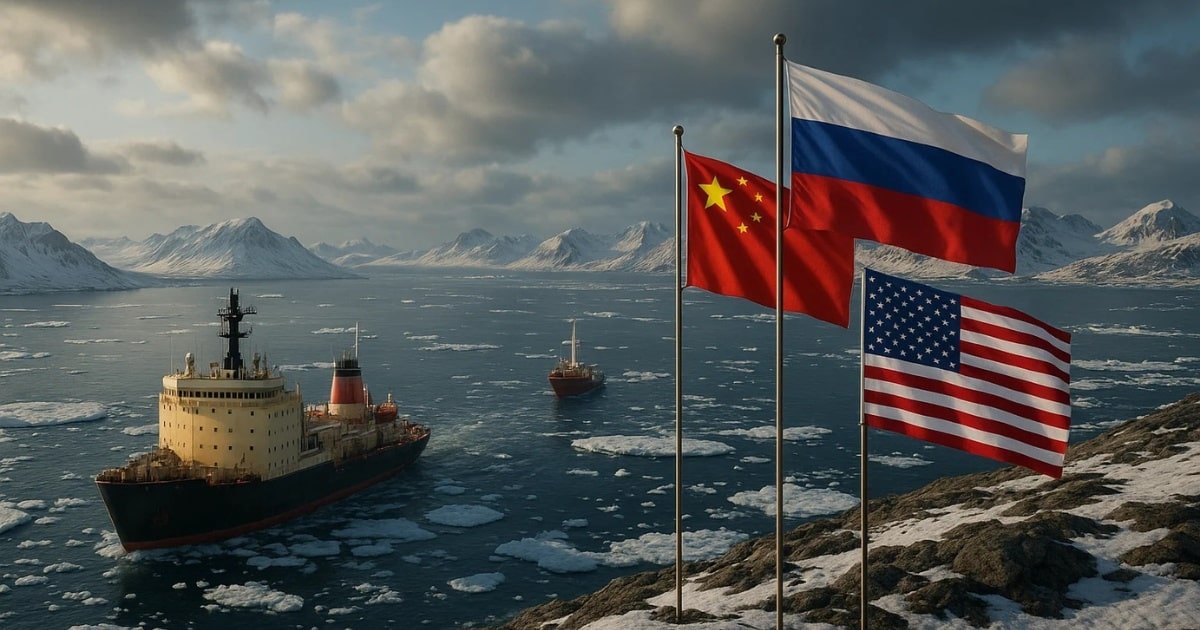
Russia views the Northern Sea Route (NSR) as more than a shipping shortcut, it’s a strategic corridor. The NSR stretches along Russia’s Arctic coast, connecting the Barents Sea to the Bering Strait, offering the shortest path between Eurasia and the Asia-Pacific region.Traffic on the NSR surged in 2023 to a record 36.25 million tonnes of cargo, with transit traffic alone exceeding 2.1 million tonnes. Yet, this momentum barely scratches the surface compared to the Suez Canal, which handled 1.57 billion tonnes in 2023.
Despite the geographic and temporal advantage, mainstream shipping remains cautious. Daniel Richards of Maritime Strategies International says container shipping companies and their clients avoid the Northern Sea Route due to its environmental sensitivity and geopolitical risks, conditions unlikely to shift soon. It remains a hard sell for cautious shippers. Only niche operators, mostly tied to Russia and China use the route, while major liners steer clear due to unpredictable ice, insurance risks, sanctions exposure, and limited logistics hubs. Nevertheless, Russia’s bolstering of icebreakers and Arctic logistics underscores its intent to make the NSR a lasting axis of influence.
China’s Polar Silk Road: Ambitions on Thin Ice
Beijing, as a non-Arctic State, is pursuing levers to become Arctic-relevant. Officially, China calls for cooperative development of the “Polar Silk Road” under the Belt and Road Initiative, encouraging enterprises to engage in infrastructure, shipping, hydrographic surveys, and resource exploration, all while advocating environmental stewardship under the Polar Code.
On the ground, Chinese companies are deeply involved in Arctic projects like Yamal LNG in Russia, backed by CNPC and Silk Road Fund, and agreements like Payakha oilfield development, as well as joint research centers from Finland to Iceland. China’s Xue Long 2 icebreaker was spotted well inside US territorial waters near Alaska in July 2025, an assertive display of capability.
Still, China’s Arctic ambitions are under scrutiny. A recent Pentagon report frames Beijing’s Polar Silk Road in military terms, raising alarms over potential dual-use infrastructure and coordinated Arctic presence with Russia.
Western Guard: NATO and Allies Step Up Arctic Defence
The West is no longer a passive spectator. NATO and its members are rapidly ramping up capabilities. In July 2024, the US, Canada, and Finland launched the ICE Pact, a pact to build icebreakers and enhance Arctic access and infrastructure as a counterbalance to Russian and Chinese moves.
Military exercises are also intensifying. NATO’s Chair of the Military Committee affirmed enhanced deployments, from anti-submarine drills to rapid troop mobility exercises like Operation Nanook, Adamant Serpent, and Joint Viking. On-the-ground training mirrors this: in early 2025, 10,000 NATO troops, including US Marines, completed the Joint Viking exercise in frigid northern Norway to sharpen Arctic warfare readiness.
Meanwhile, Denmark grapples with overstretched Arctic defenses in Greenland. Despite a $1.9 billion upgrade plan, the current fleet remains patchy, relying on aging vessels, drones, and even sled dogs to patrol vast ice-shrouded expanses.
You May Like to Read: A Polarized World Order and CPEC
Eco-Economics: Resources, Trade, and Environmental Stakes
Beneath the Arctic’s melting surface lies a treasure trove, oil, gas, rare minerals, fisheries, and new shipping lanes. Yet these prospects come with tangled costs.
Environmental frameworks are evolving. IMO’s Polar Code now mandates a transition toward net-zero emissions from international shipping by 2050, with phased targets for 2030 and 2040. Its November 2024 Heavy Fuel Oil restrictions specifically target Arctic waters. However, climate models are being derailed by gaps in Russian data-sharing, Russian withdrawal from some Arctic research bases complicates global warming projections and hampers informed policymaking.
Pakistan’s Relevance: Why the Arctic Matters, Indirectly but Critically
From Pakistan’s vantage point, the Arctic may seem distant, but its ripple effects are profound. If Arctic shipping routes ever gain momentum, global logistics, insurance norms, and trade flows could shift, impacting South Asian maritime planning and port strategies. On the resource front, Arctic minerals and energy ventures will reshape global markets, affecting prices and supply chains. For a country whose exports rely on competitive shipping costs and whose energy mix is heavily dependent on imported oil and LNG, changes in freight rates or commodity availability could directly influence inflation and fiscal stability.
Pakistan, like many developing states, would benefit from tracking the Arctic’s evolution, building academic and strategic expertise, and considering how shifts in trade corridors and commodity availability could realign its economic and security posture.
Governance & Risk: Cooperation Under Climate Stress
The geopolitical scramble in the Arctic underscores the fragility of its governance. The Arctic Council remains a dialogue forum, not a conflict-resolution body. Infrastructure expansion, sovereignty disputes, environmental risks without cohesive regulation, and a rapidly warming climate can all ignite crises.
Yet cooperation persists, even if uneasy. The ICE Pact, IMO emissions regulations, and joint Chinese-Russian research labs reflect pockets of governance. For global stability, these mechanisms must be nurtured, not overshadowed.
You May Like to Read:The Decline of U.S. and China’s Soft Power in a Multipolar World
Concluding: The Arctic Is Here, Now, and Watching Matters
The Arctic is no longer a future concern, it’s today’s strategic flashpoint. Global powers are maneuvering for control over its shipping lanes, resources, and environmental trajectory. For Pakistan, this distant frontier matters through the backdoors of trade, climate policy, and mineral markets. A prudent choice: engage, monitor, and prepare. The future of global movement, security, and resource access may well be decided on the ice.