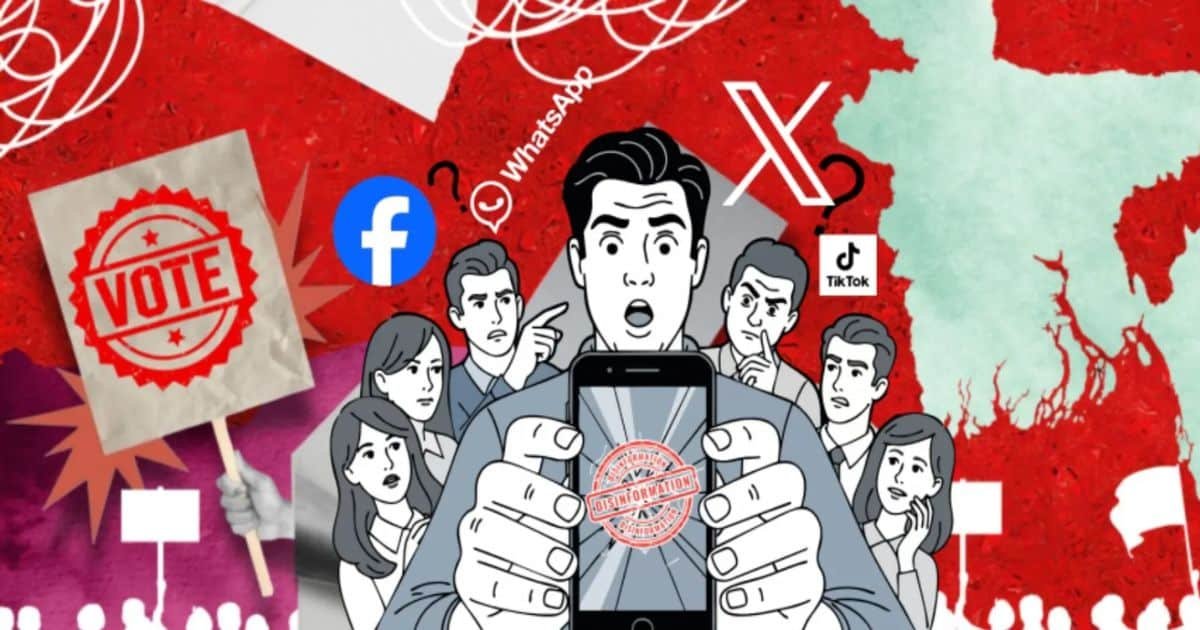




As Bangladesh prepares for its General Elections on February 12, 2026, a new report from The Daily Star reveals a sophisticated and aggressive disinformation campaign flooding social media. Monitoring data from mid-December 2025 to mid-January 2026 shows that 220 documented cases of fake news generated over 2 million interactions on Facebook within just 24 hours of being posted.
The findings highlight a digital “battleground” where political actors are leveraging AI-generated visuals, doctored images, and fabricated quotes to manipulate swing voters and fuel partisan hostility.
Key Findings from the Disinformation Report
-
Top Offenders: Entities aligned with Jamaat-i-Islami accounted for nearly half of the disinformation cases (96 posts) and dominated engagement with 90.68% (1.8 million) of total interactions.
-
Strategic Targeting: Disinformation is rarely random. Jamaat-aligned groups directed 78% of their false content at the BNP, while BNP-aligned actors targeted Jamaat in 80% of their campaigns.
-
The Interim Government: Pro-Awami League entities shifted focus toward undermining the interim government and student coordinators, including circulating false claims of civil war plots.
-
Defamation as a Weapon: Out of the 220 analyzed posts, 155 were categorized as defamatory, with political rivals accusing one another of criminality, extortion, and moral corruption.
-
The Rise of AI & Photocards: While video remains the primary medium (104 cases), AI-generated deepfakes (58 cases) and misleading photocards (44 cases) are rapidly becoming the preferred tools for creating “staged” political scenarios.
“The main intention behind a disinformation campaign is to manipulate voting choice,” says Dr. Din M Sumon Rahman, Head of Media Studies at ULAB. “Disinformation neatly feeds the confirmation bias of a decided voter while targeting swing voters who lack a strong opinion.”
Manipulative Tactics Exposed
The report details how 59% of posts used manipulative content to twist authentic facts. This includes distorting official inquiry findings and using “decontextualization”—where real videos are reframed to support false narratives, such as a simple seat-change request being portrayed as the harassment of a freedom fighter.
With the election only hours away, experts warn that the rapid spread of these fabrications threatens to shape public opinion through provocation rather than policy.
You May Like To Read: