


Growing Maritime Crime in the Indian Ocean Region
In recent years, the Indian Ocean and the Arabian Sea have become significant theatres in the fight against transnational crimes, especially drug trafficking. Criminal networks exploit the vast, often under-regulated waters to transport large quantities of narcotics from South and Southwest Asia toward markets in the Middle East, East Africa and beyond. This trend has been documented by multiple maritime security analyses and official reports, which point out that traditional smuggling routes off the Makran coast have been increasingly used to move heroin, hashish and, more recently, methamphetamine using small vessels or stateless dhows. These routes are highly attractive to smugglers because they can blend with legitimate fishing traffic and evade surveillance, creating major challenges for national navies and law enforcement agencies.
Multinational Naval Cooperation and the Role of CTF-150
Amid these growing threats, regional and global naval cooperation frameworks have grown in importance. One of the most visible of these is the Combined Task Force 150 (CTF-150), a multinational maritime security task force under the Combined Maritime Forces (CMF) headquartered in Bahrain. CTF-150’s mandate includes maritime security operations, counter-terrorism and the interdiction of illicit trafficking, including drugs, across critical sea lanes in the North Arabian Sea, Gulf of Oman and Indian Ocean. Member nations such as Australia, Canada, France, the United Kingdom, the United States and Pakistan contribute ships and personnel on a rotating basis to patrol and enforce maritime law.
2025: A Year of Intense Counter-Narcotics Activity
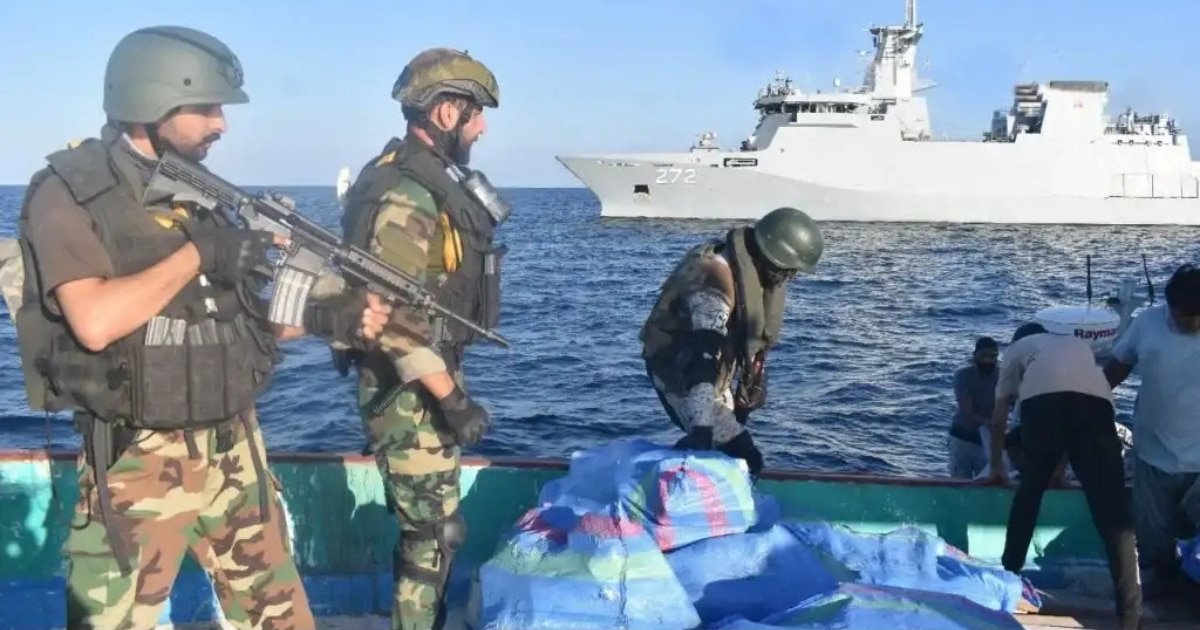
The year 2025 has seen several high-profile maritime drug interdictions involving the Pakistan Navy, both independently and in cooperation with multinational partners. In October, Pakistan Navy Ship (PNS) Yarmook, operating under Saudi-led CTF-150, intercepted two stateless dhows in the Arabian Sea and seized narcotics worth nearly $972 million, one of the largest maritime drug busts in recent regional history. The haul included several tonnes of crystal methamphetamine (ICE) and smaller quantities of cocaine, highlighting how traffickers move high-value synthetic drugs through maritime routes.
Just weeks later, PNS Tabuk seized over 2,000 kilograms of methamphetamine valued at around $130 million during another counter-narcotics patrol under CTF-150, marking the third major interdiction by Pakistan naval vessels in less than two months. These operations underscore both the scale of the threat and the effectiveness of coordinated maritime security efforts.
Further bolstering these efforts, PNS Yamama, as part of regular Regional Maritime Security Patrols (RMSP), conducted a significant interception in early December 2025, seizing around 1,500 kilograms of hashish worth about $3 million. This operation, conducted in Pakistan’s exclusive economic zone (EEZ), illustrates the navy’s sustained vigilance in securing national waters as well as cooperating with other navies on broader patrols.
Implications for Pakistan’s Maritime Security
Pakistan’s coastline spans approximately 1,000 miles along the Arabian Sea, encompassing strategic ports such as Karachi and Gwadar, which are critical to the country’s trade and economic development. These sea lanes are also crucial international routes for shipping, including energy supplies to and from the Middle East.
The increasing use of this maritime space by transnational criminal networks poses a dual challenge: threats to national security and risks to Pakistan’s economic interests if smuggling activities undermine the safety and reliability of its maritime domain.
The drug trafficking activity evident in 2025 shows how organized crime can exploit geographic advantage to transit contraband across borders. Reports indicate that narcotics originating from Afghanistan and other regions are moved across the Makran coast using small boats and then transferred to faster vessels or dhows at sea, taking advantage of vast open waters where enforcement resources are spread thin.
Pakistan’s proactive participation in multinational patrols under CTF-150 and similar initiatives demonstrates a strategic understanding that maritime security cannot be addressed in isolation. Interdiction successes like the Yarmook and Tabuk operations not only disrupt criminal networks but also contribute to a safer regional maritime environment, which has a positive impact on trade security and international confidence in Pakistan’s naval capabilities.
You May Like to Read: Unlocking the Blue Economy: Pakistan’s Maritime Potential and Naval Role in Trade and Resource Security
Regional Partnerships and Intelligence Sharing
One of the key lessons emerging from the evolving maritime security landscape is the value of intelligence sharing and interoperability among regional partners.
CTF-150 operations rely on integrated surveillance, coordinated boarding procedures and shared data to identify and intercept suspect vessels.
Member nations often rotate command and provide varied assets, from surface ships to maritime patrol aircraft, enhancing situational awareness across wide oceanic expanses.
Pakistan’s deepening cooperation with Saudi Arabia, the United States and other CMF partners has helped build operational capacity and situational insight, enabling more timely interdictions and joint responses to threats. These relationships are not only tactical but strategic, reinforcing Islamabad’s position as a key contributor to regional maritime security.
You May Like to Read: U.S. Accelerates Anti-Narcotics Maritime Strikes, Marking Tenth Attack
Balancing National and Regional Priorities
While multinational cooperation is essential, Pakistan must also continue to strengthen its domestic maritime security institutions. This includes enhancing the Pakistan Maritime Security Agency (PMSA), improving coastal radar and surveillance systems, and building capacity among law enforcement to work in tandem with naval operations.
Effective law enforcement integration ensures that seized contraband and interdicted suspects can be processed and prosecuted under national laws, closing legal gaps that traffickers might seek to exploit.
Investments in port security and vessel tracking systems likewise play an important role. Karachi and Gwadar, hubs for commercial traffic, require robust inspection protocols and close monitoring to detect illicit activity, especially as criminal groups adapt by using containerised shipping or concealment techniques to avoid detection.
You May Like to Read: Pakistan, and Kazakhstan Strengthen Ties with Focus on Maritime Cooperation and Regional Connectivity
Future Directions and Long-Term Strategy
The rise of maritime drug trafficking as part of transnational crime emphasises that Pakistan’s maritime security strategy cannot remain static. Evolving threats call for a dynamic and layered approach that includes continued engagement in multinational frameworks, investment in technology and human capital, and stronger legal frameworks to deter and prosecute maritime crime.
Forward-looking policies should prioritise capacity building within the Pakistan Navy and allied agencies, sustained intelligence exchange with regional partners, and greater cooperation with international organisations like the Combined Maritime Forces.
Such coordination not only enhances operational effectiveness but also reinforces Pakistan’s standing as a security partner in the Indian Ocean region.
Concluding
In essence, the growing focus on maritime drug interdiction in 2025 highlights both the severity of transnational crime challenges and the potential for effective cooperation. Pakistan’s active participation in CTF-150 and successful interdictions off its waters are significant achievements, but the evolving nature of maritime crime requires sustained attention, innovation and partnership to ensure that sea trade routes remain safe and secure for national and regional prosperity.
Check out our latest video: