Allegations of Misuse of Authority
The misuse of official authority by public figures is a grave concern that erodes the foundational trust between citizens and state institutions. A notable case in Pakistan highlights these issues, involving former aide to the Prime Minister on Accountability, Shehzad Akbar, and model Sophia Mirza, among others. This case, rooted in allegations of conspiracy, forgery, and abuse of public office, underscores the detrimental impact such actions can have on public confidence and the integrity of governance.
Case Details and Individuals Involved
The core of the controversy revolves around allegations made by Norwegian-Pakistani businessman Umar Farooq Zahoor, the ex-husband of Sophia Mirza—also known as Khushbakhat Mirza. Mr. Zahoor accused Shehzad Akbar, Sophia Mirza, former Federal Investigation Agency (FIA) Director General Sanaullah Abbasi, and several other FIA officials of misusing their positions to file fabricated cases and issue fake warrants against him.
According to reports, Sophia Mirza allegedly conspired with Shehzad Akbar to initiate inquiries against Umar Farooq Zahoor through the FIA. Shehzad Akbar, in his capacity as a high-ranking official, is accused of pressuring FIA officers to pursue false cases, specifically FIRs No. 36/20 and 40/20 registered in FIA Corporate Crime Circle Lahore.
These actions were purportedly aimed at having Mr. Zahoor extradited from Dubai to Pakistan and were reportedly linked to a protracted custody battle between Sophia Mirza and Umar Farooq Zahoor over their twin daughters. It was further alleged that Mr. Akbar intentionally misled the then-federal cabinet by failing to disclose Mr. Zahoor’s status as Liberia’s Ambassador-at-Large for the Middle East and Southeast Asia, a position that would typically grant diplomatic immunity.
In response to Mr. Zahoor’s complaint, the Islamabad Police registered a criminal case (FIR No. 465/22, also referred to in relation to search for FIR 156/23 by the user) at the Secretariat police station against Shehzad Akbar, Sophia Mirza, and the implicated FIA officials.
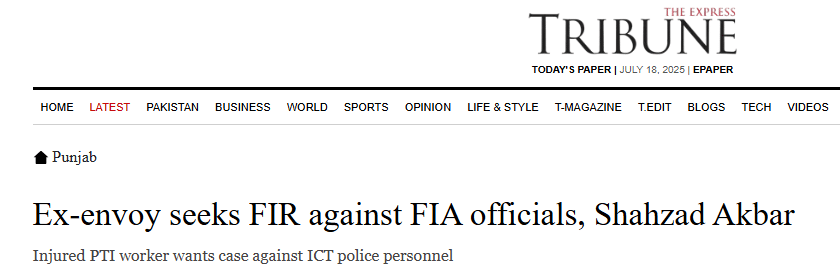
Source: Tribune
The charges include sections of the Pakistan Penal Code (PPC) related to conspiracy, forgery, and misuse of public office, specifically sections 420 (cheating and dishonestly inducing delivery of property), 468 (forgery for purpose of cheating), 471 (using forged document as genuine), 385 (putting person in fear of injury in order to commit extortion), 389 (putting person in fear of accusation of offence, in order to commit extortion), 500 (punishment for defamation) and 506 (punishment for criminal intimidation).

Source: The Friday Times
Developments in the Case
The case was investigated by a Joint Investigation Team (JIT). The JIT reportedly found that the initial FIRs (36/20 and 40/20) filed against Umar Farooq Zahoor were “false, frivolous, and based on forged documents.” Consequently, the JIT submitted cancellation reports for both FIRs to the court, which were accepted. Furthermore, Interpol removed Umar Farooq Zahoor’s name from its Red Notice List after the FIA confirmed he was no longer a person of interest for the agency.
As of the available information, there are no public reports of convictions or fines against Shehzad Akbar specifically for this case. The legal proceedings primarily centered on the registration of the FIRs and the subsequent findings by the JIT regarding the falsity of the original allegations.
Damage to Public Trust
The alleged misuse of official authority damages public trust in governmental institutions. When individuals in positions of power are accused of orchestrating false cases, fabricating evidence, and leveraging state machinery for personal vendettas or illicit gains, it fosters an environment of fear and cynicism among citizens. Leading citizens to be genuinely concerned for their own safety—because dissent or disagreements with such government officials, holding public offices, means facing fabricated legal cases and possible convictions, despite not having committed the crime.
Such actions undermine the fundamental principles of justice, accountability, and the rule of law. Citizens lose faith in the impartiality and integrity of law enforcement agencies when these bodies are perceived as tools for political manipulation or personal scores rather than independent arbiters of justice. This erosion of trust can lead to decreased public cooperation with law enforcement, discourage civic participation, and perpetuate a cycle of impunity.
The Supreme Court of Pakistan has also observed that the misuse of authority by the state can create a sense of fear and insecurity in society, undermining constitutional commands and leading to mistrust in institutions. Ultimately, when public officials abuse their authority, it not only compromises individual rights but also destabilizes the democratic fabric of the nation.