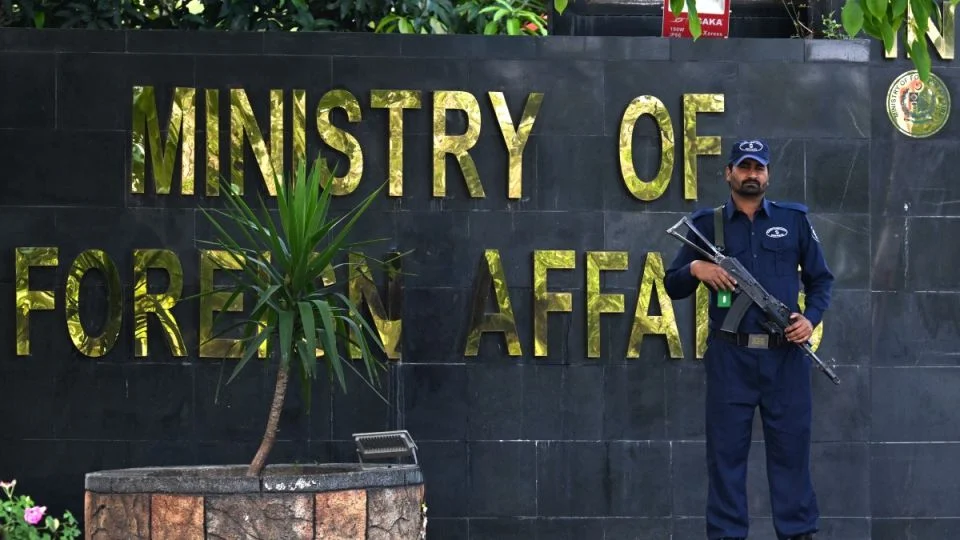




The Ministry of Foreign Affairs (MoFA) and Defence Minister Khawaja Asif have strongly condemned recent statements by Indian Defence Minister Rajnath Singh, characterizing his comments on Jammu and Kashmir as “provocative, irresponsible,” and a deliberate threat to regional peace.
Responding to Singh’s assertion that future talks with Pakistan would focus solely on Azad Jammu and Kashmir (AJK) accompanied by warnings of retaliation, Islamabad warned New Delhi not to miscalculate Pakistan’s defensive readiness, invoking the operational precedent set during the May 2025 border conflict.
🔊PR No.1️⃣8️⃣9️⃣/2️⃣0️⃣2️⃣6️⃣
Pakistan Condemns Remarks by Indian Defense Minister
🔗⬇️ pic.twitter.com/PB2AxaaI5Y
— Ministry of Foreign Affairs – Pakistan (@ForeignOfficePk) July 26, 2026
Escalating Rhetoric: Statements and Official Responses
The exchange marks a sharp rise in political and diplomatic friction between the two nuclear-armed neighbors:
-
India’s Position: Speaking on Sunday, Indian Defence Minister Rajnath Singh ruled out routine bilateral dialogue with Islamabad, asserting that any future negotiations would be limited to AJK—which he claimed was “illegally occupied”—while warning that any Pakistani “misadventure” would draw a severe military response.
-
Foreign Office Rebuttal: Issued early Monday, the Foreign Office statement rejected Singh’s remarks as an attempt to distort United Nations Security Council (UNSC) resolutions on the Jammu and Kashmir dispute. The FO stated that India’s belligerence seeks to deflect international scrutiny from its domestic political instability, human rights record in Indian Illegally Occupied Jammu and Kashmir (IIOJK), and foreign state-sponsored terrorism.
-
Defense Minister’s Warning: Defence Minister Khawaja Asif stated that coercive rhetoric cannot alter the internationally recognized status of Kashmir or lower the threshold for interstate conflict. He reiterated that while Pakistan remains open to constructive dialogue, its determination to protect its territorial integrity is absolute.
-
Precedent of Operation Bunyanum Marsoos: Both the Foreign Office and the Defence Ministry explicitly referenced the four-day military confrontation of May 2025—which culminated in a US-brokered ceasefire on May 10—as evidence of Pakistan’s capability and resolve to neutralize external aggression.
Operational Retrospective: The May 2025 Military Confrontation
The Foreign Office’s reference to Operation Bunyanum Marsoos underscores the strategic framework governing current Pakistan-India military deterrence:
Timeline of the May 2025 Escalation Cycle:
- Trigger Phase: Attack on tourists in Indian-occupied Kashmir; New Delhi accuses Pakistan without evidence.
- Diplomatic Denial: Islamabad rejects claims, demands an independent, neutral international investigation.
- Kinetic Engagement: Cross-border retaliatory strikes traded over a four-day high-intensity window.
- Ceasefire Agreement: Mediation by the United States forces operational halt on May 10, 2025.
Strategic Analysis: Regional Deterrence and Political Posturing
The sharp diplomatic pushback from Islamabad reflects broader geopolitical and domestic considerations:
Reinforcing Nuclear Deterrence and Strategic Capability
By explicitly referencing Operation Bunyanum Marsoos, Pakistan is signaling to New Delhi that coercive rhetoric will not alter the military balance. The swift operational response during the May 2025 conflict established a clear precedent: any cross-border military action by India will trigger prompt, proportional counter-strikes. Reminding India of this framework serves to reinforce conventional deterrence and prevent tactical miscalculations along the Line of Control (LoC).
Reaffirming UNSC Frameworks over Unilateral Revisionism
Islamabad’s response underscores its commitment to international law and established multilateral frameworks. Singh’s attempt to redefine the parameters of dialogue by asserting claims over AJK directly conflicts with binding UNSC resolutions that recognize Jammu and Kashmir as a disputed territory awaiting a UN-supervised plebiscite. By appealing to the United Nations and the international community, the Foreign Office seeks to prevent India from unilaterally rewriting regional legal realities.
Internal Diversion Tactics and Regional Instability
Defence Minister Khawaja Asif’s critique targets the internal political drivers behind New Delhi’s assertive rhetoric. Facing domestic socio-political friction and growing opposition to autocratic policies, the Bharatiya Janata Party (BJP) administration routinely utilizes anti-Pakistan messaging to consolidate domestic political support. However, lowering the threshold for cross-border threats risks destabilizing South Asia at a time when wider regional dynamics remain fragile.