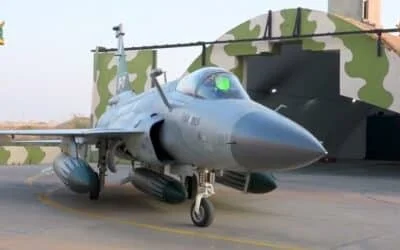




Recently, Pakistan Air Force’s (PAF) pursuit of cutting-edge technology has been making headlines, particularly with the potential acquisition of the J-35A stealth fighter. This comes after the recent conflict against India post-Operation Sindoor, emphasizing the urgent need for advanced capabilities, and a broader drive for technological superiority in air defense. The J-35A, a next-generation Chinese jet, represents not just an upgrade but a transformative leap that could fundamentally alter the strategic balance in the region.
The Dawn of a New Era: China’s Stealth Prowess
The J-35A is China’s latest contribution to the global landscape of advanced stealth fighter jets, a testament to Beijing’s rapidly maturing aerospace industry. Developed by Shenyang Aircraft Corporation, the J-35A is the land-based variant of the FC-31, which is also known as the J-35 in its naval, carrier-based form. It represents a significant step for China, moving beyond licensed production and reverse-engineering to developing indigenous fifth-generation fighter technology. The aircraft’s official unveiling marks China’s intent to offer a potent stealth option on the international market, challenging the long-held dominance of Western manufacturers.
Unveiling the J-35A: Stealth and Design Philosophy
Source: Insightful
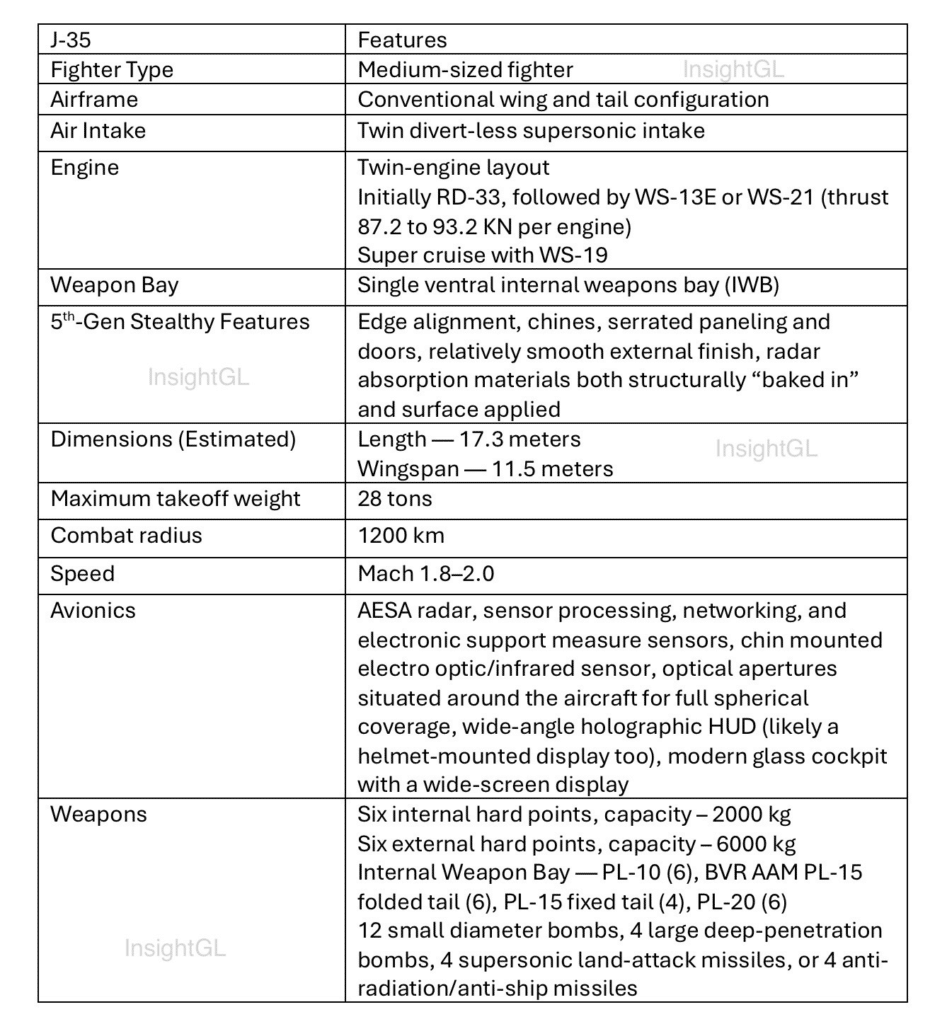
At its core, the J-35A is designed for stealth. Its airframe incorporates advanced low-observable features, including faceted surfaces, internal weapon bays, and radar-absorbent materials, all aimed at minimizing its radar cross-section. This makes it incredibly difficult for enemy radars to detect and track, providing a critical advantage in contested airspace.
The aircraft is powered by two turbofan engines, likely the indigenous WS-19, offering impressive thrust-to-weight ratio and combat performance. Its twin-engine configuration also contributes to enhanced survivability and operational reliability compared to single-engine designs.
A defining characteristic of the J-35A is its internal weapons bay. This crucial feature allows the aircraft to carry air-to-air missiles and precision-guided munitions internally, maintaining its stealth profile during combat missions. While it also possesses external hardpoints for additional ordnance when stealth is not the primary requirement, its ability to carry weapons internally provides a critical edge in high-threat environments.
Advanced Avionics and Situational Awareness
The J-35A is expected to be equipped with a suite of highly advanced avionics, central to its fifth-generation capabilities. This includes a sophisticated Active Electronically Scanned Array (AESA) radar, offering superior detection range, multi-target tracking, and electronic warfare capabilities. Coupled with an advanced electro-optical targeting system (EOTS) and a distributed aperture system (DAS), the J-35A will provide its pilot with unparalleled 360-degree situational awareness.
This sensor fusion enables the pilot to identify, track, and engage multiple threats simultaneously, dramatically reducing reaction time and increasing combat effectiveness. The advanced cockpit, likely featuring large-area displays and helmet-mounted displays, will further enhance the pilot’s interaction with these complex systems.
Lethal Precision: Armament and Combat Role
As a multi-role stealth fighter, the J-35A is designed to perform a wide range of missions, including air superiority, air-to-ground strike, and reconnaissance. Its internal weapons bay can carry a variety of air-to-air missiles for beyond-visual-range (BVR) engagements, as well as precision-guided bombs and stand-off missiles for ground attack.
For missions where stealth is less critical, the J-35A can utilize its external hardpoints to carry additional fuel tanks, more weaponry, or specialized pods, offering significant mission flexibility and payload capacity. This versatility makes it an invaluable asset for any modern air force.
Strategic Imperative: J-35A for Pakistan
The potential acquisition of the J-35A by Pakistan is a strategic imperative that stems from evolving regional security dynamics. With India’s induction of advanced platforms like the Rafale, and its ambitions for indigenous fifth-generation fighters, the PAF faces a growing technological gap.
The J-35A offers Pakistan a credible and technologically superior answer, providing a much-needed stealth capability. Its induction would enhance Pakistan’s deterrent posture, complicate adversary planning, and allow the PAF to project air power more effectively in contested airspace.
The speculation around the J-35A deal for Pakistan has intensified, particularly after recent regional conflicts, highlighting Pakistan’s urgent need for cutting-edge air defense. This acquisition would not only modernize the PAF’s fleet but also deepen the strategic partnership between Pakistan and China, ensuring a continued flow of advanced defense technology and support.
A Game Changer for Regional Dynamics
Should the J-35A enter service with the Pakistan Air Force, it would represent a significant shift in the regional air power balance. A stealth fighter of its caliber introduces a new layer of complexity for adversaries, demanding new tactics, technologies, and resource allocations to counter. Its presence would necessitate a re-evaluation of air defense strategies across the board, potentially sparking an arms race for more advanced capabilities in the region. The J-35A’s ability to penetrate sophisticated air defense networks and deliver precision strikes with reduced risk would grant the PAF a decisive operational advantage in future conflicts.
The Road Ahead
The J-35A is more than just another fighter jet; it embodies China’s ambition and Pakistan’s strategic foresight. While the exact timeline and number of aircraft for Pakistan remain subject to official announcements, the prospect of its induction signifies a bold step towards modernizing Pakistan’s aerial warfare capabilities. It underscores a commitment to acquiring the necessary technology to defend its airspace and maintain regional stability. As the J-35A moves from development to widespread operational deployment, it is set to become a silent, yet powerful, sentinel in the skies, ready to secure national interests.