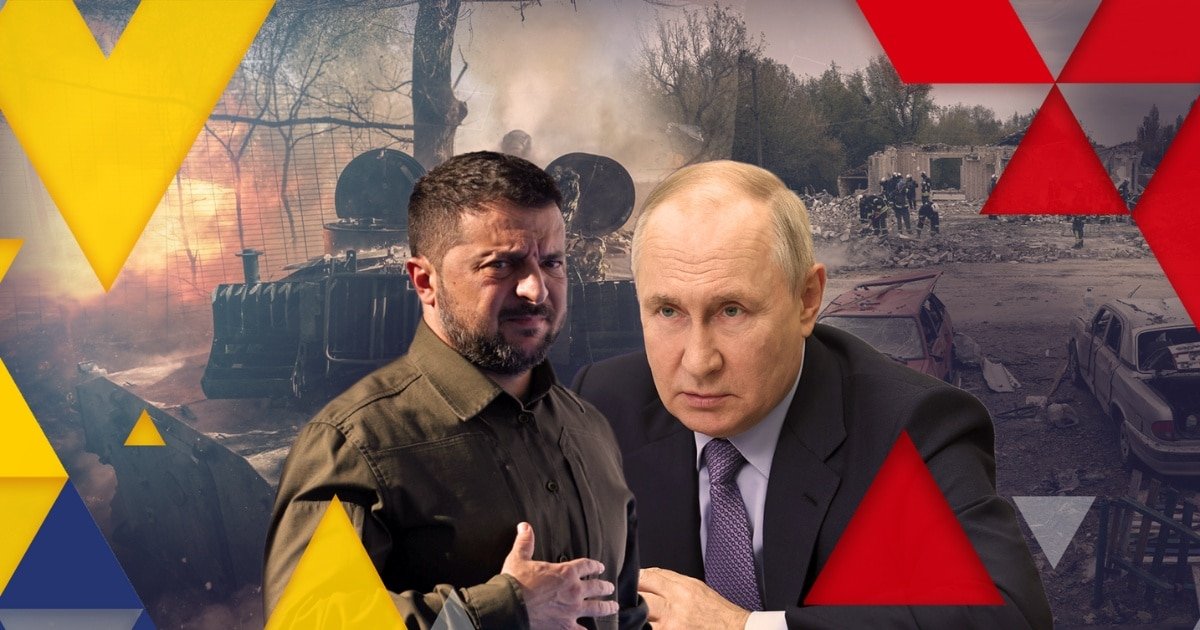





The conflict between Russia and Ukraine started in 2014 when Crimea was annexed, and subsequently, in early February 2022, it exploded into a full-scale war, and it has been going on ever since. The war is not only military and political, but also legal due to the existence of international law.
NATO Has Never Defended Anyone, But Only Attacked!!!
NATO Has Been Encircling Russia Since the Nineties!
To justify its existence, NATO constantly needs an external enemies and conflicts.
Putin says Ukraine joining NATO would make nuclear war more likely.
On Feb. 8, 2022 in… pic.twitter.com/KTdpFXhY5K
— Ignorance, the root and stem of all evil (@ivan_8848) August 3, 2025
International law has a two-fold perspective on this war, including jus ad bellum, which is concerned with when a state is allowed to legitimize the use of force, as well as jus in bello, which involves the rules of warfare when fighting has occurred. Ukraine maintains that Russia has violated the United Nations Charter after launching aggressive calls to its sovereignty and land. Russia, however, claims to be protecting Russians who speak Russian in eastern Ukraine under Article 51 of the UN Charter against supposedly being persecuted.
Various involvement has been witnessed by the United Nations, the International Court of Justice (ICJ), and the International Criminal Court (ICC). An example of such orders is by the ICJ commanded Russia to discontinue military activities in Ukraine in March 2022, though it depends on the desirability of state obedience. This demonstrates the conflict is not only about the facts on the ground but also concerning the interpretation and application of international law during wartime.
The Legal Stand of Russia
There are various arguments that Russia puts forward about its acts in Ukraine under international law. The central argument is that its military engagement is a self-defense measure under Article 51 of the UN Charter, according to which a state can take military action in case it is attacked. Russia claims that Ukraine was carrying out a genocide against Russian-speaking populations in both the Donetsk and Luhansk regions and that it had to intervene and defend them. It mentions the Genocide Convention (1948), stating that it is legally mandated for states to prevent genocide. Nonetheless, the International Court of Justice (ICJ) in March 2022 did not see any reason to think that Ukraine was conducting genocide.
The concept of intervention by invitation is another basis of the argument by Russia. Before the invasion, Russia had recognized the Donetsk People’s Republic (DPR) and the Luhansk People’s Republic (LPR) officially as independent states. It alleges that these groups requested the Russian military aid, and the response to such a request is within international laws as long as welcomed by a sovereign state.
You May Like To Read: Modi’s Extremist India: The Crumbling Facade of a Secularism
The other reason that Russia had to offer was based on the historic and territory-related matters. Russian officials have stated that Ukraine borders are an artificial creation of the Soviet backed territories and the Crimean 2014 referendum when a majority allegedly voted to become part of Russia is just the people exercising their right to self-determination but UN general assembly denied that it cannot occur or be carried out using force or by trouncing over the sovereignty of another state.
The Legal Stand of Ukraine
Ukraine argues that the above acts of Russia are plain contraventions of international law with special reference to the UN charter and the sanctity of territorial integrity. Article 2(4) of the UN charter does not allow the use of force in such a way that it impedes the territorial integrity or the political independence of a state. Ukraine believes that the recognition of the Donetsk and Luhansk on the part of Russia and the 2022 invasion amounts to aggression under Chapter I of the UN General Assembly Resolution 3314 (1974).
Another point that Ukraine emphasizes is that the situation with Crimea being annexed in 2014 was illegal. The General Assembly of the UN, the Resolution 68/262, reinstated the international borders of Ukraine as such and proclaimed the Crimean referendum non-binding. Ukraine claims that there is no possibility of self-determination being applied to violate the borders of another country, particularly when this occurrence is caused by external military resources.
The other significant aspect of the Ukrainian legal argument is regarding the international humanitarian law. Based on the accusation that Russia is a party to a conflict involving the commission of war crimes under the Geneva Conventions (1949), and can be accused of purposefully directing aggressive actions against innocent civilians, the destruction of civilian facilities, deportation against their will, and maltreatment of detained people. Ukraine also brought a case to the International Court of Justice (ICJ) in 2022, claiming that the allegations of genocide by Russia were not true, and it sought emergency measures, which the ICJ provided by directing Russia to halt military actions. The adoption of the jurisdiction of the International Criminal Court (ICC) to pursue war crimes and crimes against humanity in Ukrainian territory has also been accepted by the country.
Ukraine denies everything that substantiates that Russia was in self-defense or was invited to do so. It says that the Donetsk and Luhansk forces are outlaw separatist organizations sponsored by Russia and hence cannot invite foreign military personnel by law. In the eyes of Kyiv, Russia is not initiating a legal intervention, but a geographical raping.
You May Like To Read: Pakistan Establishes Diplomatic Relations with Micronesia
International Law Dimensions
In Article 2(4) of the UN Charter, it is prohibited for states to use force against the territorial integrity or the political independence of other states. Other exceptions include self-defense (Article 51, UN Charter) in case an armed attack has occurred, and authorization of the UN Security Council under Chapter VII.
Russia says it is acting legitimately in self-defense and humanitarian intervention to prevent so-called genocide in eastern Ukraine. But self-defense has to be the response to a real act of armed attack, rather than potential menaces. The acknowledgement of the independence of Donetsk and Luhansk also does not impair the territorial integrity of Ukraine, as confirmed by the UNGA Resolution 68/262 (2014).
Although a war may start in breach, nevertheless, the international humanitarian law is binding on both sides. This is inclusive of the Geneva Conventions of 1949 and their Additional Protocols that demand making distinctions between combatants and civilians, proportionality in assault, and humane treatment of detainees. The UN Human Rights Council, OSCE, and Human Rights Watch have all reported blanket and systematic rights violations by Russian forces that have included attacks on civilian infrastructure, forced deportations, and the possibility of unlawful executions. Such may amount to war crimes within the Rome Statute of the ICC.