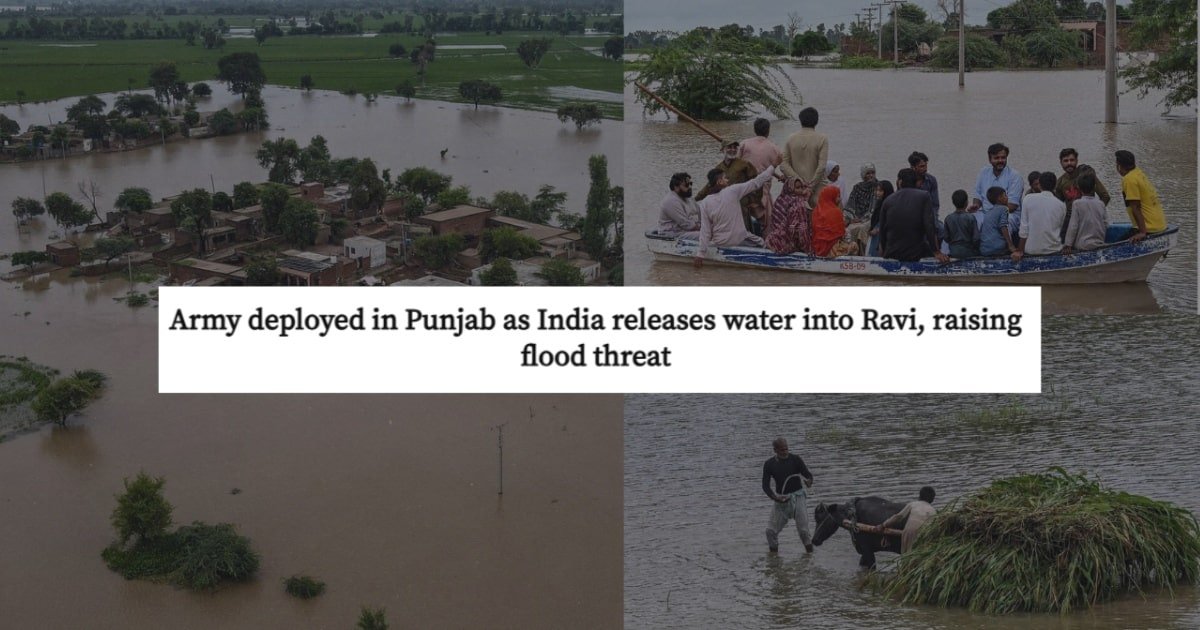





Lahore | Islamabad — The Government of Punjab has declared a provincial emergency and formally requisitioned the Pakistan Army to assist civil authorities in large-scale rescue and relief operations as torrential monsoon rains and heavy water discharges from Indian dams have pushed the Ravi, Chenab, and Sutlej rivers into dangerous flood levels.
Rivers in Exceptionally High Flood
The Provincial Disaster Management Authority (PDMA) confirmed that India has released massive discharges from both the Thein Dam and Madhopur Dam on the Ravi River. Simultaneously, heavy rainfall in the upper catchments has swelled flows into Pakistan.
According to the Flood Forecasting Division (FFD):
-
Chenab River at Head Marala and Khanki has crossed 975,000 cusecs and is rising rapidly.
-
Ravi River at Jassar is in exceptionally high flood with outflows exceeding 200,000 cusecs.
-
Sutlej River at Ganda Singh Wala is in very high flood, recording discharges of over 245,000 cusecs.
Authorities have warned that the next 48 hours will be critical in determining the scale of devastation, with possible breaches in protective embankments across Lahore, Kasur, Narowal, Sialkot, Okara, and Faisalabad districts.
You May Like To Read: Pakistan and Iran Reaffirm Commitment to Eradicate Terrorism, Secure Common Borders
Army Deployed in Six Districts
In response to formal requests from district administrations, the Punjab Home Department confirmed the deployment of Pakistan Army units in Lahore, Faisalabad, Kasur, Sialkot, Narowal, and Okara.
“The Army has been called in to aid civil authorities and ensure the safety of citizens. District administrations, Rescue 1122, police, and civil defence units are already engaged on the frontlines,” said a Home Department spokesperson.
Troops are working alongside Rescue 1122 teams using boats and outboard motors to evacuate residents from low-lying areas and transport them to safe zones.
Evacuations and Relief Measures
So far, authorities report that:
-
174,000+ people have been evacuated to safety.
-
67 relief camps, 38 medical camps, and 46 veterinary centres have been established across flood-affected districts.
-
28,000+ people have been rescued in Kasur, Okara, Pakpattan, Bahawalnagar, and Vehari.
-
1,600 tents, 1,300 life jackets, and 130 boats have been mobilised for relief work.
In Kasur alone, 72 villages and 45,000 residents have been affected by floodwaters.
Prime Minister’s Directions
Prime Minister Muhammad Shehbaz Sharif directed the National Disaster Management Authority (NDMA) and federal ministries to accelerate relief efforts in coordination with the PDMA.
“People along river passages must be relocated swiftly, and no effort should be spared in providing food, medicine, and shelter to those displaced,” the Prime Minister stressed.
He also reiterated Pakistan’s call for international cooperation in addressing the climate crisis:
“Pakistan is among the hardest-hit countries despite contributing little to global emissions. The world must realise that we cannot face this crisis alone.”
Climate Concerns & Future Risks
NDMA Chairman Lt Gen Inam Haider Malik briefed lawmakers that:
-
Next year’s monsoon is expected to be 22% more intense.
-
Nearly 45% of Pakistan’s 7,500 glaciers are melting at an accelerated pace.
-
At current rates, 65% of glaciers may vanish within the next five decades, posing existential threats to Pakistan’s water security.
He noted that the current monsoon season has already claimed around 800 lives nationwide and reiterated the need to adopt advanced satellite-based early warning systems to strengthen disaster preparedness.
Background
The latest flooding follows record-breaking rainfall in Sialkot, where 363.5 mm fell within 24 hours, the highest in 49 years. The downpour, coupled with Indian water discharges, caused breaches in flood defences in Narowal, Sialkot, and Shakargarh, leading to the collapse of Hanjli Bridge under water pressure.
Pakistan experiences annual flood-related losses of nearly $4 billion, a figure projected to rise due to worsening climate patterns and upstream water management decisions.
You May Like To Read: Prime Minister Lauds Pakistan Air Force as ‘Steel Wall’ of National Defense