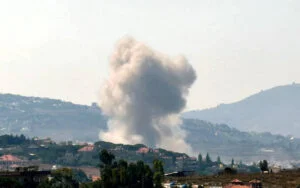




July 2025—Pakistan hit by its third major flood in just 15 years, exposing a relentless crisis. Just like the devastating floods of 2010 and 2022, the monsoon of this year was characterized by unprecedented rainfall, flooded rivers and flash floods, and the failure of drainage systems in cities that left millions of people stranded.
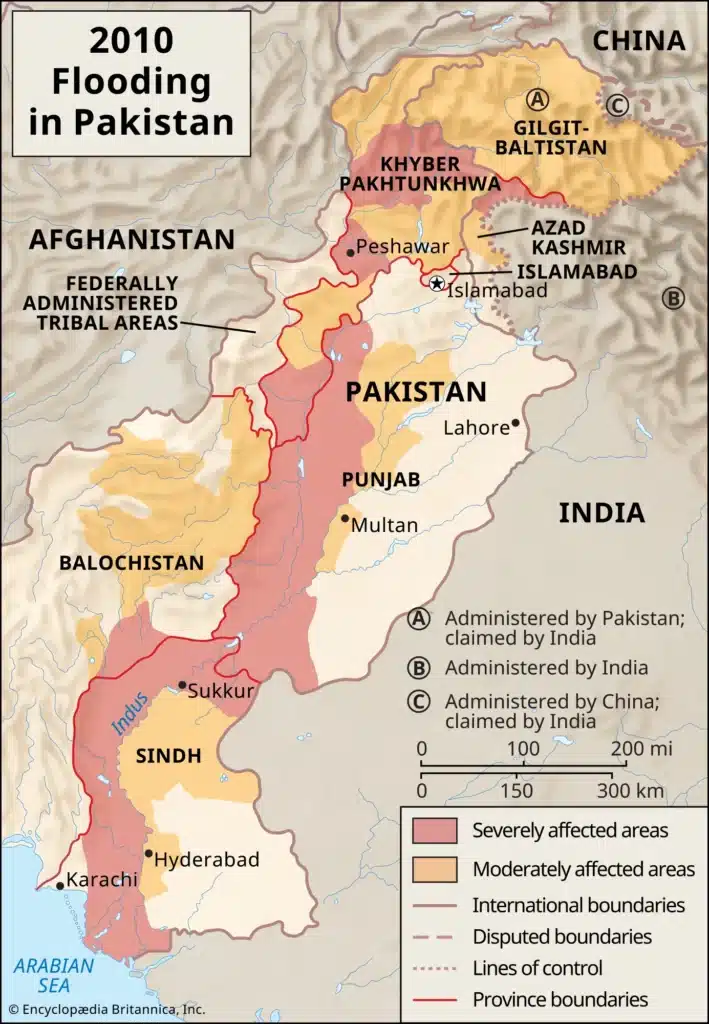
Source: Britannica Encyclopaedia
The National Disaster Management Authority (NDMA) has reported that over 3.2 million people have been affected, over 650 lives have been lost. and thousands of people have been displaced by mid-July 2025. What is happening to Pakistan is no longer a sequence of isolated natural disasters but a long-term climate crisis, which requires immediate adaptation, and more planning.
Every year of the monsoon season could be more devastating than the previous one unless drastic measures are undertaken. Due to increasing Global Warming the world is dealing with abruptly changing weather patterns, due to which increased and unpredictable rainfall during monsoon is witnessed. Meanwhile, Northern Glaciers are melting more rapidly, posing a greater threat to Glacial Lake Outburst Floods (GLOFs) in areas of Gilgit-Baltistan and Chitral.
To make matters worse, Pakistan is also among top 10 most vulnerable countries to climate-related disasters, according to the Global Climate Risk Index 2024. Ironically, despite the fact that Pakistan is not a major contributor to the global greenhouse gas emissions—contributing only 1 percent— it is disproportionately affected by the consequences. The magnitude of the destruction this year is more or less the same or even worse than the destruction in 2010 and 2022 which were termed national emergencies. But even after the years of warnings, majority of structural and policy changes have not been implemented, so every flood is worse than the previous one.
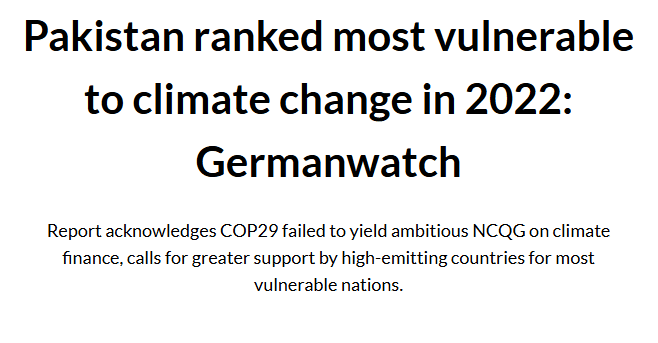
Source: Dawn
Planning and Governance Issues
The floods in July 2025 have once more underscored the systemic government and planning failure that has persisted to transform natural weather patterns into full-fledged national catastrophes in Pakistan. Although 2010 and 2022 were terrible experiences, the country has done little to combat the structural weaknesses due to which the devastating implications of floods persist.
The ineffective zoning enforcement is one of the most serious problems. Building on flood plains, riverside and drainage lines is still common, particularly in towns such as Lahore, Karachi and Rawalpindi. In most of the flood-affected districts, houses, markets and even schools are constructed in high-risk zones even after a strict ban by the authorities and evacuation and relief in times of crisis becomes a mammoth task.
The Pakistan Meteorological Department (PMD) had issued rainfall warnings but there was poor coordination with local authorities, and evacuation was either late or non-existent in most places. The local and provincial disaster management was incapacitated, and they did not have the equipment and money to respond. Distribution of relief was not prompt and was usually delayed by poor roads, confusion of roles, and lack of real time information.
Such failures are not new as they were also witnessed in 2010 and 2022 and reflects a wider institutional failure to manage risks, planning and crisis coordination. Unless there are serious reforms and political will, these trends are bound to persist and millions would be endangered every monsoon season.
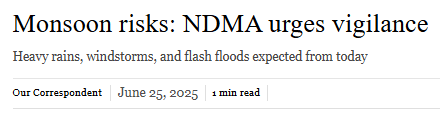
Source: Tribune
Human and Economic Cost
The human and economic toll of the floods of July 2025 is enormous. Whole settlements were displaced, and more than 450,000 individuals had to live in temporary camps, for displaced individuals, or stay with their families, many were left with no access to clean water or food and medical treatment. Hospitals and schools in flood-affected regions such as Dera Ghazi Khan, Khairpur and Swat have been either destroyed or converted into temporary shelters, which exerts pressure on a weak social support system. The most affected are women and the elderly who are finding it harder to receive relief services especially those living in remote villages.
The economic damage is also quite startling. The agriculture sector in Pakistan has been hit very badly ,acres of crops such as rice, cotton and vegetables were destroyed or swept away, particularly in Sindh and Punjab. There are also high losses of livestock which aggravate food insecurity in the rural areas. These shortages are causing price increases of basic food stuffs and aggravating inflation especially in the cities, where supply chains have been disrupted.
At the same time, there is destruction of transport networks, power lines, and industrial zones, which have crippled some sections of the economy. Small enterprises, particularly of informal sectors, have been complaining of closure, retrenchment and increasing debts. The floods of 2025 are likely to send a nation that has already experienced rampant unemployment, increasing poverty levels, and poor economic growth back several years in terms of economic development and social stability.
Disaster as a Force of Environmental Degradation
The magnitude of the damage that the floods of July 2025 have left behind can be explained not only by the high intensity of precipitation but also the years of uncontrolled environmental destruction. The cutting of trees in the areas such as Swat, Dir, and Murree has lowered the natural capacity of land to absorb rain and the result is more and faster surface run off which causes flash floods.
WWF Pakistan states that Pakistan is losing close to 27,000 hectares of forest every year and this undermines the resilience of the ecosystem to climate shocks in the country. In the absence of tree cover, the hillsides are prone to erosion during downpours which causes landslides and siltation of rivers and dams. This silt also decreases the capacity of rivers and irrigation canals to carry floods and breaches and overflow are more probable.

Source: The News
In the North, especially Gilgit-Baltistan and Chitral, increased temperature has led to an increased rate of glacial melting, which has led to Glacial Lake Outburst Floods (GLOFs). The GLOF-II Project of the UNDP cautions that more than 30 glacial lakes will soon rupture because of unstable ice walls and increasing water. This year several GLOFs were observed, which led to instant floods that swept away roads, houses and even whole villages in a matter of minutes.
Uncontrolled development and misuse of land is also hurting urban centers. In urban areas such as Karachi, Lahore, and Rawalpindi, unregulated development along natural drainage courses, inefficient waste disposal and clogged stormwater drains turned short-duration rains into urban floods. The toxic waste in the floodwaters has been polluted by industrial areas in cities such as Faisalabad and Korangi (Karachi) and has brought about severe health hazards to the people and soil erosion in the long run. Pakistan has reported an increase in water-borne diseases such as cholera and hepatitis in flood-affected regions.
Source: NCBI
A Way Forward: Climate Resilience and Adaptation
The July 2025 floods damage shows that Pakistan needs to quickly reposition its disaster response efforts to focus on climate adaptation. Floods are not single occurrences that the country can afford to deal with as emergencies, but they are becoming recurrent and more devastating than before, due to climate change as well as poor planning.
Pakistan requires a massive investment in climate-adaptive infrastructure: flood resistant roads and bridges, elevated housing in flood-prone regions and advanced drainage systems in urban centers. The government should also put stringent zoning regulations to ensure buildings are not constructed on riverbanks and flood plains and evacuate communities at risk to safe areas. In the absence of such measures, the threat will be no less (or even greater) in every next monsoon season.
It is also vital to enhance early warning systems and community-based disaster preparedness. Although there has been an improvement in weather forecast, most local governments are not well equipped or coordinated to evacuate the people in time. Pakistan ought to increase the number of flood monitoring stations and make sure that the alerts are able to reach the distant villages via the SMS, radio, and loudspeaker systems.
Training on disaster preparedness, particularly of vulnerable communities, women, and local volunteers can be lifesavers when formal systems are not adequate. Such projects as UNDP GLOF-II and NDMA National Adaptation Plan need to be expanded and provided with consistent funding and political support.Climate change is no longer a farfetched issue it is turning into a direct and expanding threat to the people, economy, and security of Pakistan. In order to stay afloat and become successful, Pakistan has to stop viewing climate adaptation as an alternative, but as a national necessity.