The Enduring Appeal of Jirgas Amid Institutional Gaps
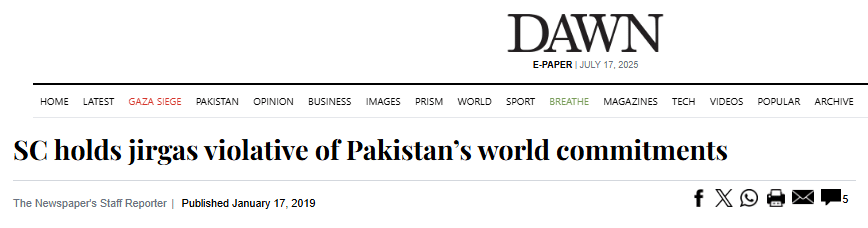
In Pakistan’s rural and tribal areas, “Jirgas” and “Punchayats” continue to serve as the primary form of conflict resolution, despite being formally illegal when adjudicating criminal matters. The Supreme Court of Pakistan explicitly held that parallel courts are unconstitutional and violate Pakistan’s international obligations under UDHR, ICCPR, and CEDAW.
Source: Dawn
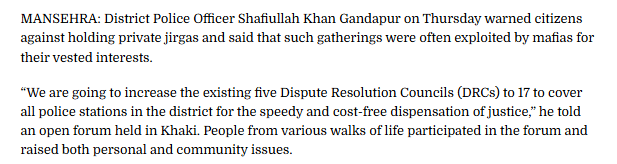
Yet in districts like Mansehra, over 17 Dispute Resolution Councils (DRCs) are being set up to offer an alternative to private jirgas, which police say are exploited by local mafias. These informal adjudicators remain deeply entrenched everywhere, from Punjab and Sindh to KP and Balochistan.
Source: Dawn
Following the 2018 FATA-KP merger, proposals were floated in July 2025 to re-instate tribal justice courts in KP’s merged districts. Proponents promised a formalized version aligned with constitutional norms, yet human rights activists called it “a blatant betrayal of the Constitution,” warning it would roll back rights gained since the merger ThePrint. The tension lies in the state’s limited capacity to enforce formal judicial rule in remote regions, creating a vacuum these bodies readily fill.
Pathways to Vigilantism and Unresolved Disputes
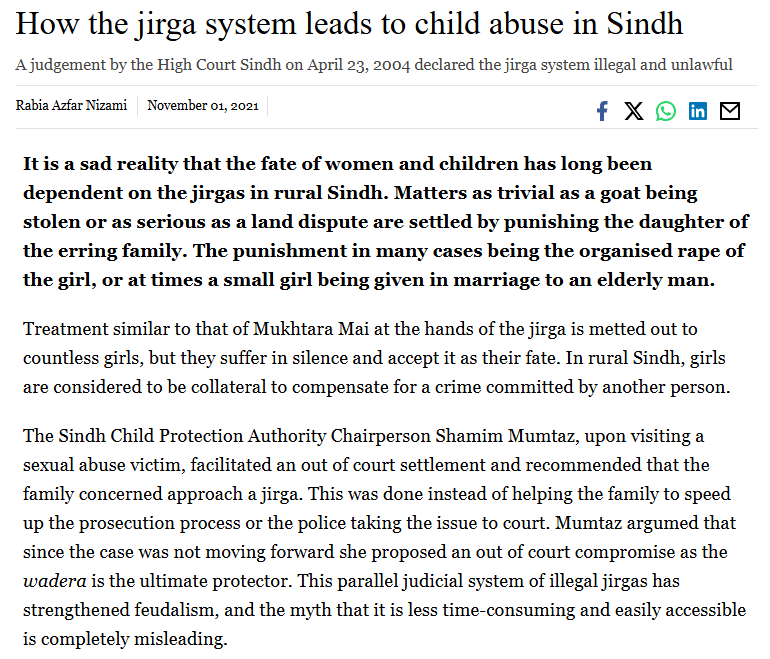
While jirgas are thought by some to deliver swift justice, critics highlight how their unchecked authority fosters vigilantism and systemic injustice. They commonly adjudicate crimes like honour killings or land disputes without due process. In rural Sindh, vulnerable women and children are sometimes forced into marriages, abused, and even ostracized as “Karis,” with no legal recourse. There have been numerous cases of Jirgas’ facilitating exploitation of already marginalized individuals i.e., Mukhtara Mai Case and so forth. The Tribune couple years ago published an alarming report, on Jirgas abetting child abuse in Sindh.
Source: Tribune
Jirgas have only served to harm the national fabric, and create a parallel judicial system, wholly illegal. Tribune noted;
This parallel judicial system of illegal jirgas has strengthened feudalism, and the myth that it is less time-consuming and easily accessible is completely misleading.
The inherent lack of transparency, absence of witness testimony, gender bias, and elite control of jirgas result in extreme, victimising and wholly illegal, judgments that frequently go unchallenged. These rulings further erode trust in formal courts, pushing communities to continue depending on informal justice.
Escalation into Collective Violence
Jirga verdicts sometimes spiral into mob attacks or organized vigilante actions. In areas where the state lacks presence, courts side-step legal norms, resulting in brute enforcements without oversight. For example, mobs in several cases have assaulted individuals over blasphemy allegations, and police have either been complicit or failed to intervene.
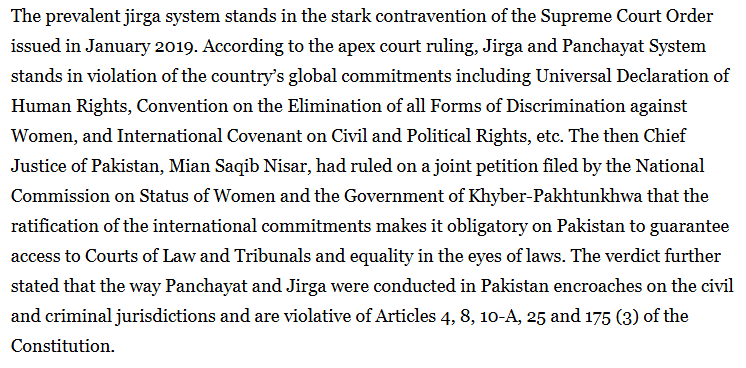
A 2021 Supreme Court case also affirmed that jirgas violate Articles 4, 8, 10A, 25, and 175(3) of the Constitution. When local elites direct jirgas toward vigilante operations, like convening lashkars or ordering extrajudicial punishments, genuine justice becomes impossible. One revealing incident in Sindh saw jirga members deployed thousands strong to demolish rival property, later only halted by elite police intervention .
Source: Tribune
Crime by Default: Unresolved Disputes Become Catalysts
Informal mechanisms often fail to penalize perpetrators, leaving cycles of grievances unresolved. Families vendetta-share, resorting to violence or enlisting proxies to settle old scores. Cases in Ghotki and Rahim Yar Khan illustrate this regional norm. When police failed to act, tribes took justice into their own hands. Such practices further destabilize law enforcement and spawn criminal bands, perpetuating rural insecurity.
Slow-Burning Reform: The Rise of DRCs
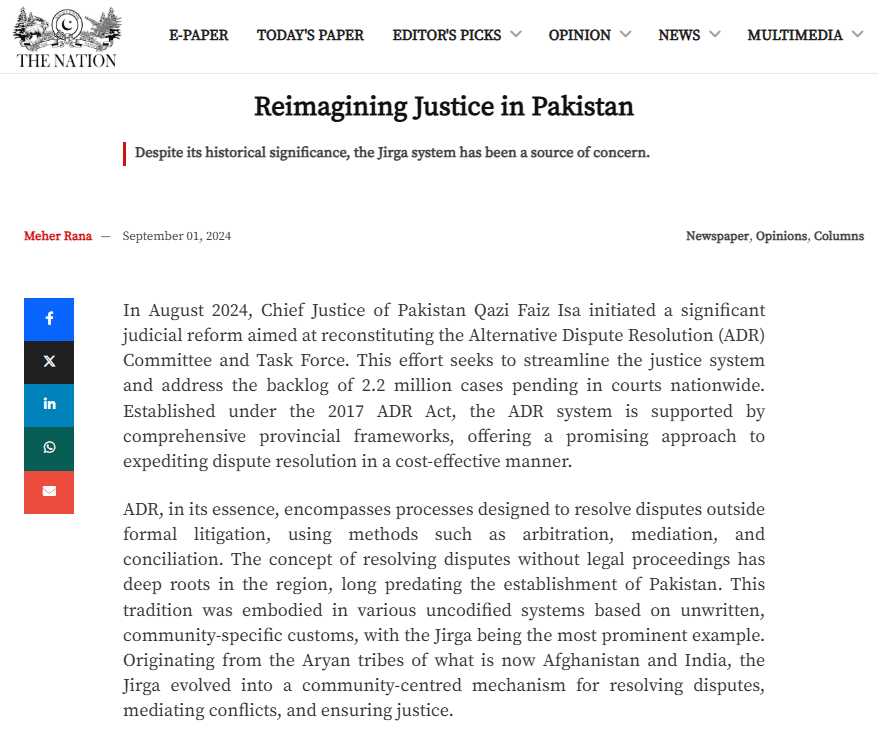
Some hopeful models are beginning to emerge. In Khyber Pakhtunkhwa, District Dispute Resolution Councils (DRCs) serve as state-sanctioned mediators that blend traditional authority with formal oversight. Unlike jirgas, DRCs involve women, include government-appointed arbitrators, and allow appeals in formal courts. However, their impact remains limited by low public awareness, sparse coverage, and occasional corruption.
Source: The Nation
In Mansehra alone, scaling DRCs from 5 to 17 is expected to reduce hijacked disputes, yet progressive efforts in the former FATA remain constrained. Without serious political will to expand and empower DRCs, informal courts will continue to dominate local justice systems.
Toward Institutional Reform: Policy Recommendations for Rural Justice
To dismantle the cycle of vigilante justice and rising rural crime driven by informal courts, Pakistan must pursue a multi-pronged and inclusive reform strategy.
- A key priority is the expansion and institutional strengthening of Dispute Resolution Councils (DRCs) across all provinces. Unlike traditional jirgas, DRCs operate with police oversight, government backing, and allow for appeals in formal courts. As seen in Khyber Pakhtunkhwa, where DRCs are now being scaled from 5 to 17 in districts like Mansehra, their structured approach can reduce the dominance of unlawful private adjudication.
- To make these forums more accessible and just, it is essential to integrate respected tribal elders within formal legal frameworks through instruments like the Alternative Dispute Resolution Act, ensuring decisions remain community-relevant but constitutionally sound. This would preserve local legitimacy while maintaining legal oversight and the right to appeal.
- Simultaneously, rural court infrastructure must be modernized, establishing dedicated benches for women and minorities, deploying mobile courts in remote regions, and speeding up case resolution timelines. Without such reforms, legal bottlenecks will continue to drive communities toward extrajudicial solutions.
- Public engagement is equally critical. Legal literacy campaigns should be launched through local media, schools, and religious platforms to educate citizens about their constitutional rights and how to access formal justice systems. The State’s failure to establish a clear legal identity in rural Pakistan has allowed jirgas to continue functioning in a quasi-official capacity.
- Rural police forces also need urgent reform. Many are underfunded, undertrained, and beholden to feudal influence. Strengthening police capacity, improving their legal training, and creating oversight mechanisms can help reassert the writ of the state and prevent local elites from hijacking the justice process.
- Lastly, protection mechanisms for vulnerable populations, especially women and children must be institutionalized at the district level. Establishing child protection units and women’s legal aid centers can prevent coercive jirga decisions involving forced marriages, honor killings, or other human rights abuses, as documented in news reports and scholarly studies.
Collectively, these reforms can replace unregulated traditional justice with a system that balances community customs with constitutional safeguards, gradually restoring faith in state institutions and reducing the violence tied to unaccountable local rulings.
Conclusion
Informal justice systems in Pakistan, once vital in resolving disputes, have evolved into havens for feudal influence, vigilantism, unaccountable violence, further marginalisation of victims, and victimisation of marginalised individuals, especially in rural areas. While deeply rooted culturally, their misuse undermines constitutional justice, fuels rural crime, and deepens community distrust in state institutions. The rise of DRCs and legislative reflection in KP offer a blueprint, but real progress hinges on systemic legal reform, robust policing, and public awareness campaigns. Only by uniting traditional justice merits, with rule-of-law principles, can Pakistan secure equitable, sustainable governance in its rural heartlands.